
Agriotes mancus
(Say, 1823)
Wheat Wireworm
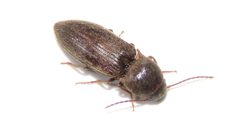
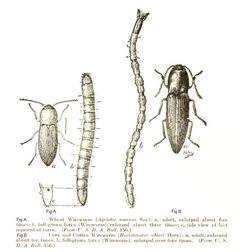
Agriotes mancus, the wheat , is a native Nearctic click beetle and the only North American Agriotes considered an agricultural pest. are small brown beetles 6.5–8.5 mm long. The larvae (wireworms) are root feeders that develop over 3–5 years, reaching 20–25 mm in length. Larvae attack cereals, potatoes, and other crops, with historical causing complete crop failures. Economic importance has declined in parts of its range since the mid-20th century, possibly due to competition with the Palearctic species Agriotes sputator. The has been identified as a blend of geranyl butanoate and geranyl hexanoate.
Pronunciation
How to pronounce Agriotes mancus: //ˈæɡriˌoʊtiːz ˈmæŋkəs//
These audio files are automatically generated. While they are not always 100% accurate, they are a good starting point.
Identification
distinguished from other Agriotes by size and coloration combined with punctured and gold-colored hairs. Larvae identified by ringed appearance from darker segment margins and especially by the two black eyelike spots on the ninth abdominal segment. May be confused with Palearctic Agriotes (A. sputator, A. lineatus, A. obscurus) in eastern North America; monitoring can help distinguish species as A. mancus males respond to both geranyl butanoate and geranyl hexanoate together, while A. sputator males are attracted to geranyl butanoate alone.
Images
Habitat
Natural is grassland, where feed on grass blades. Agricultural habitats include fields planted with cereals, potatoes, maize, and other susceptible crops. Prefers moist conditions with clay, silt, or clay loam soils. Larvae migrate to deeper soil layers if conditions become too dry or cold.
Distribution
Native to north-eastern and north-central North America. Range extends from Labrador and Nova Scotia south to Rhode Island, New York, and Pennsylvania, and west to Quebec, Ontario, Manitoba, and south-eastern Saskatchewan in Canada; and Ohio, Indiana, Illinois, Missouri, Minnesota in the United States. Missouri represents near the south-western limit of distribution.
Seasonality
beetles emerge from soil in spring. laying occurs in May, June, and July. Larvae present year-round, hibernating in winter. occurs in August or September. Adults remain in soil after pupation, not emerging until following spring.
Diet
Larvae , feeding on seeds and roots of grasses and cereals, tubers of potatoes and carrots, and roots and stem bases of cucumbers, turnips, cabbage, soybean, and other crops. feed on grass blades in natural grassland .
Life Cycle
Complete from to egg spans 4–6 years. Eggs laid in late spring to mid-summer; hatch after 3–4 weeks. Larval development takes 3–5 years depending on environmental conditions, with larvae hibernating in soil during winter. in August or September lasts 2–3 weeks. Newly formed remain in soil, before emerging the following spring.
Behavior
Larvae migrate vertically in soil profile, moving deeper when surface conditions become dry or cold. use for mate location; males produce geranyl butanoate and geranyl hexanoate to attract females.
Ecological Role
Larvae function as root-feeding herbivores in grassland . In agricultural systems, larval feeding can significantly impact plant survival and yield. Historical competition with Agriotes sputator may have reduced its relative abundance in parts of its native range.
Human Relevance
Significant agricultural pest, particularly of potatoes, maize, and wheat. Larval feeding on seeds, roots, and tubers can cause complete crop failure. Damage to potato tubers includes surface scars, holes, and deep tunnels. Management recommendations include crop , avoiding planting susceptible crops after grassland conversion, delayed planting of potatoes, soil drainage, and fertilizer application to strengthen plants. Monitoring possible with Vernon pitfall traps baited with 1:1 mixture of geranyl butanoate and geranyl hexanoate (40 mg each). Economic importance has declined in north-eastern North America since mid-20th century, possibly due to competition with Agriotes sputator.
Similar Taxa
- Agriotes sputator Palearctic established in eastern North America; similar larval and pest . Males attracted to geranyl butanoate alone, whereas A. mancus requires both geranyl butanoate and geranyl hexanoate. May have displaced A. mancus in some areas.
- Agriotes lineatus Palearctic in North America with similar and . contains geranyl butanoate and geranyl hexanoate, creating potential for cross-attraction in monitoring traps.
- Agriotes obscurus Palearctic with similar and . chemistry related, though distinct from A. mancus.
- Limonius agonusNative Nearctic ; recent surveys in Ontario found this species more abundant than A. mancus, suggesting it may be replacing A. mancus in some areas.
Sources and further reading
- BugGuide
- Wikipedia
- GBIF taxonomy match
- iNaturalist taxon
- NCBI Taxonomy
- Agriotes lineatus Archives - Entomology Today
- Beetle in a Haystack: Environmental DNA Reveals Invasive Pest Incursions
- Bug Eric: Losing the Pine Rocklands
- Sex pheromone of Nearctic Agriotes mancus and its similarity to that of three Palearctic Agriotes invasive in North America