
Alaus oculatus
(Linnaeus, 1758)
Eastern Eyed Click Beetle, Eyed Elater
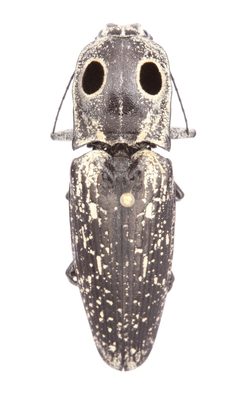
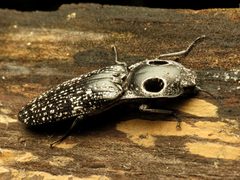
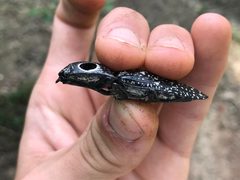
Alaus oculatus, commonly called the eastern eyed click beetle or eyed elater, is a large, striking click beetle native to eastern North America. reach 25–45 mm in length and are immediately recognizable by the prominent false eyespots on their pronotum—large oval patches of dark framed in white that function in deterrence. The possesses a remarkable clicking mechanism: a prosternal spine and mesosternal notch that, when flexed and released, produce an audible snap capable of launching the beetle several inches into the air. This serves both defensive and righting functions. The larvae are predatory wireworms that inhabit decaying wood, feeding voraciously on other beetle larvae, particularly cerambycids.
Pronunciation
How to pronounce Alaus oculatus: /əˈleɪəs ɒˈkjuːlətəs/
These audio files are automatically generated. While they are not always 100% accurate, they are a good starting point.
Identification
Alaus oculatus is distinguished from other North American Alaus by its large size (25–45 mm), bullet-shaped body, and prominent pronotal eyespots consisting of large oval black patches surrounded by narrow white rings. The are striated and mottled with silvery-white , providing cryptic bark-matching coloration. The body is uniformly black beneath the patterned . True are small and located on the to the false eyespots. Similar species include A. myops (blind click beetle), which has much reduced eyespots and slate gray coloration; A. melanops (western eyed click beetle), found in western North America with non-overlapping range; A. zunianus (Zuni click beetle) of Arizona with rounder, ivory-colored eyespots; and A. lusciosus (Texas click beetle) of the south-central states.
Images
Habitat
Deciduous and mixed forests and woodlands, particularly in areas with standing deadwood and decaying logs. are found on logs, stumps, and tree trunks; larvae inhabit rotting wood and soil near decaying wood.
Distribution
Eastern North America, from Quebec and Ontario south to Florida, west to Texas, the Dakotas, and eastern Colorado.
Seasonality
emerge in spring and are commonly found from spring through September. Some adults may overwinter in wood cavities and can be encountered at any time of year.
Diet
feed on nectar and plant juices. Larvae are predatory, feeding on of wood-boring beetles, especially Cerambycidae (longhorned beetles); caged specimens have been observed to consume over 200 cerambycid larvae each during development.
Life Cycle
are laid in soil or on standing deadwood. Larvae are predatory wireworms that develop in decaying wood, preying on other larvae. Larvae pupate in rotting logs or below ground. emerge in spring.
Behavior
are active during the day or at dusk and are strong fliers, yet appear relatively clumsy on foot. When disturbed, adults exhibit (playing dead) with legs and appressed to the body. The clicking mechanism—produced by a prosternal spine engaging a mesosternal notch—generates force sufficient to launch the several inches vertically, with tumbling in air providing approximately 50% probability of landing upright. The beetles cannot moderate click force or control body orientation during jumps. Adults are sometimes attracted to aromatic solvents and fresh paint, scents associated with freshly cut or damaged trees.
Ecological Role
as larvae, controlling of wood-boring beetles in forest . serve as through nectar feeding. The contributes to nutrient cycling through association with decaying wood .
Human Relevance
Occasionally encountered by homeowners and gardeners; harmless to humans though large size and clicking can startle. Sometimes attracted to fresh paint and aromatic solvents during construction or renovation activities. Larval on wood-boring beetles provides natural in forest and urban settings.
Similar Taxa
- Alaus myopsSimilar large size and body form, but has greatly reduced eyespots and slate gray coloration; primarily associated with pine forests.
- Alaus melanopsWestern counterpart with overlapping morphological features, but ranges do not overlap—A. melanops occurs in western North America (British Columbia to New Mexico).
- Alaus zunianusSouthwestern with rounder, more ivory-colored eyespots and more robust body build; confined to Arizona.
- Alaus lusciosusNearly identical to A. zunianus but with range in Texas, Oklahoma, Kansas, and southern Colorado.
Misconceptions
The prominent pronotal markings are often mistaken for actual ; these are false eyespots (self-mimicry) that serve to startle . The does not possess venom or sting despite its formidable appearance.
Sources and further reading
- BugGuide
- Wikipedia
- GBIF taxonomy match
- iNaturalist taxon
- NCBI Taxonomy
- Bug Eric: Eyed Elaters
- Archive — Bug of the Week
- Elateridae | Beetles In The Bush
- Pop! goes the beetle | Beetles In The Bush
- Barking up the right tree for the eyed elater, Alaus oculatus — Bug of the Week
- Pumpkin vines on the menu: Squash vine borer, Melittia cucurbitae — Bug of the Week