
Alaus myops
(Fabricius, 1801)
Small-eyed Click Beetle, Blind Click Beetle
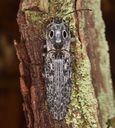
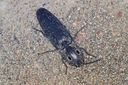
Alaus myops, commonly known as the Small-eyed Click Beetle or Blind Click Beetle, is a large elaterid distinguished by its reduced eyespots compared to its A. oculatus. are primarily slate gray in coloration and active in southern pine forests. The exhibits the characteristic clicking mechanism of the Elateridae, using a prosternal spine and mesosternal notch to launch itself when disturbed. Both adults and larvae are predatory, inhabiting loose bark on pine trees, logs, and stumps.
Pronunciation
How to pronounce Alaus myops: /əˈleɪəs ˈmaɪɒps/
These audio files are automatically generated. While they are not always 100% accurate, they are a good starting point.
Identification
Distinguished from the Eyed Click Beetle (Alaus oculatus) by smaller, less conspicuous eyespots and predominantly slate gray rather than boldly mottled black-and-white coloration. Separated from western A. melanops by geographic range (A. melanops occurs west of the Great Plains). The specific epithet 'myops' (Greek for 'near-sighted' or 'short-sighted') refers to the reduced eyespots. may be attracted to aromatic solvents and fresh paint, scents associated with freshly cut or damaged trees.
Images
Habitat
Southern pine forests; and larvae found under loose bark on pine trees, logs, and stumps. Associated with decaying wood where larvae hunt other insects.
Distribution
Eastern North America from Quebec to Florida, west to Manitoba, Minnesota, Kansas, and Texas. Most common in southern pine forests.
Seasonality
active during day or at dusk; primarily encountered late spring through June and July. Some adults may overwinter in cavities in rotten wood and be found year-round.
Diet
Both and larvae are predatory. Larvae prey on larvae and pupae of other beetles and insects in decaying wood. Adult feeding habits less documented but likely predatory or associated with fermenting tree products.
Host Associations
- Pinus - Associated with pine forests; and larvae found under bark of pine trees
Life Cycle
Larvae are large, elongate 'wireworms' with powerful jaws, living in decaying wood and preying on other insect larvae. occurs in wood. emerge and may overwinter in wood cavities.
Behavior
Exhibits (playing dead) when disturbed, lying still with legs and appressed. Uses prosternal spine and mesosternal notch mechanism to produce audible click and launch body into air when threatened or when overturned. Clicking serves both escape and self-righting functions. Strong fliers but relatively slow on foot.
Ecological Role
in decomposer of decaying wood; larvae help regulate of other wood-inhabiting insects. Contributes to nutrient cycling in forest through in decaying wood .
Human Relevance
Harmless to humans; occasionally encountered by entomologists and naturalists in pine forests. No economic significance; larvae may be beneficial as of potential pest insects in dead wood.
Similar Taxa
- Alaus oculatusLarger, more conspicuous eyespots; bold black-and-white mottled coloration; primarily eastern distribution overlapping with A. myops
- Alaus melanopsWestern Eyed Click Beetle; similar reduced eyespots but ranges do not overlap (western North America: British Columbia to New Mexico)
- Alaus zunianusRounder eyespots, ivory or beige mottling, more robust build; restricted to Arizona
- Alaus lusciosusNearly identical to A. zunianus; Texas to southern Colorado, Oklahoma, and Kansas
More Details
Etymology
The specific epithet 'myops' derives from Greek, meaning 'near-sighted' or 'short-sighted', referring to the reduced eyespots compared to other Alaus .
Research context
Has been studied in the context of click beetle chemical and identification research by entomologists including Dr. Jacqueline Serrano.
Sources and further reading
- BugGuide
- GBIF taxonomy match
- iNaturalist taxon
- NCBI Taxonomy
- Pop! goes the beetle | Beetles In The Bush
- Bug Eric: Eyed Elaters
- Archive — Bug of the Week
- Barking up the right tree for the eyed elater, Alaus oculatus — Bug of the Week
- Finding Pheromones: How One Entomologist Puts Discoveries to Work in Pest Management