
Alaus zunianus
Casey, 1893
Zuni Click Beetle, Arizona Eyed Click Beetle
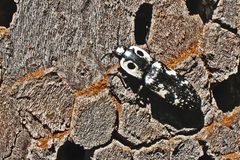
Alaus zunianus, the Zuni Click Beetle or Arizona Eyed Click Beetle, is a large, striking of click beetle in the Elateridae. It is characterized by prominent false eyespots on the pronotum, a robust body, and the ability to produce an audible clicking sound by snapping a prosternal spine into a mesosternal groove. This species appears confined to Arizona and is distinguished from related eyed elaters by its rounder eyespots and ivory or beige mottled coloration rather than stark white.
Pronunciation
How to pronounce Alaus zunianus: /ˈæ.laʊs zuːˈniː.ə.nəs/
These audio files are automatically generated. While they are not always 100% accurate, they are a good starting point.
Identification
Distinguished from Alaus oculatus (Eyed Elater) by rounder eyespots and ivory/beige mottling versus stark white. Distinguished from A. myops (Blind Click Beetle) by much larger, more prominent eyespots. Distinguished from A. lusciosus (Texas Click Beetle) by geographic range—A. zunianus appears confined to Arizona while A. lusciosus ranges from Texas to southern Colorado, Oklahoma, and Kansas. The robust body build is more pronounced than in other eyed elater .
Images
Appearance
Large, robust with prominent false eyespots on the pronotum. Eyespots are rounder than in other Alaus , surrounded by black and white . Body mottled with ivory or beige coloration rather than stark white. measure approximately 20-35 mm in length. The body is bullet-shaped and covered with soft pubescence that provides cryptic coloration against tree bark. True are small and located on the to the false eyespots.
Habitat
Associated with pine forests and wooded areas. found on logs, stumps, and tree trunks. Larvae inhabit decaying wood beneath bark of fallen trees.
Distribution
Appears confined to Arizona, United States. Range does not overlap with A. lusciosus or A. melanops.
Seasonality
active during late spring and summer, primarily June and July. Some adults may overwinter in cavities in rotten wood and can be encountered year-round.
Life Cycle
Behavior
exhibit (playing dead) when disturbed, lying still with legs and appressed to the body. When grasped, they produce an audible click by snapping a prosternal spine into a mesosternal groove, which can propel the into the air to escape or right itself if flipped onto its back. The clicking mechanism generates acceleration exceeding 2,000 m/s². Adults are strong fliers but appear less agile on foot. They are cryptic when motionless on bark.
Ecological Role
Larvae function as in the decomposer beneath bark of fallen trees, controlling of other saproxylic insect larvae. likely contribute to nutrient cycling in forest .
Human Relevance
Generally harmless to humans. Occasionally encountered by entomologists and naturalists in Arizona. Subject of research interest for chemical and studies. Not considered an agricultural or structural pest.
Similar Taxa
- Alaus oculatusLarger eyespots with stark white mottling versus ivory/beige; eyespots less round; found throughout eastern North America rather than Arizona
- Alaus lusciosusNearly identical in appearance but ranges from Texas to southern Colorado, Oklahoma, and Kansas with no range overlap
- Alaus myopsMuch smaller eyespots, mostly slate gray coloration, found in southern pine forests from Quebec to Florida and west to Manitoba, Minnesota, Kansas, and Texas
- Alaus melanopsWestern Eyed Click Beetle found in British Columbia, Oregon, Colorado, California, and New Mexico; resembles A. myops but ranges do not overlap
Misconceptions
The prominent eyespots are false eyespots (ocelli) used for deterrence, not true . The actual are small and located on the . The cannot control the force of its click or its body orientation during jumping, resulting in approximately 50% probability of landing upright.
More Details
Pheromone Research
Subject of chemical research by Jacqueline Serrano, Ph.D., who identified the first conclusive identifications for North American Elateridae. Serrano collected specimens in southeastern Arizona for this research.
Etymology
The name 'Alaus' and 'elater' derive from the ancient Greek word for 'that which drives away', referring to the 's clicking escape mechanism.