
Alaus lusciosus
Texas Eyed Click Beetle, Texas Click Beetle
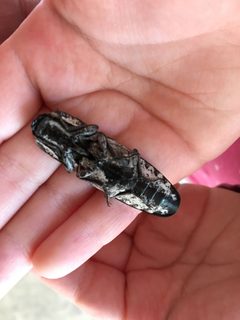
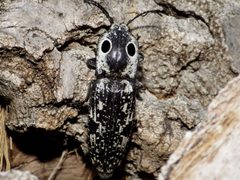
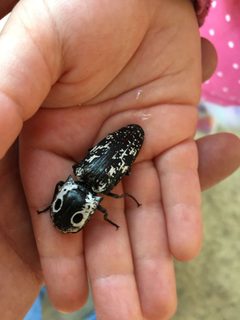
Alaus lusciosus, the Texas Eyed Click Beetle, is a large click beetle (Elateridae) distinguished by prominent false eyespots on the pronotum. measure 20–35 mm and are nearly identical to A. zunianus, with which they share rounder eyespots and ivory or beige mottling rather than stark white patterning. The ranges from Texas to southern Colorado, Oklahoma, and Kansas, where adults are active during the day or at dusk and are strong fliers. Larvae are predatory, inhabiting decaying wood and preying on other larvae and pupae.
Pronunciation
How to pronounce Alaus lusciosus: /əˈlaʊs lʌsˈsi.əs/
These audio files are automatically generated. While they are not always 100% accurate, they are a good starting point.
Identification
Most similar to A. zunianus, which is confined to Arizona; the two are nearly identical in appearance but geographically separated. Distinguished from A. oculatus (eastern North America) by rounder eyespots versus more oval eyespots, and ivory/beige mottling versus stark white. A. melanops and A. myops have much smaller, reduced eyespots. are active during daylight hours, unlike many click beetles. The clicking sound produced when the prosternal spine snaps into the mesosternal groove is diagnostic for the .
Images
Appearance
Large, robust click beetle with bullet-shaped body. Pronotum bears two prominent circular false eyespots—black patches surrounded by narrow white rings—positioned to mimic vertebrate . Body mottled with ivory or beige patterning on dark background, providing cryptic coloration against bark. measure 20–35 mm in length. serrate. The rounder eyespots and more robust build distinguish it from the more slender A. oculatus with its larger, more oval eyespots.
Habitat
Associated with pine forests and woodlands. found on logs, stumps, and tree trunks. Larvae inhabit decaying wood beneath bark of fallen trees, particularly in early stages of decomposition with bark still clinging to underlying wood.
Distribution
South-central United States: Texas, southern Colorado, Oklahoma, and Kansas. The represents the eastern counterpart to A. zunianus of Arizona, with the two ranges meeting near the Arizona-New Mexico border region.
Seasonality
active late spring through summer, primarily June and July. Some adults may overwinter in cavities in rotten wood and can be encountered at any time of year. Larvae present year-round beneath bark.
Diet
Larvae are predatory, feeding on larvae and pupae of other beetles and insects inhabiting decaying wood. feeding habits are poorly documented; may feed on fermenting sap or associated with freshly cut or downed trees.
Host Associations
- Pinus - and larvae associated with pine forests; larvae found under loose bark on pine trees, logs, and stumps
Life Cycle
Complete . laid in decaying wood. Larvae are elongate, cylindrical 'wireworms' with powerful jaws, developing through multiple instars while preying on other insects in subcortical . occurs in wood. emerge and may overwinter in wood cavities.
Behavior
exhibit cryptic , remaining motionless on bark where their mottled coloration renders them nearly invisible. When disturbed, adults exhibit (playing dead with legs and appressed to body). The defensive click mechanism involves arching the and pronotum to retract the prosternal spine from the mesosternal notch, then releasing stored elastic energy to snap the spine back into the groove, producing an audible click and propelling the into the air to escape or right itself if overturned. Adults are strong fliers but appear less agile on foot.
Ecological Role
Larvae function as in subcortical , regulating of other wood-inhabiting insects. They occupy a relatively high trophic position in the of decomposing wood . may contribute to nutrient cycling through association with decaying wood and fungal communities.
Human Relevance
Harmless to humans; poses no health risk. Occasionally encountered by homeowners and outdoor enthusiasts, sometimes causing alarm due to large size and prominent eyespots. The clicking is a source of curiosity and entertainment. Larvae are sometimes encountered during firewood collection or tree maintenance. The has been documented in iNaturalist with nearly 3,000 observations, indicating moderate public interest and detectability.
Similar Taxa
- Alaus zunianusNearly identical in appearance with round eyespots and ivory/beige mottling; distinguished by geographic range (Arizona only)
- Alaus oculatusShares large eyespots but has more oval (not round) eyespots, stark white (not ivory/beige) mottling, and more slender build; eastern North America
- Alaus melanopsWestern with much smaller, reduced eyespots; range includes British Columbia to New Mexico but does not overlap with A. lusciosus
- Alaus myopsBlind Click Beetle with greatly reduced eyespots, mostly slate gray coloration; ranges from Quebec to Texas but more common in southern pine forests
More Details
Biomechanics of Clicking
The click mechanism involves a prosternal spine and mesosternal notch on the 's underside. When threatened, the beetle arches back its and pronotum, retracting the spine from the notch cavity. Thoracic muscles contract to store elastic energy; when the spine tip passes over the notch edge, energy releases, snapping the spine back with force sufficient to produce an audible click and launch the beetle several inches into the air. Research suggests this mechanism evolved primarily for vertical jumping from soft substrates rather than escape, as beetles cannot moderate jumping force and have approximately 50% probability of landing upright.
Defensive Eyespots
The prominent false eyespots on the pronotum are patches of (black surrounded by white) that mimic vertebrate . These are not true eyes—the actual are small and located on the to the false eyespots. The eyespots likely function to startle or confuse such as birds or reptiles. When combined with cryptic body coloration and , this multi-layered defense system provides effective protection.