
Xyleborus celsus
Eichhoff, 1868
Hickory Timber Beetle
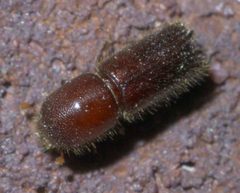
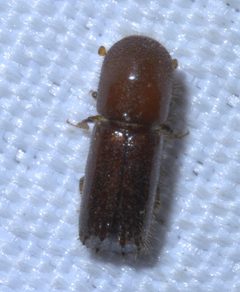
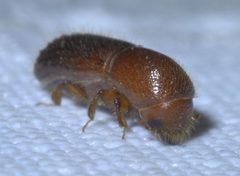
Xyleborus celsus, commonly known as the hickory timber , is a ambrosia beetle native to North America. It specializes in colonizing stressed or dying black hickory trees (Carya texana) and other hickory . The species overwinters as and completes development from to adult in approximately 35 days. Unlike some congenerics, it appears to be a native primary colonizer of weakened trees rather than an aggressive killer of healthy .
Pronunciation
How to pronounce Xyleborus celsus: //zaɪˈlɛbərəs ˈsɛlsəs//
These audio files are automatically generated. While they are not always 100% accurate, they are a good starting point.
Identification
As a small scolytine (likely 2–3 mm based on ), X. celsus would require microscopic examination for definitive identification. It can be distinguished from the redbay ambrosia beetle (Xyleborus glabratus) by its native North American distribution and association with hickory rather than laurel . It lacks the pronounced pest status and tree-killing of X. glabratus. Separation from other native Xyleborus requires examination of elytral declivity structure, antennal club segmentation, and other microscopic characters not documented in available sources.
Images
Habitat
Oak-hickory forests in central North America. Specifically associated with black hickory (Carya texana) stands in Missouri. Attacks occur primarily on trees 10–25 cm diameter at breast height, with most activity concentrated within 1.5 m above ground level. Strongly prefers stressed, girdled, or herbicide-treated trees over healthy specimens.
Distribution
North America: documented from south-central Missouri, with broader distribution inferred across the eastern United States and Canada (Ontario, Vermont, and conterminous 48 states recorded in GBIF). Native range appears to correspond with hickory forest distribution.
Seasonality
(two per year) in Missouri. Overwinters as . Timing of attack relative to tree stress events varies seasonally; beetles respond to fresh tree stress cues throughout the growing season.
Host Associations
- Carya texana - primary black hickory; primary in Missouri studies
- Carya spp. - probable 'hickory timber ' suggests broader hickory association, though specific range not experimentally confirmed beyond C. texana
Life Cycle
with two annually. Overwinters as . to adult development requires approximately 35 days at summer temperatures. Three larval instars. adults exhibit two behavioral : either extend natal galleries for additional breeding or disperse to locate new trees.
Behavior
Strongly attracted to stressed, injured, or dying trees rather than healthy . In experimental studies, significantly more beetles were captured on axe-girdled and herbicide-treated trees than on untreated healthy trees. Prefers larger diameter trees (≥17 cm D.B.H.) over smaller ones (10–15 cm D.B.H.). Attack height on stems varies with timing of tree girdling relative to arrival, suggesting behavioral plasticity in response to host condition. Aspect of attack on tree trunk varies randomly, indicating no directional preference. Not attracted to ethanol-baited traps at 118 ml concentration, suggesting reliance on host tree-specific cues rather than general stress volatiles.
Ecological Role
Primary colonizer of stressed and dying hickory trees. Functions as a forest agent by accelerating decomposition of weakened trees and recycling nutrients. Unlike ambrosia beetles, does not appear to kill healthy trees or pathogenic fungi to living . Likely maintains mutualistic fungal gardens in galleries, though specific fungal associates not documented in available sources.
Human Relevance
Minor native forest insect; not documented as a significant pest of timber, orchards, or urban trees. Its preference for already-stressed trees limits economic impact. May contribute to hickory timber degradation in salvage logging operations. Serves as a research subject for understanding native ambrosia beetle and as a contrast to congenerics like X. glabratus.
Similar Taxa
- Xyleborus glabratus congeneric with similar size and , but distinguished by Asian native range, association with Lauraceae (redbay, avocado, sassafras), and aggressive tree-killing through laurel wilt vectored by Raffaelea lauricola. X. celsus is native to North America, associated with hickory, and not documented as a of tree-killing .
- Other Xyleborus speciesNumerous occur in North American forests; microscopic examination of elytral declivity, antennal club, and other morphological characters required for definitive identification. Many lack and ecological documentation.
More Details
Research History
Most detailed ecological information derives from two studies published in The Canadian Entomologist in the 1970s–1980s by researchers working in Missouri. These remain the primary source for and selection data. No recent comprehensive studies identified.
Fungal Association
As an ambrosia beetle, X. celsus likely cultivates nutritional fungal gardens in wood galleries, though specific fungal have not been documented. This distinguishes ambrosia beetles from true bark beetles that feed directly on phloem.
Ethanol Attraction
Not attracted to ethanol-baited traps in experimental conditions, unlike many scolytine beetles that use ethanol as a stress cue. This suggests reliance on alternative host-location mechanisms, possibly hickory-specific volatiles or visual/tactile cues.
Sources and further reading
- BugGuide
- Wikipedia
- GBIF taxonomy match
- iNaturalist taxon
- NCBI Taxonomy
- Catalogue of Life
- Xyleborus glabratus and Euwallacea fornicatus - Entomology Today
- Xyleborus-glabratus - Entomology Today
- Forest Pest Invasions Can—And Should—Be Studied Before They Happen
- The Ambrosia Beetle Megaplatypus mutatus: Tiny but Destructive
- The Best Look Yet at the Tiny Fungus Storage Units Inside Ambrosia Beetles
- Why Are We Having a Record Outbreak of Exotic Fruit Flies in 2025?
- HOST SELECTION BY XYLEBORUS CELSUS (COLEOPTERA: SCOLYTIDAE) IN MISSOURI
- LIFE HISTORY, DEVELOPMENT, AND INSECT–HOST RELATIONSHIPS OF XYLEBORUS CELSUS (COLEOPTERA: SCOLYTIDAE) IN MISSOURI