
Ips perturbatus
Wood & Bright, 1992
Northern Spruce Engraver
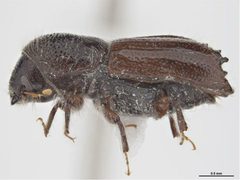
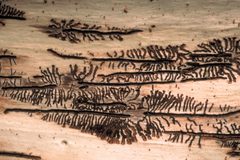
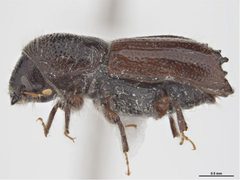
Ips perturbatus, the northern spruce engraver, is a bark beetle in the Curculionidae ( Scolytinae) that colonizes spruce trees (Picea spp.) across northern North America. It is primarily associated with white spruce (Picea glauca) and typically breeds on trees already killed or weakened by other agents, though it can attack stressed living trees. The has one per year in most of its range, with in the ground. Males initiate galleries and attract 1–4 females to form harems; females construct tunnels averaging 10 cm in length and lay approximately 49 eggs each. The species is notable for its associations with ophiostomatoid fungi, particularly Leptographium fruticetum, which may play a role in its .
Pronunciation
How to pronounce Ips perturbatus: /ɪps pərˈtɜrbətəs/
These audio files are automatically generated. While they are not always 100% accurate, they are a good starting point.
Identification
Distinguished from other Ips by the number and arrangement of spines on the declivity; like , males bear paired rows of spines on the rear of the , with specific counts used for species identification (e.g., fivespined engraver I. grandicollis, sixspined engraver I. sexdentatus). Specific spine count for I. perturbatus not explicitly stated in sources but follows the pattern. Small , typical of bark beetles in size.
Images
Habitat
Spruce-dominated forests; specifically colonizes white spruce (Picea glauca) and other Picea . Has been documented on felled trees 30–35 cm diameter at breast height and on trees killed by Dendroctonus piceaperda or dying from Diprion polytomum attack.
Distribution
Northern North America: central Alberta, northern British Columbia, Yukon Territory, Manitoba, Labrador, and the Gaspé Peninsula.
Seasonality
One per year. Colony initiation on trees begins late May. Gallery excavation and oviposition occur primarily during the first three weeks after gallery initiation. present under bark by mid-July; main from host trees mid-September. Adults leave host trees late September to early October to hibernate in ground; spring emergence from sites.
Host Associations
- Picea glauca - primary white spruce, main in Alberta and Gaspé studies
- Picea - spruce-infesting bark beetle
- Dendroctonus piceaperda - ecological facilitatortypically breeds on trees killed by this
- Diprion polytomum - ecological facilitatoralso found on white spruce dying from this 's attacks
- Leptographium fruticetum - fungal associatehighest relative dominance and frequency of occurrence with , suggesting specific relationship
- Hyalorhinocladiella sp. 2 - fungal associaterepeatedly isolated from and galleries
- Ophiostoma bicolor - fungal associaterepeatedly isolated
- Ophiostoma manitobense - fungal associaterepeatedly isolated
Life Cycle
Complete with one per year in central Alberta and Gaspé Peninsula. -to- development occurs within tree galleries. Adults found under bark by mid-July but delay until mid-September; late emergence precludes before winter, enforcing univoltinism. Adults overwinter in ground, not in host trees. Adult lifespan approaches two years; females lay eggs during first summer (two sets), then following spring (third set) before dying.
Behavior
Males initiate attack on trees and excavate chambers. Males produce to attract females. Harem : males mate with 1–4 females per gallery. Males assist females by removing and woody debris from tunnels. Male residence in galleries limited: gradual attrition with less than 15% remaining after 6 weeks; larger males abandon galleries sooner than smaller males. Females remain in oviposition tunnels longer, with nearly half still present after 6 weeks; female size does not predict residence time. High -to- mortality (98% in one study, 58.33% in another) attributed to intense gallery crowding.
Ecological Role
Secondary colonizer of dead or dying spruce trees; contributes to decomposition of woody . for ophiostomatoid fungi, with potential mutualistic relationships, particularly with Leptographium fruticetum. Facilitates nutrient cycling in forest . Serves as for Coeloides dendroctoni, though rates low (under 5%).
Human Relevance
Economic impact primarily through damage to spruce timber; attacks can degrade wood quality. Management concerns in forestry operations, particularly regarding timing of log harvesting and storage to minimize . Not a primary killer of healthy trees like some related bark beetles, but contributes to mortality of stressed stands.
Similar Taxa
- Ips grandicollisBoth are spruce-inhabiting Ips ; distinguished by spine count on declivity (I. grandicollis has five spines in two rows)
- Ips sexdentatusSixspined engraver, distinguished by six spines on rear; both colonize conifers
- Ips typographusEuropean spruce bark beetle, not native to North America but similar preferences; distinguished by geographic range and
- Dendroctonus rufipennisSpruce beetle, primary killer of spruce vs. secondary colonizer; larger, different gallery patterns
Sources and further reading
- BugGuide
- GBIF taxonomy match
- iNaturalist taxon
- NCBI Taxonomy
- Catalogue of Life
- Congrats to Antoine Abrieux, Innovator Fellow Award | Bug Squad
- Beetle Mania to Descend on the Bohart | Bug Squad
- Unhappy Christmas tree - Fivespined engraver, Ips grandicollis — Bug of the Week
- A thrips is a thrips… | Beetles In The Bush
- Insect-resistant Maize Could Increase Yields and Decrease Pesticide Use in Mexico
- How Systematic Entomology Will Thrive in the Age of Artificial Intelligence
- THE BIOLOGY OF IPS PERTURBATUS EICHHOFF
- Ophiostomatoid fungi associated with the northern spruce engraver, Ips perturbatus, in western Canada
- REPRODUCTION AND DEVELOPMENTAL PHENOLOGY OF IPS PERTURBATUS (COLEOPTERA: SCOLYTIDAE) INHABITING WHITE SPRUCE (PINACEAE)
- A new Leptographium species associated with the northern spruce engraver, Ips perturbatus, in western Canada
- A newLeptographiumspecies associated with the northern spruce engraver,Ips perturbatus, in western Canada