
Rhyssomatus
Schoenherr, 1837
Species Guides
13Rhyssomatus is a of true weevils (Curculionidae) containing at least 180 described . The genus includes significant agricultural pests, particularly of soybean and other leguminous crops. Several species have been intensively studied due to their economic impact, including R. nigerrimus (Mexican soybean weevil), R. subtilis (black soybean weevil in Argentina), and R. lineaticollis (milkweed stem weevil in North America). Species exhibit diverse ranging from monophagous to oligophagous on legumes.
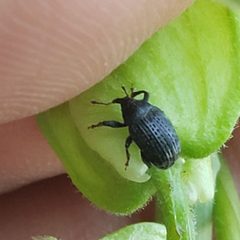
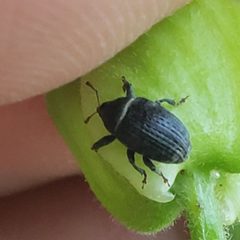
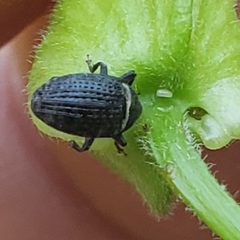
Pronunciation
How to pronounce Rhyssomatus: /ˌrɪs.oʊˈmeɪ.təs/
These audio files are automatically generated. While they are not always 100% accurate, they are a good starting point.
Images
Habitat
occupy diverse including agricultural fields, prairie remnants, and disturbed areas. R. nigerrimus and R. subtilis are strongly associated with soybean regions. R. lineaticollis inhabits fragmented prairie landscapes with Asclepias syriaca patches. Some species utilize weedy alternate plants when primary hosts are unavailable.
Distribution
Widespread in the Americas. R. nigerrimus occurs in Mexico. R. subtilis is to northwestern and northeastern Argentina, with recent range expansion to Córdoba Province. R. lineaticollis is found in east-central Iowa, USA. The as a whole ranges from North America through Central and South America based on GBIF records including Vermont, USA.
Diet
Larval feeding occurs within plant tissues, particularly seeds and pods. feed on foliage, with some clipping leaf petioles. Several species are feeders on legumes: R. nigerrimus reproduces exclusively on soybean (Glycine max); R. lineaticollis is monophagous on Asclepias syriaca; R. subtilis is oligophagous on soybean and dry beans. Some species utilize alternate plants for adult feeding and when primary hosts are unavailable.
Host Associations
- Glycine max - PRIMARY_HOST_REPRODUCTIVEsoybean; exclusive reproductive for R. nigerrimus and R. subtilis
- Asclepias syriaca - PRIMARY_HOST_REPRODUCTIVEcommon milkweed; exclusive for R. lineaticollis
- Sesbania punicea - PRIMARY_HOST_REPRODUCTIVEreproductive for R. marginatus in South Africa context
- Rottboellia cochinchinensis - ALTERNATE_HOSTalternate for R. nigerrimus during rainy season
- Hyparrhenia rufa - ALTERNATE_HOSTalternate for R. nigerrimus
- Sorghum halepense - ALTERNATE_HOSTalternate for R. nigerrimus ; strongest EAG response
- Ipomoea trifida - ALTERNATE_HOSTalternate for R. nigerrimus
- Crotalaria pallida - ALTERNATE_HOSTtested in studies with R. nigerrimus
- Crotalaria retusa - ALTERNATE_HOSTtested in studies with R. nigerrimus
- Crotalaria spectabilis - ALTERNATE_HOSTtested in studies with R. nigerrimus
- Crotalaria verrucosa - ALTERNATE_HOSTtested in studies with R. nigerrimus
- Phaseolus vulgaris - ALTERNATE_HOSTcommon bean; tested in studies
- Vigna unguiculata - ALTERNATE_HOSTcowpea; tested in studies
Life Cycle
Most studied are . R. nigerrimus overwinters as pupae in soil, emerging after spring rains. initially colonize weedy alternate plants for floral resources, then move to soybean where mating occurs on pods. R. subtilis larvae develop within pods feeding on seeds, then exit and drop to soil to pupate. R. lineaticollis exhibits similar soil-dwelling pupal stage. time appears synchronized with host plant , particularly pod development stages.
Behavior
Several form mating on plants. R. nigerrimus congregate in dense clusters on soybean leaves and pods, with mating most frequently observed midday. has been documented: R. nigerrimus produces low-volume stridulatory sounds via - rubbing, with two distinct patterns (paired chirps and series of chirps) that vary with group size and sex. Paired chirps may function in species recognition; series of chirps associated with stress or disturbance. R. lineaticollis is sedentary with limited (50% of recaptures move <1 m, maximum <1 km). Females of some species exhibit meticulous oviposition site selection to minimize intraspecific larval competition.
Ecological Role
Significant agricultural pests requiring management. R. subtilis, R. nigerrimus, and related cause direct yield loss through larval seed feeding and pod damage. Some species serve as agents: R. marginatus was introduced to South Africa for control of Sesbania punicea, where it supplements primary agent Trichapion lativentre by destroying up to 88% of remaining seeds. The represents a model for studying herbivore-plant interactions, in weevils, and movement in fragmented landscapes.
Human Relevance
Major economic impact on soybean production in Mexico and Argentina. R. nigerrimus and R. subtilis are managed with and foliar applications. Research toward reduced-risk management includes development of acoustic traps for monitoring, identification of plant volatiles for lure-based trapping, and use of alternate host plants as attractants. R. marginatus demonstrates potential for of legumes. The has been subject to extensive research on resistance monitoring for transgenic crop target pests.
Similar Taxa
- Sternechus subsignatusco-occurs with R. subtilis on soybean in Argentina; distinguished by larger size and stem-boring habit versus pod-feeding in Rhyssomatus
- Promecops carinicollisco-occurs with R. subtilis on soybean in Argentina; distinguished by smaller size and leaf-feeding habit versus pod-feeding in Rhyssomatus
- Trichapion lativentreco-occurs with R. marginatus on Sesbania punicea; distinguished as apionid weevil with flower-bud feeding versus seed-feeding in Rhyssomatus
Sources and further reading
- BugGuide
- Wikipedia
- GBIF taxonomy match
- iNaturalist taxon
- NCBI Taxonomy
- Catalogue of Life
- Rhyssomatus nigerrimus - Entomology Today
- “Picudo negro” (black weevil) on soybean in Argentina | Beetles In The Bush
- Eavesdropping on Soybean Weevils: Scientists Detect Subtle Acoustic Signals
- May | 2014 | Beetles In The Bush
- Curculionidae | Beetles In The Bush
- Argentina | Beetles In The Bush
- New Host Plants for Soybean Weevil, Rhyssomatus nigerrimus1, in Mexico
- Acoustic behavior of the adult soybean weevil, Rhyssomatus nigerrimus (Coleoptera: Curculionidae)
- Attraction of Rhyssomatus nigerrimus (Fahraeus) (Coleoptera: Curculionidae) to Odors from Alternate Host Plants
- Induced volatiles in the interaction between soybean (Glycine max) and the Mexican soybean weevil (Rhyssomatus nigerrimus)
- Olfactory responses of the soybean weevil Rhyssomatus nigerrimus to the scent of alternate host inflorescences
- Subterranean Distribution and Seasonal Emergence from Soil of Adults of Rhyssomatus nigerrimus 1 Fahraeus, 1837
- Oviposition patterns and the supplementary role of a seed-feeding weevil, Rhyssomatus marginatus (Coleoptera: Curculionidae), in the biological control of a perennial leguminous weed, Sesbania punicea
- Movement patterns of Rhyssomatus lineaticollis Say (Coleoptera: Curculionidae) within and among Asclepias syriaca (Asclepiadaceae) patches in a fragmented landscape
- Geographical Distribution and New Host Associations ofRhyssomatus subtilis(Coleoptera: Curculionidae) Northwestern in Argentina
- First Report of the Black Soybean Weevil Rhyssomatus subtilis Fiedler (Coleoptera: Curculionidae) in Córdoba, Argentina. Crop Damage Estimation