
Rhyssomatus lineaticollis
(Say, 1824)
Milkweed Stem Weevil
Rhyssomatus lineaticollis, commonly known as the milkweed stem weevil, is a specialized herbivore associated with milkweed plants (Asclepias spp.). feed on stems and leaf petioles, while larvae develop inside seed pods. The is notable for its monophagous to oligophagous relationship with milkweeds, including the common milkweed (Asclepias syriaca) and the rare, threatened Asclepias meadii. Research indicates this weevil is relatively sedentary, with limited distances, functioning as a patchy in fragmented agricultural landscapes. The species is distributed across eastern and central North America.
Pronunciation
How to pronounce Rhyssomatus lineaticollis: /rɪˈsoʊmətəs lɪˌniːətiˈkɔlɪs/
These audio files are automatically generated. While they are not always 100% accurate, they are a good starting point.
Identification
Rhyssomatus lineaticollis can be distinguished from similar weevil by its consistent association with milkweed plants (Asclepias spp.). may be recognized by their feeding damage—clipped leaf petioles that cause leaflets to drop. The species is most reliably identified by its host specificity and geographic distribution in eastern North America. Conclusive identification requires examination of genitalic characters or comparison with vouchered specimens.
Images
Appearance
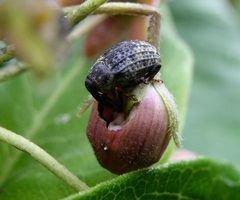
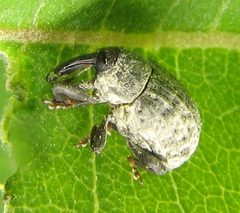
are small to medium-sized weevils typical of the Curculionidae, with an elongated snout (rostrum) bearing that are elbowed and clubbed. The body is generally dark in coloration. Specific morphological details distinguishing R. lineaticollis from include characteristic pronotal and elytral markings implied by the epithet 'lineaticollis' (lined neck/collar), though precise color pattern descriptions are not detailed in available sources.
Habitat
Agricultural landscapes, prairies, and open supporting stands of Asclepias syriaca (common milkweed). The thrives in fragmented landscapes where milkweed patches occur in matrices of cultivated fields, roadsides, and disturbed areas. plant patchiness and human disturbance history influence local .
Distribution
Eastern and central North America, with records from the United States and Canada. Specific documented locations include Ontario and Québec in Canada, Vermont in the United States, and broadly across the midwestern and eastern United States where Asclepias syriaca occurs. The ' range corresponds closely with that of its primary plant.
Seasonality
are active during the growing season of their plant, with activity beginning when milkweeds emerge in spring. Peak activity occurs during milkweed flowering and pod development stages. Adults have been observed in soybean fields during early vegetative growth stages in subsequent cropping seasons, suggesting timing tied to host plant .
Diet
feed on stems and leaf petioles of milkweed plants (Asclepias spp.), causing characteristic clipped leaflets. Larvae feed internally on developing seeds within milkweed pods.
Host Associations
- Asclepias syriaca - Primary Common milkweed; feed on stems and petioles, larvae develop in pods
- Asclepias meadii - Rare and threatened milkweed ; weevil described as destructive to this plant
Life Cycle
are laid singly inside milkweed pods. Larvae feed on developing seeds within the pod, completing development without exiting. Mature larvae exit pods, drop to soil, burrow, and pupate underground. emerge in the subsequent growing season when plants are in early to mid-vegetative stages. The is tightly synchronized with milkweed .
Behavior
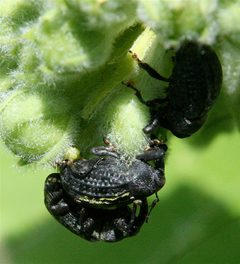
are relatively sedentary, with mark-recapture studies showing 50% of individuals moving less than 1 meter and maximum distances under 1 kilometer. Between-patch dispersal occurs regularly despite limited individual movement, facilitated by the dense patch structure of milkweed in modern agricultural landscapes. Adults aggregate on plants for mating. through stridulation has been documented in and may occur in this .
Ecological Role
As a specialized herbivore, R. lineaticollis functions as a regulator of milkweed in its native range. Its monophagous relationship with milkweeds represents a classic plant-herbivore coevolutionary interaction. The species serves as a member of the milkweed-associated insect , which includes other adapted to tolerate cardenolide defenses. In agricultural contexts, the weevil's presence indicates milkweed and may influence milkweed in field margins.
Human Relevance
The is of conservation concern due to its impact on Asclepias meadii, a rare and threatened milkweed. It is also relevant to monarch butterfly conservation discussions, as milkweed availability affects monarch and the weevil influences milkweed . In soybean-growing regions, related Rhyssomatus species (particularly R. subtilis in South America) are significant agricultural pests, though R. lineaticollis itself is not a crop pest. The species has been studied as a model organism for understanding and population structure in fragmented landscapes.
Similar Taxa
- Rhyssomatus subtilisCongeneric with similar and ; distinguished by geographic range (South America vs. North America) and associations (soybean and dry beans vs. milkweeds)
- Rhyssomatus nigerrimusSoybean weevil of Mexico with abilities; differs in specificity (soybean only) and geographic distribution
- Sternechus subsignatusSouth American 'big weevil' with stem-boring habit; larger and more damaging to soybean than Rhyssomatus
- Promecops carinicollisSouth American 'little weevil' with leaf-feeding habit; less damaging than Rhyssomatus
More Details
Research significance
Rhyssomatus lineaticollis has been extensively studied using mark-recapture techniques to understand in fragmented landscapes, providing insights into how monophagous herbivores persist when plants are patchily distributed.
Population structure
The functions as a patchy rather than a true metapopulation because all suitable patches appear to be occupied, with no vacant patches available for .
Historical context
The increase in Asclepias syriaca patch over the last 150 years due to human disturbance and the ' weedy habit has likely facilitated R. lineaticollis persistence and range expansion.
Sources and further reading
- BugGuide
- Wikipedia
- GBIF taxonomy match
- iNaturalist taxon
- NCBI Taxonomy
- Catalogue of Life
- Rhyssomatus nigerrimus - Entomology Today
- “Picudo negro” (black weevil) on soybean in Argentina | Beetles In The Bush
- Eavesdropping on Soybean Weevils: Scientists Detect Subtle Acoustic Signals
- May | 2014 | Beetles In The Bush
- Curculionidae | Beetles In The Bush
- Argentina | Beetles In The Bush
- Movement patterns of Rhyssomatus lineaticollis Say (Coleoptera: Curculionidae) within and among Asclepias syriaca (Asclepiadaceae) patches in a fragmented landscape