
Trichapion
Wagner, 1912
Species Guides
23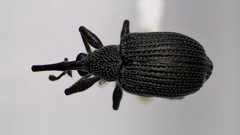
Pronunciation
How to pronounce Trichapion: /tɹɪˈkæpiˌɑn/
These audio files are automatically generated. While they are not always 100% accurate, they are a good starting point.
Identification
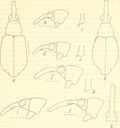
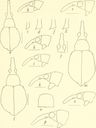
Distinguished from the related Apion by structural features of the rostrum and ; exact diagnostic characters require examination. Formerly classified within Apion, now separated based on morphological differences.
Images
Habitat
Associated with plants in the Sesbania (Fabaceae); specific requirements vary by .
Distribution
Records from Colombia (CO) and Argentina; broader distribution unclear. At least one , Trichapion lativentre, has been introduced to South Africa for .
Host Associations
- Sesbania punicea - Primary for Trichapion lativentre; used in programs
- Sesbania exaltata - tested Evaluated for suitability for T. lativentre in Argentina
- Sesbania drummondii - tested Evaluated for suitability for T. lativentre in Argentina
Behavior
Trichapion lativentre has been observed to suppress growth and of its plant Sesbania punicea; abundance correlates with effectiveness of weed suppression.
Ecological Role
agent for Sesbania weeds; abundance directly affects suppression of plant growth and seed production.
Human Relevance
Used in programs against Sesbania , particularly in South Africa. specificity testing conducted to evaluate safety for non-target plants.
Similar Taxa
Misconceptions
Frequently misidentified or historically classified under Apion; literature prior to taxonomic revision may not distinguish Trichapion as separate .
More Details
Taxonomic history
now placed in Trichapion were formerly included in Apion. placement has also shifted, with some sources listing Apionidae and others Brentidae (Apioninae as ). NCBI currently lists Apionidae; GBIF and iNaturalist list Brentidae.
Biological control research
Trichapion lativentre has been the most studied , with research focused on its effectiveness against Sesbania punicea in South Africa and range testing on North American Sesbania species in Argentina.
Sources and further reading
- BugGuide
- Wikipedia
- GBIF taxonomy match
- iNaturalist taxon
- NCBI Taxonomy
- Suitability of the North American Weeds Sesbania exaltata and S. drummondii (Leguminosae) as Hosts for Neodiplogrammus quadrivittatus and Trichapion lativentre (Coleoptera: Curculionidae) in Argentina
- Relationships Between the History of Colonization and Abundance of Trichapion lativentre (Coleoptera: Apionidae) in the Suppression of Growth and Reproduction of a Weed, Sesbania punicea (Fabaceae)