
Sitona lepidus
Gyllenhal, 1834
clover root weevil
Sitona lepidus, commonly known as the clover root weevil, is a root-feeding weevil native to Europe that has become an pest in New Zealand and North America. feed on clover foliage while larvae feed on root nodules, reducing nitrogen fixation and pasture quality. The is particularly damaging in New Zealand due to the absence of natural competitors and established programs using the Microctonus aethiopoides are underway.
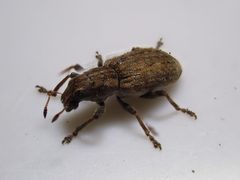
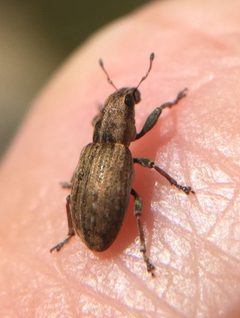
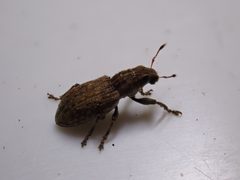
Pronunciation
How to pronounce Sitona lepidus: //sɪˈtoʊnə ˈlɛpɪdəs//
These audio files are automatically generated. While they are not always 100% accurate, they are a good starting point.
Images
Habitat
Pastoral grasslands, agricultural fields, and meadows where clover (Trifolium spp.) occur. In New Zealand, primarily found in white clover-based dairy and sheep pastures. occur on foliage; larvae develop in soil around plant roots.
Distribution
Native to Europe; introduced to New Zealand in the early 1990s and now distributed throughout the North Island with potential to spread throughout the country. Also present in North America. GBIF records indicate presence on Azores islands (Corvo, Faial, Flores, Graciosa, Pico).
Seasonality
In temperate regions, most oviposition occurs in September and October with a secondary period in early summer; hatching is largely confined to late spring and early summer. Activity patterns are temperature-dependent.
Diet
Larvae feed on root nodules of leguminous plants, particularly white clover (Trifolium repens) and red clover (Trifolium pratense). feed on clover foliage. Neonatal larvae demonstrate specific recognition and preferentially orient toward white clover roots over subterranean clover, strawberry clover, or ryegrass.
Host Associations
- Trifolium repens - primary white clover; preferred for larval feeding and oviposition
- Trifolium pratense - red clover; feeding deterrence observed with high formononetin cultivars
- Trifolium subterraneum - non-preferred subterranean clover; larvae avoid when white clover available
- Trifolium fragiferum - non-preferred strawberry clover; larvae avoid when white clover available
- Lolium perenne - non- ryegrass; not recognized as by larvae
Life Cycle
are laid on or near plants, primarily in September-October with a secondary period in early summer. Eggs are easily dislodged and typically hatch on the ground. Larvae burrow into soil and feed on root nodules. occurs in soil. emerge and feed on foliage. Development is temperature-dependent; hatching occurs largely in late spring and early summer.
Behavior
Neonatal larvae demonstrate directed movement toward plant roots, recognizing white clover roots at distances of 25-60 mm. Larval searching intensifies at CO2 concentrations around 1000 ppm (similar to those near white clover roots), suggesting CO2 acts as a search trigger rather than attractant. exhibit lifting and antennal movement associated with host location, and preferentially select white clover seedlings over mature plants. Adults show strong positive response to white clover in tests (74-84% choice rate).
Ecological Role
As a root-feeding herbivore, reduces nitrogen fixation in clover by damaging root nodules, thereby lowering pasture nutritional quality and forage value. In New Zealand, functions as a significant agricultural pest due to absence of competing . Serves as for introduced agents including the Microctonus aethiopoides.
Human Relevance
Major pest of pastoral agriculture in New Zealand, threatening farm productivity through reduction of clover content in pastures and decreased nitrogen fixation. programs using Irish strain of Microctonus aethiopoides have been established. No registered specifically target the damaging larval stage. Pasture management practices (eliminating remnant clover before renovation, crop ) can reduce but re-invasion is possible.
Similar Taxa
- Sitona hispidulusclover root curculio; also feeds on clover and alfalfa roots but distinguished by distribution (native to North America) and specific damage patterns
- Sitona lineatuspea leaf weevil; feeds on pea foliage and has different preferences and
- Sitona discoideuslucerne weevil; pest of alfalfa/lucerne with different range
More Details
Chemical ecology
Formononetin and associated isoflavones in red clover act as chemical defenses, reducing feeding and increasing mortality. High-formononetin red clover lines cause abdominal fat accumulation in adults and reduced laying. Cyanogenic ability in white clover cultivars does not appear to affect oviposition preference.
Biological control in New Zealand
The Irish strain of Microctonus aethiopoides was released in 2006 and has established successfully, achieving levels of 43-72% in some regions. This strain exhibits unique gregarious oviposition not observed in other M. aethiopoides . A separate strain of M. aethiopoides was previously released in 1982 for control of Sitona discoideus on lucerne.
Taxonomic note
Listed as a synonym of Sitona obsoletus in some databases (GBIF), but widely treated as valid in applied entomology literature, particularly in New Zealand agricultural research.
Sources and further reading
- BugGuide
- Wikipedia
- GBIF taxonomy match
- NCBI Taxonomy
- Sitona lineatus Archives - Entomology Today
- Clover Root Curculio: Historic Perspectives Guide Modern Management
- Complexity Untangled: For Plant Defenses, Pest Attack Order Matters
- Bug Eric: Carpet Beetles, Genus Anthrenus
- Britain’s First Bug Reserve – is OPEN - Buglife Blog - Buglife
- Bug Eric: Wasp Wednesday: Cerceris sextoides
- Clover root weevil (Sitona lepidus) in New Zealand: the story so far
- Oviposition and hatching of the clover weevil Sitona lepidus Gyll. (Coleoptera: Curculionidae)
- Interaction between Sitona lepidus and red clover lines selected for formononetin content
- Host plant recognition by the root feeding clover weevil, Sitona lepidus (Coleoptera: Curculionidae)
- Intraspecific variation in Trifolium pratense: impact on feeding and host location by Sitona lepidus (Coleoptera, Curculionidae)
- Methods to distinguish between the <i>Microctonus aethiopoides</i> strains that parasitise <i>Sitona lepidus</i> and <i>Sitona discoideus</i>
- The behaviour of adult <i>Sitona lepidus</i> Gyllenhal (Coleoptera Curculionidae) in response to white clover
- Reproductive behaviour of <i>Microctonus aethiopoides</i> Loan (Hymenoptera Braconidae) parasitising <i>Sitona lepidus</i>
- <i>Sitona lepidus </i>Gyllenhal newly established in New Zealand: assessment of distribution in the North Island
- Abundance and parasitism of clover root weevil (<i>Sitona lepidus</i>) and Argentine stem weevil (<i>Listronotus bonariensis</i>) in pastures
- Behavioural Acceptability of Sitona lepidus (Coleoptera: Curculionidae) to the Parasitoid Microctonus aethiopoides (Hymenoptera: Braconidae) Using the Pathogenic Bacterium Serratia marcescens Bizio
- Reconciling the maintenance of quarantine cultures of <i>Microctonus aethiopoides</i> (Loan) with premature mortality in the host clover root weevil <i>Sitona lepidus</i> Gyllenhal
- Progress in the search for biological control agents of clover root weevil, Sitona lepidus (Coleoptera: Curculionidae)
- Effects of carbon dioxide on the searching behaviour of the root-feeding clover weevil Sitona lepidus (Coleoptera: Curculionidae)