
Sitona lineatus
(Linnaeus, 1758)
pea leaf weevil, pea weevil, bean weevil
Sitona lineatus is an weevil pest of pulse crops, particularly field pea (Pisum sativum) and faba bean (Vicia faba). Native to Europe and North Africa, it has established in western Canadian prairie provinces and is expanding southward into the northern United States. feed on foliage, while larvae develop underground feeding on root nodules and Rhizobium bacteria. The exhibits distinct spring and late-summer periods tied to temperature thresholds, with spring from sites driving crop . Economic impacts include yield reductions up to 28% through combined foliar and root damage.
Pronunciation
How to pronounce Sitona lineatus: /sɪˈtoʊnə laɪˈniːətəs/
These audio files are automatically generated. While they are not always 100% accurate, they are a good starting point.
Identification
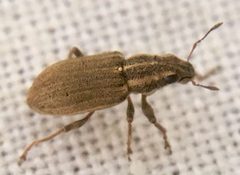
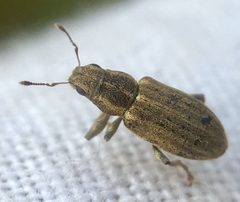
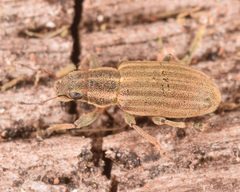
Distinguished from similar Sitona by the distinctive lined pattern of on the . The combination of dark with red tibiae and provides a useful color character. are smaller than many related curculionids. Larvae are found in soil associated with legume root nodules, not in seeds or pods (unlike Bruchus pea weevils). -baited cone traps are highly specific for monitoring and can predict subsequent feeding damage.
Images
Appearance
measure 3.4–5.3 mm in length. The display characteristic alternating lines () of colored , giving the its name 'lineatus' meaning 'lined' or 'striped'. The and pronotum bear fine pointed setae among the scales. are clubbed, pointed, and preceded by 7 segments. are dark; tibiae and are red. As beetles, the forewings are modified into hardened elytra covering the and , with membranous hindwings folded beneath for .
Habitat
Agricultural landscapes dominated by Fabaceae crops, particularly field pea, faba bean, and other pulse crops. Overwinters in field margins, leguminous crops (clover, alfalfa/lucerne), and non-crop refugia. Spring occurs when temperatures exceed 12.5°C. Distribution expansion is limited primarily by precipitation rather than temperature.
Distribution
Native to the Palearctic region (Europe, North Africa, Asia). in North America, established in western Canadian prairie provinces (Alberta, Saskatchewan, Manitoba) with range expansion toward North Dakota and northward into higher latitudes of Alberta. Climate models predict further northward expansion potential.
Seasonality
with two distinct periods. Post-diapausal spring flight begins late March when temperatures exceed 12.5°C, peaking mid-April; this flight drives crop from sites. Post- late-summer flight occurs from late July through mid-October, with maximum aerial in late August. Less than 10% of newly emerged adults disperse by flight; most remain in soil or walk to overwintering sites.
Diet
Oligophagous within Fabaceae. Primary (supporting complete development): field pea (Pisum sativum), faba bean (Vicia faba), and other legumes. Secondary hosts provide nourishment outside reproductive periods: alfalfa, clover, and other legumes. Adults feed on leaves; larvae feed on root nodules and associated Rhizobium bacteria. Documented feeding on chickpea (Cicer arietinum) in the Palouse region.
Host Associations
- Pisum sativum - primary field pea; supports complete development
- Vicia faba - primary faba bean; supports complete development
- Cicer arietinum - chickpea; documented feeding damage in Palouse region
- Medicago sativa - secondary alfalfa; and pre-reproductive feeding
- Trifolium spp. - secondary clover; site and feeding
Life Cycle
. overwinter in field margins and legume crops. Spring from dormancy triggered by temperatures ~12.5°C. Adults migrate to crop fields, feed, and reproduce. laid in soil near plants. Larvae burrow into soil and feed through 5 instars on root nodules and Rhizobium. occurs in soil. Adults emerge mid-summer, feed on crop foliage, then migrate to sites in late summer (August).
Behavior
Spring from sites to crops is wind-assisted and downwind-directed. exhibit increased longevity when feeding on pea crops versus alfalfa; this translates to higher female . Females disperse from high- areas to low-density areas to maximize -to-plant ratio. Trivial is limited; once crops are located, redistribution occurs primarily by . Adults fly most frequently during midday.
Ecological Role
Agricultural pest with significant economic impact on pulse crop production. Larval feeding on root nodules reduces nitrogen fixation capacity of plants, potentially requiring supplemental . Interactions with other pests and (e.g., pea aphid, pea enation mosaic virus) can alter plant defense responses and susceptibility.
Human Relevance
Major pest of pulse crops with documented yield losses up to 28% in Canada. Damage includes reduced pod production, lower protein content, and impaired nitrogen fixation necessitating artificial . Management strategies include monitoring, no-till farming (which reduces compared to conventional tillage), nitrogen supplementation, using predatory beetles and (Steinernema carpocapsae), and . No established or larval-targeted currently exist.
Similar Taxa
- Sitona hispidulusClover root curculio; also damages legume root nodules but differs in preferences and geographic distribution. cause minimal foliar damage compared to S. lineatus.
- Bruchus pisorumPea weevil; seed-feeding pest with larvae developing inside pea seeds rather than in soil on root nodules. Different and damage .
- Hypera posticaAlfalfa weevil; larger with different range and damage patterns on alfalfa.
Sources and further reading
- BugGuide
- Wikipedia
- GBIF taxonomy match
- iNaturalist taxon
- NCBI Taxonomy
- Complexity Untangled: For Plant Defenses, Pest Attack Order Matters
- New Research Collection Targets Insect Pests of Pulse Crops
- Treating Southern Soybeans with Neonicotinoids Yields Economic Benefits After All
- Arachnid Matriphagy: These Spider Mothers Literally Die for Their Young
- Clover Root Curculio: Historic Perspectives Guide Modern Management
- Beetle in a Haystack: Environmental DNA Reveals Invasive Pest Incursions
- Flight periodicity and infestation size of Sitona lineatus
- Chickpea, Cicer arietinum: a new host for the pea leaf weevil, Sitona lineatus
- Untersuchungen zum Fraβpflanzenspektrum von Sitona lineatus L. (Curcul., Coleopt.)1
- Influence of Host-Plant on the Susceptibility of Sitona lineatus L. (Col., Curculionidae) to Steinernema carpocapsae Weiser
- Spring dispersal of Sitona lineatus: the use of aggregation pheromone traps for monitoring
- Distribution, biology and integrated management of the pea leaf weevil, Sitona lineatus L. (Coleoptera: Curculionidae), with an analysis of research needs.
- From fields to landscapes: pheromone trapping and feeding damage of Sitona lineatus (Coleoptera: Curculionidae) during range expansion in Canadian pulse crops
- Partial application of insecticide to broad bean (Vicia fabae) as a means of controlling bean aphid (Aphis fabae) and bean weevil (Sitona lineatus)
- Sitona lineatus Host-Plant Odors and Their Components: Effect on Locomotor Behavior and Peripheral Sensitivity Variations