
Sitona hispidulus
(Fabricius, 1777)
Clover Root Curculio, Clover Weevil
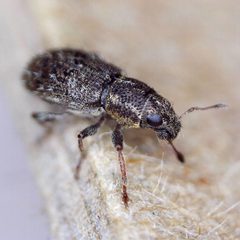
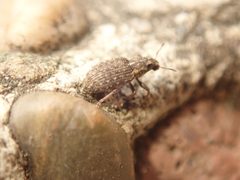
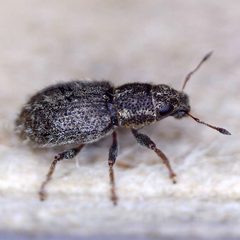
hispidulus, the clover root curculio, is a weevil native to Europe that has been introduced to Asia and North America. The larval stage is the most damaging, feeding cryptically underground on root nodules and taproots of legumes, particularly alfalfa and clovers. feed on foliage with minimal damage. The species has been overlooked as a pest for decades but causes chronic issues including reduced stand establishment, shortened stand life, and increased winterkill in forage systems. levels are limited by availability of root nodules for early instars and taproot for later instars.
Pronunciation
How to pronounce Sitona hispidulus: //sɪˈtoʊnə hɪˈspɪdjʊləs//
These audio files are automatically generated. While they are not always 100% accurate, they are a good starting point.
Images
Habitat
Agricultural fields and forage systems; specifically the rhizosphere of leguminous crops including alfalfa, clovers, peas, and vetches. Larvae occur in soil where they feed on root nodules and taproots. occur on foliage and in field margins where they overwinter outside of crop fields.
Distribution
Native to Europe; introduced to Asia and North America. Present across Europe including Austria, Belgium, Britain, Bulgaria, Corsica, Czechoslovakia, Denmark, Finland, France, Germany, Greece, Hungary, Italy, Netherlands, Norway, Poland, Portugal, Romania, Spain, Sweden, Switzerland, and Yugoslavia. In Asia: Cyprus, Iran, Israel, Japan, Syria, Turkey. In North America: Canada and USA, including North Carolina where seasonal reproductive has been studied.
Seasonality
overwinter outside of fields and migrate into fields in late spring to lay . Larvae develop underground through five instars before pupating. Adults re-emerge in summer and continue feeding. In the Palouse region, first- adults typically attack before pea aphids arrive, while second-generation adults attack after aphids and pea enation mosaic virus have arrived.
Diet
Larvae feed on nitrogen-fixing root nodules and taproot cortex of leguminous plants. First and second instars primarily consume root nodules; fifth instars feed on taproot . feed on foliage with minimal damage.
Host Associations
- Medicago sativa - larval alfalfa; larvae feed on root nodules (early instars) and taproot (later instars)
- Trifolium - larval clovers
- Pisum sativum - peas
- Vicia - vetches
- Vicia faba - broad bean
Life Cycle
Complete with five larval instars. are laid in soil. First and second instar larvae feed on root nodules and are correlated with nodule availability and soil moisture. Third and fourth instars show no consistent correlation with measured rhizosphere components. Fifth instar larvae are associated with taproot . occurs in soil. emerge, feed on foliage, and overwinter outside of fields before migrating back in late spring.
Behavior
migrate into fields from sites in late spring. Larval feeding is cryptic, occurring underground, making detection and monitoring difficult. Larval feeding damage accumulates over time rather than killing plants outright.
Ecological Role
Herbivore and pest of leguminous crops. Larval feeding on nitrogen-fixing nodules may reduce nitrogen fixation in plants. are controlled by availability of root nodules, with -dependent mortality occurring when nodules are sparse. Serves as host for including Steinernema feltiae, S. bibionis, and Heterorhabditis bacteriophora.
Human Relevance
Significant agricultural pest of alfalfa and clover production in North America. Causes chronic damage including reduced stand establishment and , shortened stand life, increased winterkill, and decreased water and nutrient uptake. Synergism with secondary plant can decrease yield two- or three-fold compared to damage from the pest alone. No established , predictive models, or registered targeting larvae currently exist. Historical suppression by broad-spectrum insecticides used against alfalfa weevil ended when those insecticides were banned, leading to resurgence. using shows promise, with S. feltiae causing 100% larval mortality in laboratory tests.
Similar Taxa
- Hypera posticaAlfalfa weevil; historically, used against H. postica indirectly suppressed S. hispidulus . Both are weevil pests of alfalfa but H. postica is more well-known and has characteristic foliage damage from larval feeding, whereas S. hispidulus larval damage is underground on roots.
- Sitona lineatusPea leaf weevil; congeneric also a pest of legumes, but feeds on pea leaves with tiny feeding bites rather than root nodules. S. lineatus has been studied for its effects on plant defense signaling when attacking before or after pea aphids.
More Details
Population Dynamics
First-instar larval mortality is high (66-81%) due to lack of available root nodules. of early instars is significantly related to nodule number and . Fourth-instar abundance is associated with taproot biomass independently of nodule effects, suggesting taproot surface area may limit levels.
Entomopathogenic Nematode Susceptibility
Third instar larvae are more susceptible to than first, second instars, pupae, or . Steinernema feltiae is the most aggressive tested, causing complete larval mortality in 6 days at 30 L3 nematodes per insect. All three nematode species (S. feltiae, S. bibionis, Heterorhabditis bacteriophora) multiply sufficiently in S. hispidulus, which is considered among the best for these nematodes.
Sources and further reading
- BugGuide
- Wikipedia
- GBIF taxonomy match
- iNaturalist taxon
- NCBI Taxonomy
- Clover Root Curculio: Historic Perspectives Guide Modern Management
- Sitona hispidulus Archives - Entomology Today
- Sitona lineatus Archives - Entomology Today
- Complexity Untangled: For Plant Defenses, Pest Attack Order Matters
- Britain’s First Bug Reserve – is OPEN - Buglife Blog - Buglife
- Bug Eric: Wasp Wednesday: Cerceris sextoides
- Sitona hispidulus . [Distribution map].
- Seasonal Aspects of the Reproductive Biology of Sitona hispidulus (Coleoptera: Curculionidae) in North Carolina
- MULTIVARIATE ANALYSIS OF THE POPULATION STRUCTURE OF SITONA HISPIDULUS (COLEOPTERA: CURCULIONIDAE) IN ALFALFA FIELD SOIL
- Infectivity and reproductive potential of the Oswego strain of Heterorhabditis bacteriophora associated with life stages of the clover root curculio, Sitona hispidulus
- Effects of root nodules and taproots on survival and abundance of Sitona hispidulus (Coleoptera: Curculionidae) on Medicago sativa
- Susceptibility of the clover root weevil, Sitona hispidulus F. (Col., Curculionidae) to Steinernema feltiae, St. bibionis, and Heterorhabditis bacteriophora
- Effect of Spatial Distribution on Determining the Number of Samples Required to Estimate Populations of Hypera postica, Sitona hispidulus , and Hypera punctata1 for Specified Probability and Accuracy Levels 2
- Seeking Alfalfa Resistance to a Rhizophagous Pest, the Clover Root Curculio (Sitona hispidulus F.).