
Sitonini
Genus Guides
1Sitonini is a tribe of broad-nosed weevils (Curculionidae: Entiminae) with a Holarctic distribution. Members are specialized feeders on Fabaceae, with consuming leaves and larvae feeding on root nodules. The tribe includes economically significant pests, particularly in the Sitona and Charagmus, which damage lupin and other legume crops in Europe.
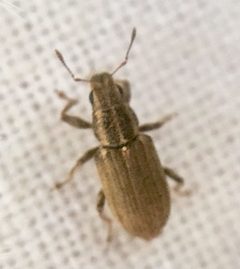
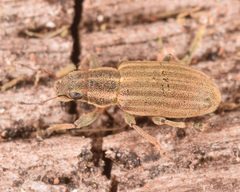
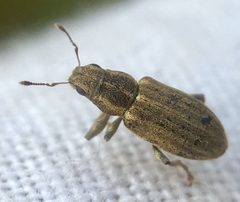
Pronunciation
How to pronounce Sitonini: /sɪˈtoʊnɪˌnaɪ/
These audio files are automatically generated. While they are not always 100% accurate, they are a good starting point.
Identification
Sitonini weevils can be distinguished from other Entiminae tribes by their association with Fabaceae and their characteristic feeding damage: produce U-shaped notches on leaf margins, while larvae are subterranean root-nodule feeders. The tribe comprises seven extant : Andrion, Charagmus, Coelositona, Eugnathus, Schelopius, Sitona, and Velazquezia, plus the fossil genus †Sitonitellus. -level identification requires examination of genitalia and other morphological details.
Images
Habitat
Associated with Fabaceae plants across diverse environments from lowlands to altitudes exceeding 1000 m. Agricultural thrive on light sandy soils and sandy loams. shelter in host plants such as Lupinus polyphyllus and Cytisus scoparius.
Distribution
Holarctic native distribution. Charagmus griseus historically widespread across the West Palaearctic including Europe and North Africa. Charagmus gressorius distributed across the Central-Asiatic–European–Mediterranean region including Turkey, Macaronesia, the Caucasus, and Central Asia to Kazakhstan. Both have expanded throughout Europe, reaching Scandinavia and Baltic countries by the early 2010s.
Seasonality
emerge from sites when lupin seedlings emerge in spring. Activity continues through the growing season until adults return to overwintering sites in .
Diet
feed on leaves of leguminous plants, particularly lupins (Lupinus spp.), producing characteristic U-shaped notches. Larvae feed exclusively on root nodules of Fabaceae, including Lupinus angustifolius, L. albus, L. luteus, L. polyphyllus, Cytisus scoparius, Genista, and Ornithopus. Members are adapted to quinolizidine alkaloids present in plants.
Host Associations
- Lupinus angustifolius - larval (root nodules), host (leaves)narrow-leaved lupin; major crop in Europe
- Lupinus albus - larval (root nodules), host (leaves)white lupin; major crop
- Lupinus luteus - larval (root nodules), host (leaves)yellow lupin
- Lupinus polyphyllus - shelter, larval (root nodules), host (leaves) for
- Cytisus scoparius - shelter, larval (root nodules), host (leaves) for
- Genista - larval (root nodules), host (leaves)
- Ornithopus - larval (root nodules), host (leaves)
- Bradyrhizobium - indirect interactionsymbiotic nitrogen-fixing bacteria in root nodules consumed by larvae
Life Cycle
overwinter in plants and emerge when spring seedlings appear. After feeding and mating, females deposit yellowish-white ellipsoid on plants and soil surface; eggs darken after 2–3 days and are washed into soil by rain. Larvae develop underground, feeding on root nodules through multiple instars (4–5 instars inferred from related Sitona ). occurs in soil. New adults emerge and seek sites in perennial hosts.
Behavior
exhibit cryptic that complicates detection and control. Feeding produces distinctive U-shaped notches on leaf margins with negligible economic impact compared to larval damage. Larval feeding on root nodules causes major economic damage by reducing nitrogen fixation and creating lacerations that admit soil-borne . A potential mutualistic interaction with Fusarium fungi has been observed, where higher larval survival occurs on infected plants.
Ecological Role
Significant agricultural pests of legume crops, particularly lupins, causing up to 40% grain yield reduction in L. angustifolius. Larval feeding severely impairs nitrogen fixation in root nodules. Root damage facilitates entry of soil-borne plant including Fusarium spp., Phoma spp., Pythium spp., Rhizoctonia spp., Sclerotinia spp., and Thielaviopsis basicola. A pathogen role has been hypothesized but not confirmed.
Human Relevance
Major pests of lupin in Europe, especially in north-eastern Germany and Poland. necessitate combining applications with ecological methods. Economic impact stems primarily from larval root-nodule feeding rather than leaf damage.
Similar Taxa
- Other Entiminae tribesDistinguished by Fabaceae specificity and root-nodule feeding habit of larvae; most other broad-nosed weevils have broader host ranges or different larval feeding strategies
More Details
Taxonomic note
The Charagmus and Sitona have undergone taxonomic revision; such as C. gressorius and C. griseus were formerly classified as Sitona gressorius and S. griseus.
Egg characteristics
Charagmus griseus produces larger (0.895 × 0.664 mm) than C. gressorius (0.558 × <0.526 mm), potentially influencing soil preferences and distribution patterns.