
Bruchus pisorum
Linnaeus, 1758
pea weevil, pea beetle, pea seed beetle
Bruchus pisorum is a seed beetle in the Chrysomelidae, commonly but incorrectly known as the pea weevil due to historical taxonomic confusion with true weevils (Curculionidae). It is a significant agricultural pest of cultivated pea (Pisum sativum), with larvae developing inside pea seeds. The is now in distribution, having spread from its native range in Western Asia through human-mediated transport in stored seeds. It is , with and emerging in spring to infest pea crops.
Pronunciation
How to pronounce Bruchus pisorum: /ˈbruːkus pɪˈsɔːrəm/
These audio files are automatically generated. While they are not always 100% accurate, they are a good starting point.
Identification
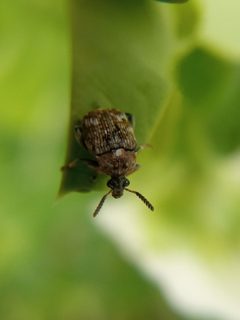
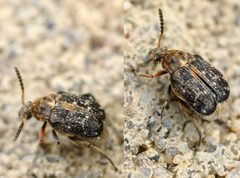
Distinguished from true weevils (Curculionidae) by the absence of an elongated rostrum; Bruchus has a short, non-snouted . The combination of short exposing abdominal patches, pronotal denticle, and white pattern on dark background separates it from other Bruchus . B. pisorum specifically associates with pea (Pisum sativum), whereas typically infest other legume . relatively short, not exceeding one-third body length.
Images
Habitat
Agricultural , specifically pea (Pisum sativum) crops. thrive in no-till and minimum tillage farming systems. overwinter in field margins, hedgerows, and other sheltered locations, migrating to pea crops in spring. Can survive extended periods in dry stored pea seeds.
Distribution
Native to Western Asia (Asia Minor). Now due to human-mediated spread in stored seeds. Established in Europe, Northern Asia (excluding China), North America, temperate Asia, South America (Chile), South Africa, Japan, parts of China, and Australia. In Russia, range has expanded eastward and northward since the 1980s, with records in Altai Territory, Tatarstan, Bashkiria, Kemerovo and Tomsk oblasts, and Arkhangelsk oblast.
Seasonality
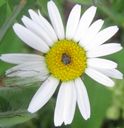
. emerge from sites in early spring (mid-August to early September in South Australia, timing varies by region). Arrival in pea crops typically coincides with commencement of flowering. Adults may remain in harvested seeds until the following spring or emerge over summer to fly to overwintering sites.
Diet
feeder on seeds of Pisum sativum (cultivated pea). Larvae develop entirely within pea seeds, consuming the cotyledons. feed on pea pollen; ingestion of pea pollen has been observed as a prerequisite for copulation in some studies, though ovarian development can occur on pollen of other .
Host Associations
- Pisum sativum - obligate Primary for larval development; seeds are consumed by larvae. feed on pollen and oviposit on pods.
- Lathyrus sativus - non-Larvae can complete development when artificially placed inside pods, but females show reduced oviposition preference; pod callus tissue formation kills larvae attempting natural entry.
- Lathyrus tingitanus - non-Pod callus tissue growth beneath prevents larval establishment; strong oviposition deterrence.
Life Cycle
. laid singly on surface of pea pods; bright yellow-orange in color. Incubation 3-5 weeks depending on temperature. Larvae chew through pod wall, locate developing seed, and undergo four instars over 7-11 weeks. lasts 2-3 weeks within seed. emerge either from unharvested crop seeds in summer or remain in harvested seeds until following spring. ranges from 3 to 735 eggs per female.
Behavior
congregate along crop edges upon arrival in pea fields; mechanism of -finding and edge preference is unknown. Females fly through crops searching for pods; longer pods receive more , with oviposition declining once seeds have filled. Oviposition preference range is narrower than range suitable for larval development. Adults shelter in vegetative parts of crop when flowers absent.
Ecological Role
Primary seed of Pisum sativum. Can reduce seed weight, quality, and marketability significantly. Serves as for Triaspis thoracica (Hymenoptera: Braconidae), which can reduce weevil larval in early-instar stages. populations alter phytosanitary condition of pea agroecosystems.
Human Relevance
Major economic pest of pea crops worldwide. Infested seeds show reduced germination, vigor, and productivity; seeds with bruchid holes cannot provide viable crop yields. Management relies on application (acetamiprid and zeta-cypermethrin showing highest efficacy), timing sprays to first visible . Pre-sowing generally ineffective due to insufficient duration of protection. Development of cultivars (e.g., Modus, Glyans) is priority for environmental protection.
Similar Taxa
- Sitona lineatusAlso called 'pea leaf weevil' and is a pulse crop pest, but belongs to Curculionidae (true weevils with rostrum), feeds on leaves rather than seeds, and has different damage .
- Other Bruchus species infest other legume (e.g., Vicia, Lens, Cicer); association with Pisum sativum is diagnostic for B. pisorum.
Misconceptions
Despite 'pea weevil', this is not a true weevil. The Bruchidae (seed beetles) was separated from Curculionidae in 1843; Bruchus lacks the elongated rostrum characteristic of true weevils. The misnomer persists due to Linnaeus's original placement and historical confusion based on facial structure and tarsal segmentation.
More Details
Taxonomic history
Originally described as Dermestes pisorum by Linnaeus (1758). Linnaeus (1767) established Bruchus with B. pisorum as type . Formerly placed in Curculionidae, now correctly classified in Chrysomelidae ( Bruchinae or Bruchidae depending on classification system used).
Invasion dynamics
Range expansion in Russia since 1980s correlated with climate warming, adoption of no-till/minimum tillage practices, and decreasing farm sizes. Isolated high- foci established through anthropogenic transport rather than natural .
Resistance mechanisms in hosts
Some Lathyrus exhibit (pod callus tissue killing larvae) and antixenosis (deterrence of oviposition) against B. pisorum. Pea cultivar resistance associated with lower protein and phosphorus content, thicker pod walls, and earlier flowering .
Sources and further reading
- BugGuide
- Wikipedia
- GBIF taxonomy match
- iNaturalist taxon
- NCBI Taxonomy
- pea weevil - Bruchus pisorum - Entomology Today
- New Research Collection Targets Insect Pests of Pulse Crops
- Bruchus pisorum Archives - Entomology Today
- Molecular characterization of mariner-like elements in Bruchus pisorum and Bruchus rufimanus (Coleoptera: Bruchidae)
- Effectiveness of modern insecticides against the pea weevil (Bruchus pisorum L.)
- Distribution and Biology of Invasive Species of Pea Weevil (Bruchus pisorum)
- Response of Pea Varieties to Damage Degree of Pea Weevil,Bruchus pisorumL.
- A study of the biology and control of the pea weevil, Bruchus pisorum L (Coleoptera, Bruchidae) in the Palouse area of Idaho and Washington
- Imaginal and ovicidal effect of some insecticides against Bruchus pisorum L. (Coleoptera: Chrisomelidae)
- Some Notes on the Biology of the Pea Weevil Bruchus Pisorum L. (Coleoptera, Bruchidae) at Moscow, Idaho
- Pea weevil damage and chemical characteristics of pea cultivars determining their resistance to Bruchus pisorum L.
- Evaluation of Phenological and Morphological Traits in Pea Accessions (Pisum sativum L.) and Their Resistance to Pea Weevil (Bruchus pisorum L.)
- Oviposition Preference of Pea Weevil, Bruchus pisorum L. Among Host and Non-host Plants and its Implication for Pest Management
- Response of two Lathyrus species to infestation by the pea weevil Bruchus pisorum L. (Coleoptera: Bruchidae)
- Electrophysiological and behavioral responses of pea weevil Bruchus pisorum L. (Coleóptera: Bruchidae) to volatiles collected from its host Pisum sativum L