
Bruchus affinis
Frölich, 1799
seed beetle
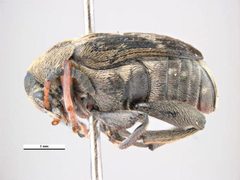
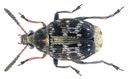
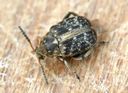
Bruchus affinis is a native to the western Palaearctic Region, first recorded in North America in Canada (British Columbia, Ontario, Québec) before 2007. It was likely introduced via imported Lathyrus seeds for planting. The develops inside seeds of Lathyrus species, with feeding on pollen and nectar. Development from to adult requires approximately 60 days. The Dinarmus basalis has been recorded causing about 10% mortality in Canadian .
Pronunciation
How to pronounce Bruchus affinis: /ˈbruː.kus əˈfɪ.nɪs/
These audio files are automatically generated. While they are not always 100% accurate, they are a good starting point.
Images
Habitat
Gardens, roadsides, and field edges with flowering Lathyrus plants. Associated with Lathyrus latifolius and L. sylvestris vines.
Distribution
Native to western Palaearctic Region. in North America with established in Canada: British Columbia (Vancouver), Ontario (Ottawa), and Québec (Gatineau, Wakefield, Laval, Montréal, Notre-Dame-de-l'Île-Perrot). Earliest Canadian record from 2007.
Seasonality
Lathyrus flowering begins mid-June; oviposition occurs late June; first emerge late August. Overwinters as adult in .
Diet
feed on pollen and nectar of Lathyrus . Larvae develop inside seeds of Lathyrus latifolius, L. sylvestris, and other Lathyrus species. Adults require pollen of L. latifolius or L. sylvestris to terminate sexual and commence oviposition.
Host Associations
- Lathyrus latifolius - primary larval ; pollen source for terminationeverlasting pea
- Lathyrus sylvestris - primary larval ; pollen source for terminationnarrow-leaved everlasting pea
- Lathyrus grandiflorus - potential larval
- Lathyrus tuberosus - potential larval
- Vicia faba - minor broad bean; impacts expected to be small
- Vicia sp. - potential
Life Cycle
. hatch approximately 10 days after oviposition. Development from egg to requires about 60 days. Pupal stages occur inside seeds. Overwinters as adult in sexual .
Behavior
exhibit sexual that is terminated by feeding on specific plant pollen (Lathyrus latifolius or L. sylvestris). Females lay on newly formed pods without regard to seed availability or existing egg . larvae perforate pods to reach ovules; multiple larvae may enter the same ovule but only one develops per seed. Not a pest of stored products; does not infest dried seeds.
Ecological Role
Seed that reduces plant reproductive output in infested Lathyrus . Host for Dinarmus basalis (Pteromalidae), which causes approximately 10% mortality. Potential agent for Lathyrus . Impact on native North American Lathyrus species remains unknown.
Human Relevance
Introduced to North America via commercial seed trade. Expected to have minimal impact on broad bean (Vicia faba) production. Potential for of Lathyrus .
Similar Taxa
- Other Bruchus speciesRequires examination of genitalia and associations for definitive identification; B. affinis specifically associated with Lathyrus hosts
- Bruchus rufimanusBroad bean beetle with similar ; B. affinis distinguished by preference and genitalia structure
Sources and further reading
- BugGuide
- GBIF taxonomy match
- iNaturalist taxon
- NCBI Taxonomy
- Meet 'Mantis Master Keeper' Andrew Pfeifer | Bug Squad
- Saving the Rusty-Patched Bumble Bee | Bug Squad
- Take 2 on tropical tiger moths: Spotted oleander caterpillar moth, Empyreuma affinis — Bug of the Week
- Mason bees in peril when parasitic wasps arrive – Leucospid wasp, Leucospis affinis — Bug of the Week
- A Tick that Feeds on Birds May Increase the Range of Lyme Disease
- Genetic Analysis Guides Conservation of Endangered Bumble Bee
- Palaearctic seed beetle Bruchus affinis (Coleoptera, Chrysomelidae, Bruchinae) new to North America, arrival, distribution, and autecology
- Figure 4 from: Douglas HB, Dumont S, Savard K, Thurston GS, Light MHS (2022) Palaearctic seed beetle Bruchus affinis (Coleoptera, Chrysomelidae, Bruchinae) new to North America, arrival, distribution, and autecology. ZooKeys 1128: 19-31. https://doi.org/10.3897/zookeys.1128.90016
- Figure 2 from: Douglas HB, Dumont S, Savard K, Thurston GS, Light MHS (2022) Palaearctic seed beetle Bruchus affinis (Coleoptera, Chrysomelidae, Bruchinae) new to North America, arrival, distribution, and autecology. ZooKeys 1128: 19-31. https://doi.org/10.3897/zookeys.1128.90016
- Figure 1 from: Douglas HB, Dumont S, Savard K, Thurston GS, Light MHS (2022) Palaearctic seed beetle Bruchus affinis (Coleoptera, Chrysomelidae, Bruchinae) new to North America, arrival, distribution, and autecology. ZooKeys 1128: 19-31. https://doi.org/10.3897/zookeys.1128.90016
- Etude de l'adaptation de Bruchus affinisàLathyrus sylvestris: analyse de la mortalité avant l'installation des larves dans les graines
- Biology of Seed Beetle, Bruchus affinis Frolich (Coleoptera: Chrysomelidae) on Various Field Pea Genotypes under Temperate Conditions of Kashmir
- Figure 5 from: Douglas HB, Dumont S, Savard K, Thurston GS, Light MHS (2022) Palaearctic seed beetle Bruchus affinis (Coleoptera, Chrysomelidae, Bruchinae) new to North America, arrival, distribution, and autecology. ZooKeys 1128: 19-31. https://doi.org/10.3897/zookeys.1128.90016