
Bruchus rufimanus
Boheman, 1833
Broadbean Weevil, Broad Bean Beetle, Broad Bean Seed Beetle
Bruchus rufimanus is a leaf beetle and major agricultural pest of faba beans (Vicia faba). feed on pollen and nectar, particularly from Fabaceae, while larvae develop inside seeds where they are protected from control measures. The exhibits precise phenological synchrony with its plant, with adult timed to crop flowering. Sexual maturation is triggered by and pollen consumption, with females becoming reproductive after ingesting faba bean pollen. occurs as adults in protected sites or as larvae/pupae within stored seeds.
Pronunciation
How to pronounce Bruchus rufimanus: /ˈbruːkʊs ruːfɪˈmanʊs/
These audio files are automatically generated. While they are not always 100% accurate, they are a good starting point.
Identification
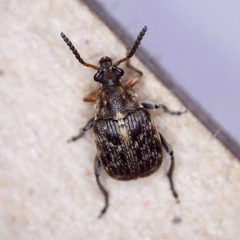
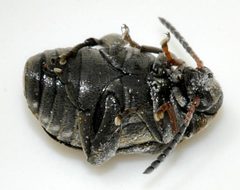
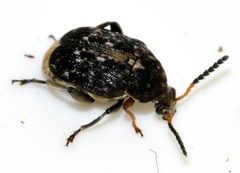
range 3–5 mm in length, making them among the largest in Bruchus. Larval presence is indicated by circular holes in seeds; emergence holes are smaller. are small (<1–2 mm), white-yellowish to green-yellowish, and laid predominantly on lower plant parts. Adults are extremely mobile during daylight hours and in flowers and young leaves at night.
Images
Habitat
Agricultural fields cultivating faba beans (Vicia faba); sites include under tree bark of old standing trees, hedgerows, lichen, forests, and leaf litter. Fields near woody and herbaceous environments and storage facilities elevated risk.
Distribution
Europe; recorded in France, UK, Ireland, Germany (Saxony), Latvia, and on Azorean islands (Faial, São Jorge, São Miguel, Santa Maria, Terceira). patterns follow faba bean areas.
Seasonality
with single per year. emerge from in early spring when day length reaches 16–18 hours. Field coincides with faba bean flowering (BBCH 61–65). Oviposition extends from flowering through early pod development, continuing up to 5–10 days after end of flowering (BBCH 77). Adult from seeds occurs before or after harvest depending on development timing.
Diet
feed on pollen and nectar, primarily from Fabaceae and Vicia ; sexual maturation in females specifically requires faba bean pollen and nectar. Larvae feed on endosperm and embryo within developing faba bean seeds. Alternative pollen sources consumed include wild chervil, oilseed rape, and wild Prunus.
Host Associations
- Vicia faba - primary Required for larval development; oviposition on pods, larval development in seeds
- Fabaceae - pollen/nectar source feeding and pre-reproductive nutrition
Life Cycle
: laid on developing pods, predominantly lower plant parts, up to 10 eggs per pod, 50–100 eggs per female. Larva: hatches after 10 days to 3 weeks, bores through pod wall into seed, develops 2–3 months protected within seed. Pupa: formed within seed after larva cuts circular cap; approximately 10 days duration. : emerges through cap; overwinters in reproductive under bark, in leaf litter, or within stored seeds as larva/pupa.
Behavior
are diurnally active and highly mobile, migrating between crops following flower availability. Reproductive terminates in response to : males require 16h day length, optimal at 18h; females require combined photoperiod extension and faba bean pollen ingestion. Temperature thresholds govern activity: minimum 15°C, optimal above 20°C, very favorable above 25°C; rain, wind, and temperatures below 20°C halt oviposition. Adults aggregate in flowers and young leaves for at night and early morning.
Ecological Role
Agricultural pest reducing seed germination (13% reduction in lab, variable in field) and seedling development. Damaged seeds show increased susceptibility to fungal including Fusarium, Alternaria, Aspergillus, Penicillium, Cladosporium, Mucor, and Botrytis . Serves as for Chremylus rubiginosus, Triaspis thoracicus (Braconidae), and Dinarmus acutus (Pteromalidae). including spiders may prey on .
Human Relevance
Major economic pest of faba bean production. Yield losses of 45–70% reported from infested beans. Seed quality degradation affects human consumption markets (3% damage threshold) and export markets (zero for living insects). Management relies on -targeted applications timed to temperature thresholds and crop stage; and neonicotinoids used with protection restrictions. Alternative methods include trapping, fungi, oils, and storage treatments (warm air, , extended storage).
Similar Taxa
- Bruchus pisorumPea weevil ; both are major pulse crop pests with larval development in seeds, but B. pisorum attacks Pisum sativum rather than Vicia faba and is smaller in size
- Other Bruchus speciesB. rufimanus distinguished by larger size (3–5 mm), specific association with faba bean, and phenological synchrony patterns
Sources and further reading
- BugGuide
- Wikipedia
- GBIF taxonomy match
- iNaturalist taxon
- NCBI Taxonomy
- pea weevil - Bruchus pisorum - Entomology Today
- Bruchus pisorum Archives - Entomology Today
- New Research Collection Targets Insect Pests of Pulse Crops
- Molecular characterization of mariner-like elements in Bruchus pisorum and Bruchus rufimanus (Coleoptera: Bruchidae)
- Biology of broadbean seed beetle ( Bruchus rufimanus ; Coleoptera: Chrysomelidae) in Latvia
- A comparison of the efficiency of kairomone lures for Bruchus rufimanus trapping
- Untersuchungen zu Biologie und Befallsdynamik des Ackerbohnenkäfers (Coleoptera, Bruchidae: Bruchus rufimanus) in Sachsen Studies on Biology and Infestation Dynamics of the Bean Seed Beetle (Coleoptera, Bruchidae: Bruchus Rufimanus) in Saxony
- Susceptibility response of varieties and local populations of lupines to Bruchus rufimanus (Coleoptera: Chrysomelidae)
- Monitoring the activity and biology of pest Bruchus rufimanus (Coleoptera: Chrysomelidae) in beans crops
- Bruchus rufimanus Boh. Effect on Broad Bean Seed Quality and the Infection Level of Seed-Borne Fungal Pathogens
- Physiological Synchrony of the Broad Bean Weevil, Bruchus rufimanus Boh., to the Host Plant Phenology, Vicia faba L.
- Overview of Bruchus rufimanus Boheman 1833 (Coleoptera: Chrysomelidae): Biology, chemical ecology and semiochemical opportunities in integrated pest management programs
- IMPROVED QUALITY OF FABA BEANS (VICIA FABA L.) CROP WITH BIO-CONTROL AGAINST BRUCHID BEETLE (BRUCHUS RUFIMANUS)
- Responsiveness of the broad bean weevil,Bruchus rufimanus, toVicia fabagenotypes