
Triaspis
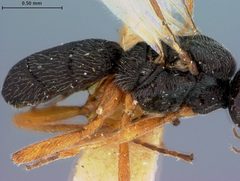
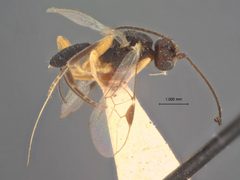
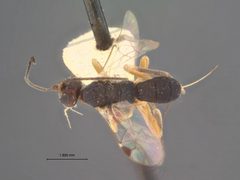
Triaspis is a of in the Braconidae. within this genus are agents that parasitize weevil larvae and , particularly those of agricultural pests. The genus includes species such as T. thoracicus, an egg-larval parasitoid of pea weevils, and T. aequoris, a larval parasitoid of sunflower seed weevils.
Pronunciation
How to pronounce Triaspis: /ˈtraɪ.əs.pɪs/
These audio files are automatically generated. While they are not always 100% accurate, they are a good starting point.
Images
Habitat
Agricultural , particularly fields of legumes and sunflower . Laboratory rearing occurs in controlled environments including jars, bottles, desiccators, crystallizers, and Petri dishes.
Distribution
Western Europe, North America (including North Dakota and South Dakota, USA), Czechoslovakia, Moravia, Transcaucasia, Georgia, and Azerbaijan. T. thoracicus was introduced from the USA to Europe in 1938 for of bruchid pests.
Seasonality
activity occurs primarily in the first half of the day. Peak of T. thoracicus occurs on day 5 after flight initiation.
Host Associations
- Bruchus pisorum - -larval primary ; pea weevil, most dangerous pest of pea crops
- Bruchus atomarius - -larval reported in literature, though polyphagy claims disputed
- Bruchus lentis - -larval reported in literature, though polyphagy claims disputed
- Bruchus rufimanus - -larval reported in literature, though polyphagy claims disputed
- Smicronyx fulvus - larval red sunflower seed weevil; sole reared from cultivated sunflowers in some studies
- Acanthoscelides obtectus - alternative bean weevil; used for laboratory rearing but with low rates
Life Cycle
-larval development spanning two developmental phases. One of T. thoracicus averages 30 days at 28-39°C. emerge from host after approximately 30 days.
Behavior
activity occurs primarily in the first half of the day with no regular pattern in flight dynamics observed. Females can parasitize laid on developing green pods.
Ecological Role
Natural enemy of weevil pests in agricultural systems. Part of a complex (approximately 20 ) regulating pea weevil . Serves as a alternative to chemical in programs.
Human Relevance
Used as a agent against agricultural pests. T. thoracicus was introduced from the USA to Europe in 1938 specifically for bruchid control. Laboratory rearing programs have been developed for mass release, though natural field appear low based on survey data.
Sources and further reading
- BugGuide
- Wikipedia
- iNaturalist taxon
- NCBI Taxonomy
- Catalogue of Life
- Паразит гороховой зерновки Triaspis thoracicus cur. и перспективы его разведения и применения
- Emergence- and DNA-based detection methods show inconsistent effects of planting date on parasitism of red sunflower seed weevil, Smicronyx fulvus LeConte, by Triaspis aequoris Martin
- Parasitization of the Red Sunflower Seed Weevil (Coleoptera: Curculionidae) by its Larval ParasitoidTriaspis aequoris(Hymenoptera: Braconidae) in Cultivated Sunflower
- A new Angolan species from the Triaspis hypericoides complex (Malpighiaceae) based on macromorphology and palynology
- Перспективы разведения и применения Triaspis thoracicus Cur. В контроли численности гороховой зерновки (Bruchus pisorum L.)