
Cucujus
Fabricius, 1775
flat bark beetles
Species Guides
2- Cucujus clavipes(Red Flat Bark Beetle)
- Cucujus puniceus(Red Flat Bark Beetle)
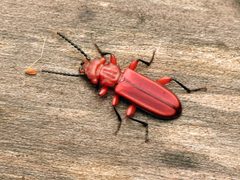
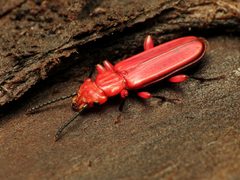
Cucujus is a of flat bark beetles in the Cucujidae, containing approximately 25 recognized distributed across the Holarctic region. Species are dorso-ventrally compressed, brightly colored in red or red-and-black patterns, and range from 6–25 mm in length. The genus is most diverse in Asia, with species in North America, Europe, and Asia. Several species, notably C. cinnaberinus and C. clavipes, have been subjects of ecological and physiological research due to their conservation status and extreme cold adaptations.
Pronunciation
How to pronounce Cucujus: //kuˈkuː.jus//
These audio files are automatically generated. While they are not always 100% accurate, they are a good starting point.
Identification
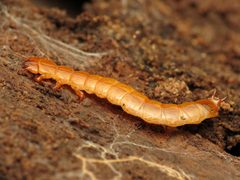
Distinguished from other Cucujidae by the being wider than the pronotum with prominent temples, and by male genitalia that are elongate, inverted, and possess a . The combination of bright red or red-and-black coloration with strongly flattened body form is characteristic. Larvae share the dorso-ventrally compressed body shape of .
Images
Habitat
All life stages occur under dead bark of trees. In Europe, C. cinnaberinus prefers dead wood with well-peeled bark at intermediate decay stages with sufficient sun exposure at the tree level. C. clavipes puniceus in western North America occurs in forested areas at elevations up to 2300 m, while C. clavipes clavipes in eastern North America is more opportunistic, found in various forests as well as urban and agricultural areas with tree vegetation below 500 m elevation. Associated with broadleaved trees including Populus, Fraxinus, and Alnus; C. haematodes in far eastern Russia predominantly occurs in broadleaved trees at lower altitudes.
Distribution
Holarctic distribution with in North America, Europe, and Asia; most diverse in Asia. C. cinnaberinus occurs across Europe with strongholds in the Carpathians and Białowieża Forest. C. clavipes occurs throughout North America with two : C. c. clavipes in eastern regions and C. c. puniceus in western regions, with non-overlapping ranges. C. haematodes has Eurasian distribution with strong in the Primorskiy Region of far eastern Russia.
Seasonality
activity patterns differ between : C. clavipes clavipes and C. clavipes puniceus show distinct phenological differences across their non-overlapping ranges. Larvae of C. cinnaberinus observed in May, August, and September in Romania.
Life Cycle
All life stages live under dead bark. Larvae are dorso-ventrally compressed and develop in the cambial layer of dead trees. Specific developmental details unknown for most .
Ecological Role
Predatory; apparently predacious on other insects in the cambial layer, though direct evidence is limited. C. cinnaberinus microhabitats are -rich and shared with other threatened saproxylic beetles including Boros schneideri, Pytho kolwensis, Cardiophorus nigerrimus, and Dendrophagus crenatus. Associated species at microhabitat level include springtails (Collembola), mites (Acarina), ants (Formicidae), histerids (Histeridae), and carabids (Carabidae).
Human Relevance
C. cinnaberinus is protected under EU Council Directive 92/43/EEC (Annexes II and IV) and the Bern Convention (Annex II), assessed as Near Threatened by IUCN. Subject of citizen science monitoring programs. C. clavipes puniceus studied for natural antifreeze compounds and extreme cold (surviving to –100°C through vitrification), with potential applications in cryobiology. Climate change poses significant threat: projected loss of 47–70% of suitable for C. clavipes within decades.
Similar Taxa
- SilvanidaeSimilar flattened body form and saproxylic habits; distinguished by width relative to pronotum and male genitalia structure in Cucujus
- Parandra (Cerambycidae)Superficially similar reddish coloration and elongate form; distinguished by Cucujus having dorso-ventrally compressed body and different antennal structure
Sources and further reading
- BugGuide
- Wikipedia
- GBIF taxonomy match
- iNaturalist taxon
- NCBI Taxonomy
- Catalogue of Life
- ID Challenge #23 | Beetles In The Bush
- Habitatrichtlijnsoort Vermiljoenkever (Cucujus cinnaberinus) als nieuwe soort in Vlaanderen
- CUCUJUS CINNABERINUS (SCOPOLI, 1774) (COLEOPTERA: CUCUJIDAE) IN ROSCI0045 CORIDORUL JIULUI, ROMANIA
- New data on the distribution of Cucujus cinnaberinus in western Romania
- Ecological requirements of a rare saproxylic beetle Cucujus haematodes- the beetles’ stronghold on the edge of its distribution area
- Possible factors influencing the distribution of a threatened saproxylic beetle Cucujus cinnaberinus (Scopoli 1763) (Coleoptera: Cucujidae)
- Saproxylic beetle thrives on the openness in management: a case study on the ecological requirements of Cucujus cinnaberinus from Central Europe
- MANDIBULAR STRUCTURE AND FEEDING HABITS OF THREE MORPHOLOGICALLY SIMILAR COLEOPTEROUS LARVAE: CUCUJUS CLAVIPES (CUCUJIDAE), DENDROIDES CANADENSIS (PYROCHROIDAE), AND PYTHO DEPRESSUS (SALPINGIDAE)
- Habitat preferences influencing populations, distribution and conservation of the endangered saproxylic beetle Cucujus cinnaberinus (Coleoptera: Cucujidae) at the landscape level
- Cucujus cinnaberinus (Scopoli, 1763) at its terra typica in Slovenia: historical overview, distribution patterns and habitat selection
- Correction to: Large-scale habitat model reveals a key role of large trees and protected areas in the metapopulation survival of the saproxylic specialist Cucujus cinnaberinus
- Deep supercooling, vitrification and limited survival to –100°C in the Alaskan beetleCucujus clavipes puniceus(Coleoptera: Cucujidae) larvae
- Ecological requirements of a rare saproxylic beetle Cucujus haematodes – the beetles’ stronghold on the edge of its distribution area
- From Phenology and Habitat Preferences to Climate Change: Importance of Citizen Science in Studying Insect Ecology in the Continental Scale with American Red Flat Bark Beetle, Cucujus clavipes, as a Model Species
- Large-scale habitat model reveals a key role of large trees and protected areas in the metapopulation survival of the saproxylic specialist Cucujus cinnaberinus