
Cucujus clavipes
Fabricius, 1781
Red Flat Bark Beetle, Flat Bark Beetle
Cucujus clavipes, the red , is a saproxylic distributed across North America with two recognized : C. c. clavipes in the east and C. c. puniceus in the west. The is notable for extreme cold , particularly in the western subspecies whose larvae can survive temperatures down to -100°C through deep supercooling and vitrification. are active primarily in spring and summer and are found under bark of dead hardwood trees.
Pronunciation
How to pronounce Cucujus clavipes: //kʊˈkuːdʒəs ˈklævɪˌpiːz//
These audio files are automatically generated. While they are not always 100% accurate, they are a good starting point.
Identification
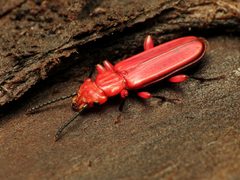
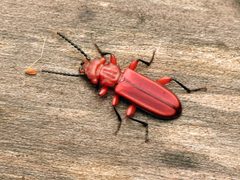
Distinguished from other flat bark beetles by its bright red coloration combined with black and triangular . The strongly flattened, parallel-sided body form is characteristic of the Cucujus. C. c. clavipes (eastern) and C. c. puniceus (western) are and differ in elevation preferences and , but require examination of subtle morphological or genetic characters for definitive identification.
Images
Appearance
measure 10–14 mm in length. Body is strongly dorsoventrally flattened with parallel sides, an for living in narrow spaces under bark. has 5 visible segments with a strongly forked process at the apex. Coloration is bright or dull red. is triangular in shape. are black.
Habitat
Saproxylic; found under bark of dead hardwood trees, particularly poplar (Populus) and ash (Fraxinus). clavipes occurs below 500 m elevation in diverse forests, urban areas, and agricultural settings with tree vegetation. Subspecies puniceus occurs mainly in forested areas up to 2300 m elevation in western North America.
Distribution
North America, from North Carolina (~35°N) to Alaska (Brooks Range, ~67°30'N). Two : C. c. clavipes in eastern North America and C. c. puniceus in western North America. Recorded in Canada (Alberta, Ontario) and throughout the United States. Ranges do not overlap.
Seasonality
active primarily during spring and summer months. differs between , with C. c. clavipes showing more extended activity periods. occurs as larvae.
Diet
Life Cycle
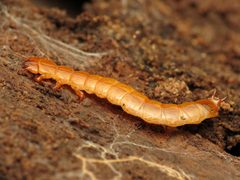
Larval stage is the primary stage. Larvae inhabit the cambial layer beneath bark of decaying hardwood logs. Development includes , larval, pupal, and stages; specific duration not documented.
Behavior
and larvae are adapted for movement in narrow spaces under bark due to dorsoventrally depressed body form. Western larvae undergo extreme dehydration and accumulate glycerol (4–6 mol l⁻¹) and antifreeze proteins as winter approaches. Can switch between freeze-avoidance and freeze- strategies in different years based on prior physiological state.
Ecological Role
Saproxylic contributing to decomposition of dead wood. Co-occurs with diverse of other saproxylic species. Potential biological indicator for monitoring changes in forest fauna and saproxylic insect communities, particularly given projected loss from climate change.
Human Relevance
Subject of physiological research due to extreme cold mechanisms. Used as a model for citizen science studies of insect at continental . No direct economic importance documented.
Similar Taxa
- Dendroides canadensisLarvae share similar dorsoventrally flattened body form and under bark of decaying wood; distinguished by -level characters and preferences (Dendroides often associated with different decay stages)
- Pytho depressusSimilar larval body form and ; distinguished by occurrence under bark of dead conifers (especially pine) rather than hardwoods, and -level morphological characters
More Details
Cold tolerance mechanisms
C. c. puniceus larvae are among the most cold-tolerant arthropods known. They achieve survival to -100°C through deep supercooling, extreme dehydration (body water reduced from ~2.0 to ~0.4 mg mg⁻¹ dry mass), accumulation of glycerol, production of antifreeze proteins and antifreeze glycolipids, gut purging to remove ice nucleators, and vitrification (glass formation) below -58°C. Antifreeze proteins can depress the hysteretic freezing point by up to 13°C in winter.
Taxonomic uncertainty
The two show consistent differences in , physiology, , and preferences with completely distributions. Authors have suggested they may represent distinct requiring molecular verification.
Climate change vulnerability
modeling projects potential loss of 47–70% of suitable by 2080–2100 for both under climate warming scenarios, suggesting conservation attention may be warranted despite current unthreatened status.
Sources and further reading
- BugGuide
- Wikipedia
- GBIF taxonomy match
- iNaturalist taxon
- NCBI Taxonomy
- Golden Orbweavers Ignore Biological Rules | Bug Squad
- How one hot spider keeps her cool in the tropics: Golden silk spider, Nephila clavipes — Bug of the Week
- Terrifying big spiders soon in the DMV? Meet the Jorō Spider, Trichonephila clavata, and its cousin the Golden Silk Spider, Trichonephila clavipes — Bug of the Week
- Is the Jorō spider coming to your neighborhood? Trichonephila clavata — Bug of the Week
- Jorō spiders enjoy their new home in the DMV: Jorō spider, Trichonephila clavata — Bug of the Week
- Destination: Eastern North America to revisit Jorō spiders, Trichonephila clavata, spreading in their new home in the United States — Bug of the Week
- Deep supercooling, vitrification and limited survival to –100°C in the Alaskan beetleCucujus clavipes puniceus(Coleoptera: Cucujidae) larvae
- MANDIBULAR STRUCTURE AND FEEDING HABITS OF THREE MORPHOLOGICALLY SIMILAR COLEOPTEROUS LARVAE: CUCUJUS CLAVIPES (CUCUJIDAE), DENDROIDES CANADENSIS (PYROCHROIDAE), AND PYTHO DEPRESSUS (SALPINGIDAE)
- From Phenology and Habitat Preferences to Climate Change: Importance of Citizen Science in Studying Insect Ecology in the Continental Scale with American Red Flat Bark Beetle, Cucujus clavipes, as a Model Species