
Dendroides canadensis
Latreille, 1810
fire-colored beetle, Canada Fire-colored Beetle
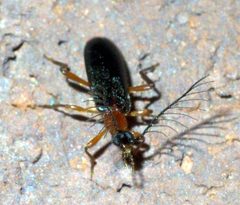
Dendroides canadensis, commonly known as the fire-colored beetle or Canada Fire-colored Beetle, is a in the Pyrochroidae. range from 7 to 16 mm in length and display distinctive coloration with black and contrasting with reddish-brown and legs. The species is notable for having both freezing and freezing susceptibility (supercooling) adaptations, representing the first documented instance of by switching between these two mechanisms. Larvae inhabit the cambial layer under bark of decaying hardwood logs.


Pronunciation
How to pronounce Dendroides canadensis: /dɛnˈdrɔɪdiːz ˌkænəˈdɛnsɪs/
These audio files are automatically generated. While they are not always 100% accurate, they are a good starting point.
Identification
Distinguished from similar by the combination of black with reddish-brown and legs, plus pectinate . Large that are contiguous in males help separate from related . Larvae identified by straight (non-recurved) urogomphi and association with decaying hardwood (not conifer) bark. May be confused with Cucujus clavipes or Pytho depressus larvae, but the latter occurs under conifer bark rather than hardwood.
Images
Habitat
are found among foliage and are attracted to lights at night. Larvae inhabit the cambial layer under bark of upper and side surfaces of fallen hardwood trees and branches, where partially decomposed wood and bark accumulate from activity of other small .
Distribution
Eastern North America, from Manitoba and Nova Scotia in Canada south to Oklahoma and Florida in the United States. Canadian records include Manitoba, New Brunswick, Nova Scotia, Ontario, and Prince Edward Island.
Seasonality
are active at night and attracted to lights. Specific seasonal activity periods not documented in available sources.
Life Cycle
Larvae live under bark of decaying hardwood logs. In response to decreasing autumn temperatures, larvae cease feeding and drinking, evacuate the gut, and increase antifreeze proteins in the hind-gut and primary urine to prepare for .
Behavior
are and attracted to lights. Larvae switch between two distinct mechanisms: freezing (keeping body fluids above crystallization at −8 to −12°C) and freezing susceptibility (supercooling, surviving with ice in body up to −26°C). This seasonal plasticity in cold hardiness strategy is unique among documented insects.
Ecological Role
Larvae occupy the cambial layer of decaying hardwood, contributing to decomposition processes in dead wood . Traditional literature describes the as predacious on other insects in this microhabitat, though this has not been verified by specific original studies.
Human Relevance
Antifreeze proteins from this have been studied for potential applications in enhancing cold resistance in plants. The species' unique dual strategy has made it a subject of physiological research.
Similar Taxa
- Cucujus clavipesLarvae share similar dorsoventrally depressed body form and occur in decaying wood , but are found under bark of both hardwood and softwood; mandibular structure and specific habitat preferences differ.
- Pytho depressusLarvae have similar body form but are found under bark of dead conifers (especially pine) rather than hardwood; geographic range and associations differ.
Misconceptions
Long-standing entomological literature describes Dendroides as predacious on other insects in the cambial layer, but no specific original studies have demonstrated this feeding ; actual diet remains unverified.
More Details
Antifreeze biochemistry
Antifreeze molecules are similar to those of Tenebrio molitor but distinct from any known fish antifreeze proteins. Multiple types of antifreeze are used simultaneously, complementing each other to enhance cold protection.
Research significance
This was the first documented case of an insect switching between freezing and supercooling strategies for , challenging assumptions that insects use only one cold-hardiness mechanism.
Sources and further reading
- BugGuide
- Wikipedia
- GBIF taxonomy match
- iNaturalist taxon
- NCBI Taxonomy
- Bug Eric: Spider Sunday: Red Velvet Jumper
- Bug Eric: True Bug Tuesday: Mirid plant bug
- Snake Road | Beetles In The Bush
- Melanthiaceae | Beetles In The Bush
- Vampire Moths Suck the Blood of Vertebrates, Including Humans
- MANDIBULAR STRUCTURE AND FEEDING HABITS OF THREE MORPHOLOGICALLY SIMILAR COLEOPTEROUS LARVAE: CUCUJUS CLAVIPES (CUCUJIDAE), DENDROIDES CANADENSIS (PYROCHROIDAE), AND PYTHO DEPRESSUS (SALPINGIDAE)