
Cucujus puniceus
Mannerheim, 1843
Red Flat Bark Beetle
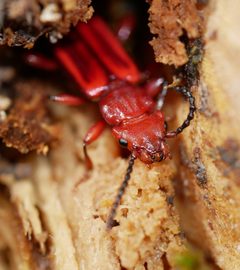
Cucujus puniceus is a of in the Cucujidae, distributed across northern North America. The species has been extensively studied for its exceptional cold mechanisms. Larvae survive winter temperatures through deep supercooling and vitrification, with documented survival to at least –100°C. The species is treated as a synonym of Cucujus clavipes by some authorities, or as a distinct species or by others.
Identification
May be confused with Cucujus clavipes; separation requires examination of specific morphological characters not detailed in available sources. The flat, elongate body form is characteristic of the Cucujidae.
Images
Habitat
Overwinters beneath the bark of fallen trees; microhabitat insulation varies with snow cover.
Distribution
North America: Alaska, Alberta, British Columbia, Manitoba, and adjacent northern regions.
Seasonality
Active in summer with high body water content (~2.0 mg mg⁻¹ dry mass); winter survival involves dehydration and cryoprotectant accumulation.
Life Cycle
Larval stage has been studied for cold ; larvae accumulate glycerol (4–6 mol l⁻¹) and thermal hysteresis proteins in preparation for winter.
Behavior
Larvae exhibit deep supercooling with mean supercooling points of –35 to –42°C in winter; some individuals achieve supercooling points as low as –58°C. At temperatures below –58°C, larvae undergo vitrification, transitioning to a glass-like state that prevents freezing to at least –150°C.
Human Relevance
Serves as a model organism for studying extreme cold and vitrification in insects; has potential applications for understanding cryopreservation.
Similar Taxa
- Cucujus clavipesClosely related and sometimes treated as ; C. puniceus has been treated as a (C. c. puniceus) or synonym.
- Parandra politaSuperficially similar in general body form to observers unfamiliar with Cucujidae; belongs to Cerambycidae and lacks the extreme cold of C. puniceus.
Misconceptions
Some sources treat C. puniceus as a synonym of C. clavipes, while others recognize it as a distinct or ; this taxonomic uncertainty reflects ongoing revision in the group.
More Details
Cold tolerance mechanisms
Larvae lose body water from summer highs near 2.0 mg mg⁻¹ dry mass to winter lows near 0.4 mg mg⁻¹ dry mass, accompanied by glycerol accumulation and thermal hysteresis production. Vitrification represents a novel strategy among insects.