
Lilioceris
Reitter, 1912
lily leaf beetles, air potato leaf beetles
Species Guides
2- Lilioceris cheni(air potato leaf beetle)
- Lilioceris lilii(lily leaf beetle)
Lilioceris is a of leaf beetles (Chrysomelidae) in the Criocerinae, first described by Edmund Reitter in 1912. The genus contains over 100 , with approximately 80 species occurring in Asia. Several species are notable agricultural and horticultural pests, particularly of plants in the lily (Liliaceae). Lilioceris lilii (lily ) is a serious pest of native and cultivated lilies in Europe and North America, while L. cheni has been successfully deployed as a agent against the air potato vine (Dioscorea bulbifera) in Florida. Species range from 4–10 mm in length with elongated, narrow bodies and distinct shoulders between the and pronotum.
Pronunciation
How to pronounce Lilioceris: //ˌlɪliˈoʊsɛrɪs//
These audio files are automatically generated. While they are not always 100% accurate, they are a good starting point.
Identification
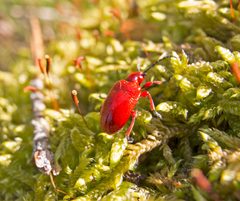
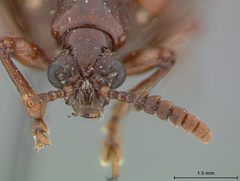
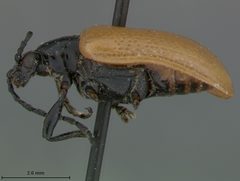
Lilioceris are 4–10 mm long with elongated, narrow bodies and a pronounced shoulder between the and pronotum. of some economically important species display bright aposematic coloration: L. lilii is scarlet red, while L. cheni has red and black patterning. Larvae carry distinctive fecal shields on their backs—a trait visible in L. lilii and L. cheni. The can be distinguished from related criocerine genera by body proportions and antennal structure, though species-level identification requires examination of genitalia.
Images
Distribution
The has its highest diversity in Asia, with approximately 80 . L. lilii is native to Asia and occurs throughout Eurasia from Siberia to Morocco and from the United Kingdom to China; it is in North America (eastern Canada and New England). L. cheni is native to Nepal and China and has been introduced to Florida for .
Host Associations
Life Cycle
Behavior
Larvae of L. lilii and L. cheni carry fecal shields on their backs, likely as a defensive against . L. cheni and larvae are voracious feeders, converting leaf tissue into and creating ragged holes in leaves. The bright red and black coloration of L. cheni adults is aposematic, warning predators of potential unpalatability due to host plant toxins.
Ecological Role
Some Lilioceris function as significant herbivores and agricultural pests. In their native ranges, they are subject to regulation by . L. cheni has been successfully employed as a agent, reducing bulbil production and vine of air potato in Florida.
Human Relevance
L. lilii is a serious pest of ornamental lilies, causing complete defoliation of plants. L. cheni was introduced to Florida in 2011 as a agent for air potato; over 400,000 beetles were released by 2015, with documented reductions in plant . The Florida Department of Agriculture mass-rears L. cheni for ongoing distribution.
Similar Taxa
- CriocerisBoth are criocerine leaf beetles with similar body shapes; Crioceris typically have different color patterns and associations (asparagus)
- LemaRelated criocerine with some feeding on monocots; Lema species often have more rounded bodies and different antennal proportions
Sources and further reading
- BugGuide
- Wikipedia
- GBIF taxonomy match
- iNaturalist taxon
- NCBI Taxonomy
- Destination Sanibel Island, Florida – Taking down air potato: Air Potato Leaf Beetle, 'Lilioceris cheni' — Bug of the Week
- Save wildlife - close the UK borders to plants - Buglife Blog - Buglife
- How One Entomologist Found Her Calling in Crop Protection
- Archive — Bug of the Week
- Lilioceris lilii . [Distribution map].
- First record of Lilioceris lilii in Greece
- European parasitoids ofLilioceris lilii(Coleoptera: Chrysomelidae)
- Advancements in Mass Rearing the Air Potato Beetle Lilioceris cheni
- Biology of Lilioceris spp. (Coleoptera: Chrysomelidae) and their parasitoids in Europe
- Host plants, biology and chemical ecology of the introduced lily leaf beetle, Lilioceris lilii (scopoli) (coleoptera: chrysomelidae)
- Introduction and Establishment of Three Parasitoids of the Lily Leaf Beetle, Lilioceris lilii, (Coleoptera: Chrysomelidae) in North America