
Lilioceris cheni
Gressitt & Kimoto, 1961
air potato leaf beetle
Lilioceris cheni is a leaf-feeding beetle in the Chrysomelidae, native to China and Nepal. It was introduced to Florida in 2012 as a agent to combat the air potato vine (Dioscorea bulbifera). The has established successfully and is now widely distributed across the southern United States. Mass rearing programs produce over 50,000 beetles annually for release. Both larvae and feed on air potato foliage, causing significant damage that reduces vine and bulbil production.
Pronunciation
How to pronounce Lilioceris cheni: //ˌlɪli.oʊˈsɪərɪs ˈkiːnaɪ//
These audio files are automatically generated. While they are not always 100% accurate, they are a good starting point.
Identification
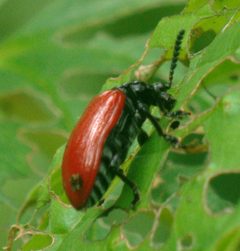
The bright red with black legs and separate this from most other North American leaf beetles. Within its introduced range in the southeastern United States, no other shares this specific color pattern and association with air potato vine. The related Lilioceris lilii (lily beetle) has similar red coloration but is found on true lilies (Lilium) in more northern regions and has a different body shape.
Images
Habitat
In its native range, associated with Dioscorea in forested and disturbed . In the introduced range, found wherever air potato vine invades, including natural areas, disturbed sites, roadsides, and urban green spaces. Mass rearing occurs in greenhouse, screenhouse, and outdoor facilities with potted air potato plants.
Distribution
Native to China and Nepal. Introduced and established in Florida, Georgia, Alabama, Mississippi, Louisiana, Texas, and Hawaii in the United States. Released at nearly 7,000 sites across these states between 2014 and 2021.
Seasonality
are active year-round in subtropical Florida, with peak activity during warmer months. In temperate parts of the introduced range, activity is limited to the growing season. The complete spans approximately 28 days under favorable conditions.
Diet
Highly specialized feeder on Dioscorea . Dioscorea bulbifera (air potato) is the preferred . feed on fresh leaves and can survive on bulbils but with reduced lifespan. Larvae require fresh air potato vine leaves for development and cannot survive on artificial diet alone. No successful development or occurs on 73 non-Dioscorea plant species tested.
Host Associations
- Dioscorea bulbifera - primary air potato vine; preferred for all life stages
- Dioscorea oppositifolia - secondary limited feeding, no successful
- Dioscorea alata - secondary limited feeding, no successful
- Dioscorea japonica - secondary limited feeding, no successful
- Dioscorea pentaphylla - secondary limited feeding, no successful
Life Cycle
Holometabolous development with complete . hatch in approximately 4 days. Four larval instars last about 8 days total. Larvae drop from plants to pupate in soil, secreting a whitish foamy substance that hardens into a protective cocoon. Pupal stage lasts approximately 14 days. emerge and can live over 5 months under field conditions, up to 1 year in laboratory. Adults require approximately 10 days post- before mating begins.
Behavior
bite leaf , causing leaves to cup—females preferentially lay in these cupped areas. Larvae exhibit a distinctive defensive of accumulating and carrying excrement on their backs, presumably to deter . Adults can survive starvation for several days to two weeks depending on prior nutritional status, allowing for distribution and short-term survival post-release.
Ecological Role
agent that reduces of air potato vine, thereby protecting native plant from displacement. The is considered a cost-effective management alternative to chemical and mechanical control methods. High specificity minimizes risk to non-target native and agricultural plants.
Human Relevance
Intentionally introduced and mass-reared for of air potato vine in the southern United States. The Florida Department of Agriculture and Consumer Services Division of Plant Industry produces and releases over 50,000 beetles annually. Considered a success story in , with documented reductions in air potato vine and bulbil production at release sites.
Similar Taxa
- Lilioceris liliiSimilar red coloration and body form, but found on true lilies (Lilium) rather than air potato, with more northern distribution in North America
- Lilioceris egenaRelated also evaluated for air potato biocontrol, introduced from Nepal and China; females lay on tubers rather than leaves
More Details
Biotypes
Two distinct were collected: Chinese (2011) and Nepalese (2002). Both were released in Florida in 2012.
Mass Rearing
From 2014–2021, 407,554 beetles were produced and 366,384 released at nearly 7,000 sites across six states.
Egg Production
Females can lay more than 1,200 in their lifetime, with some sources reporting up to 1,900 eggs over a 5-month lifespan.
Sources and further reading
- BugGuide
- Wikipedia
- GBIF taxonomy match
- iNaturalist taxon
- NCBI Taxonomy
- Bug Squad
- Pipe Cleaner Caterpillars | Bug Squad
- Destination Sanibel Island, Florida – Taking down air potato: Air Potato Leaf Beetle, 'Lilioceris cheni' — Bug of the Week
- Archive — Bug of the Week
- Save wildlife - close the UK borders to plants - Buglife Blog - Buglife
- Teach a Man to Fish (and some entomology) and You’ll Feed Him for a Lifetime
- Advancements in Mass Rearing the Air Potato Beetle Lilioceris cheni
- Air Potato Leaf Beetle (Suggested Common Name), Lilioceris cheni Gressitt and Kimoto (Insecta: Coleoptera: Chrysomelidae: Criocerinae)
- Ecological host-range of Lilioceris cheni (Coleoptera: Chrysomelidae), a biological control agent of Dioscorea bulbifera
- Host range validation, molecular identification and release and establishment of a Chinese biotype of the Asian leaf beetleLilioceris cheni(Coleoptera: Chrysomelidae: Criocerinae) for control ofDioscorea bulbiferaL. in the southern United States