
Mecas cana
(Newman, 1840)
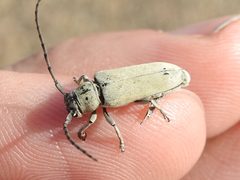
Mecas cana is a longhorn beetle in the Cerambycidae, described by Newman in 1840. The species is distributed across North America, including the United States and Mexico. Two are recognized: Mecas cana cana (the nominate subspecies) and Mecas cana saturnina (LeConte, 1859). Like other members of the Mecas, this species is associated with plants in the sunflower family (Asteraceae), where larvae bore into stems and roots.
Pronunciation
How to pronounce Mecas cana: /ˈmɛkəs ˈkanə/
These audio files are automatically generated. While they are not always 100% accurate, they are a good starting point.
Identification
Mecas cana can be distinguished from other Mecas by its gray and geographic distribution. Mecas pergrata, another species associated with Asteraceae, may occur in similar but differs in details of coloration and body proportions. Mecas femoralis, a Florida , is restricted to that region. Accurate identification to level requires examination of genitalia or comparison with . Larvae are white, legless, and reach approximately 1 inch (25 mm) at maturity, with a small brown capsule; they cannot be reliably distinguished from other Mecas species without molecular analysis or rearing to adulthood.
Images
Habitat
Found in open supporting plants in the sunflower (Asteraceae), including prairies, meadows, roadsides, and agricultural fields. have been observed on grasses and low vegetation. The is associated with both native and cultivated sunflowers (Helianthus spp.) and related plants.
Distribution
North America: United States and Mexico. The nominate Mecas cana cana and Mecas cana saturnina have overlapping or adjacent ranges, though precise distributions of each subspecies require further documentation.
Seasonality
are active during the growing season, with peak activity coinciding with flowering of plants. In Texas and surrounding regions, this corresponds to late spring through summer. Larvae overwinter in host plant stems or roots and pupate the following year, with adult typically in early to mid-summer.
Diet
Larvae feed internally on the pith of stems and roots of plants in the sunflower (Asteraceae), including sunflowers (Helianthus spp.). feed on foliage, pollen, and nectar of plants and possibly other vegetation.
Host Associations
- Helianthus annuus - larval Cultivated sunflower; larvae bore in stems and roots
- Helianthus spp. - larval Native sunflower
- Asteraceae - larval -level association; specific wild plants poorly documented
Life Cycle
One per year. emerge in early to mid-summer and feed on plant foliage, pollen, and nectar. Females deposit beneath the stem surface, typically above a girdle they create about one-third of the way down the stalk. Larvae hatch and initially feed in the petiole or upper stem, then bore downward through the pith to the base of the plant. At the base, larvae girdle the stem internally before moving below the girdle to create an chamber. occurs in this chamber in late spring or early summer, with adults emerging shortly thereafter. The girdling causes the upper portion of the stalk to die and eventually fall to the ground.
Behavior
females exhibit distinctive girdling , chewing two encircling cuts through the stem about one-third of the distance from the top. This girdling kills the upper stem and causes it to fall, with the larva developing in the fallen portion. Adults are relatively sedentary when disturbed compared to some other cerambycids, though they will take if handled carelessly. Activity patterns suggest or tendencies, with adults sometimes found resting on vegetation during daylight hours.
Ecological Role
As a stem-borer, Mecas cana contributes to nutrient cycling by breaking down plant and creating entry points for decomposers. The girdling accelerates the return of above-ground plant material to the soil surface. In natural , levels are typically low and damage is inconsequential. In agricultural settings, particularly sunflower , the can act as a pest by reducing yield through stalk lodging and direct damage to developing seeds.
Human Relevance
Considered an occasional pest of cultivated sunflowers in Texas and surrounding regions. Larval tunneling weakens stalks, predisposing plants to lodging (falling over), which complicates harvest and reduces yield. The is mentioned in agricultural extension publications as one of several longhorn beetles (girdlers) affecting sunflower production. Management recommendations include destroying to reduce larvae and avoiding continuous sunflower planting or with soybeans (which the related pest Dectes texanus). No specific recommendations exist for Mecas cana; general management for cerambycid stem borers applies.
Similar Taxa
- Mecas pergrataAlso associated with Asteraceae and similar in size and general appearance; differs in details of coloration, pattern, and geographic distribution
- Mecas femoralisFlorida with more restricted range; similar but geographically isolated
- Dectes texanusAnother cerambycid stem borer of sunflowers and soybeans; are pale gray with longer than the body, and larvae do not create the double-girdle characteristic of Mecas spp.
- Ataxia hubbardiLonghorn beetle also associated with sunflowers; does not girdle stalks and remains active through winter rather than entering dormancy
More Details
Subspecies
Two are recognized: Mecas cana cana (Newman, 1840) and Mecas cana saturnina (LeConte, 1859). The taxonomic distinction between these forms is based on subtle morphological differences, and their biological or ecological differentiation is not well documented.
Research needs
plant specificity, precise geographic ranges of , and economic impact relative to other sunflower pests remain poorly studied. The first documented host plant record for the related Oberea oculaticollis was only recently obtained through field observation, suggesting similar gaps may exist for Mecas cana.