
Dectes texanus
LeConte, 1862
Dectes stem borer, Texas prick, soybean stem borer
Dectes texanus is a native North American longhorn beetle (Cerambycidae: Lamiinae) that has emerged as a significant agricultural pest of soybeans and sunflowers in the Midwestern and Great Plains regions of the United States. are characterized by longer than their bodies and a pale gray coloration. Larvae tunnel inside plant stems from July through October, then girdle the stem base internally before , causing pre-harvest lodging and yield losses. The has expanded its range and pest status dramatically since the 1980s, correlating with increased soybean acreage and adoption of no-till farming practices. Originally associated with wild including ragweed and cocklebur, it colonized cultivated soybeans approximately 50 years ago.
Pronunciation
How to pronounce Dectes texanus: /ˈdɛk.tiːz tɛkˈseɪ.nəs/
These audio files are automatically generated. While they are not always 100% accurate, they are a good starting point.
Identification
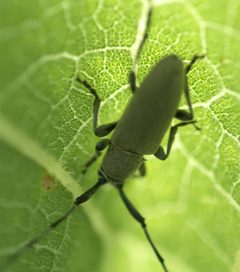
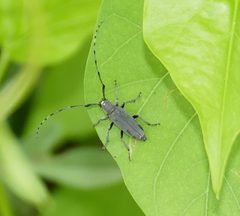
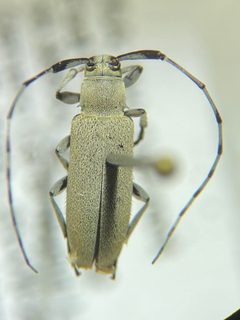
are pale gray beetles approximately 9–10 mm in length with distinctly longer than the body. The is only slightly protruding, with a relatively large lower lobe of the —features that distinguish it from the Dectes sayi, which has a more protruding face and smaller lower eye lobe creating an impression of "tall cheeks." Larvae are legless, -like, with a small brown and abdominal segments resembling an accordion; fully grown larvae reach 12–16 mm.
Images
Habitat
Agricultural fields, particularly soybean and sunflower crops; also found in areas with wild plants including ragweed, cocklebur, and wild sunflower. Overwinters in the bases of host plant stalks below the soil line.
Distribution
Native to eastern North America; established in at least 14 states. In Kansas, documented in 64 counties as of 2008 with range expansion from 5 counties in 1985. Highest occur in southwest and north-central Kansas; notably sparse in eastern Kansas despite extensive soybean acreage. Also present in Missouri, western Tennessee, Mississippi, Arkansas, and Texas.
Seasonality
Single per year. emerge late June through July, with extended period lasting through the growing season. laid in leaf petioles; larvae tunnel and feed July through October. Larvae girdle stems and overwinter from October through May, pupating May to June.
Diet
Larvae feed internally on pith of plant petioles and stems. feed on of newly expanded plant tissue.
Host Associations
- Glycine max - larval (primary crop host)soybean
- Helianthus annuus - larval (primary crop host)cultivated sunflower
- Helianthus spp. - larval wild sunflower
- Ambrosia artemisiifolia - larval common ragweed
- Xanthium spp. - larval cocklebur
Life Cycle
Single annually: inserted into pith of leaf petioles, hatching in a few days; larvae tunnel down petioles into main stems, feeding up and down the pith from late July through October; mature larvae girdle the stem internally at or just above ground level (1–2 inches), then move below the girdle to pack around themselves and overwinter; occurs May to June in the soil or plant base; emerge late June through July, living several weeks.
Behavior
Larvae exhibit cryptic , spending most of their time tunneling inside plant stems. Mature larvae girdle stems internally before , causing lodging. are reasonably strong fliers capable of infesting fields within several miles but do not undergo long-distance ; they are weak fliers relative to some cerambycids. Courtship behavior involves male of females, with evidence for a female contact .
Ecological Role
Agricultural pest causing economic damage through stem lodging and yield reduction. Some research suggests 10–15% yield reduction from tunneling activity alone. Serves as for flies including Zelia tricolor (Tachinidae).
Human Relevance
Significant economic pest of soybean and sunflower production in the Great Plains and Midwest. Management relies on cultural practices: early harvest to avoid lodging losses, fall tillage to reduce , destruction of crop stubble, crop , and weed control to eliminate alternate . No-till farming increases overwintering survival. Chemical control is not recommended due to cryptic larval habit; no elite soybean cultivars currently available though QTL for resistance have been identified.
Similar Taxa
- Dectes sayiCongeneric also found in soybeans; distinguished by more protruding , smaller lower lobe, and preference for common ragweed over soybean
- Ataxia hubbardiAnother cerambycid stem-borer in sunflowers; larvae remain active through winter without girdling, do not cause significant damage
- Mecas spp.Longhorn beetles that girdle sunflower stems; larger (approximately 12 mm), gray, with different girdling pattern (two girdles about one-third down stalk)
More Details
Population expansion
The has shown dramatic increase and range expansion since the 1980s. In Kansas, fields with >50% plants infested rose from 4% (1999) to 11% (2008). This correlates with expanded soybean acreage, increased no-till farming, and possibly climate factors.
Host plant resistance
Wild Helianthus annuus shows substantial resistance to oviposition due to higher resin content, lower succulence, and tougher . These antixenotic properties have been inadvertently diminished in cultivated sunflower breeding.
Transcriptomic adaptations
Larvae feeding on soybean upregulate genes involved in oxidoreductase activity, polygalacturonase activity, P450s, and carboxylesterases—suggesting enhanced detoxification and -wall digestion capabilities compared to larvae on primary .
Genomic resources
GWAS studies have identified 3 QTL for reduced larval and 4 QTL for reduced girdled stems in soybean, with effects of 1–9% reduction, offering potential for breeding cultivars.
Sources and further reading
- BugGuide
- Wikipedia
- GBIF taxonomy match
- iNaturalist taxon
- NCBI Taxonomy
- Catalogue of Life
- Soybean Insects: Mid-to-Late Season Pests (V8 to Maturity) - AgriLife Extension Entomology
- Managing Insect Pests of Texas Sunflowers - AgriLife Extension Entomology
- longhorned beetles | Beetles In The Bush | Page 10
- Bug Eric: More Insects From Sunflowers
- Bibliography | Beetles In The Bush
- Dectes texanus LeConte
- Biology in Missouri of Dectes texanus,1 a New Pest of Soybean2
- Pest Status and Distribution of the Stem Borer,Dectes texanus, in Kansas
- The biology and behavior of the longhorned beetle, Dectes texanus on sunflower and soybean
- The biology and behavior of the longhorned beetle, Dectes texanus on sunflower and soybean
- Genomic Markers Associated With Soybean Resistance to the Stem Borer, Dectes texanus (Coleoptera: Cerambycidae)
- Zelia tricolor(Diptera: Tachinidae): First Host Record fromDectes texanus(Coleoptera: Cerambycidae)
- Variation in Fitness of the Longhorned Beetle,Dectes texanus, as a Function of Host Plant
- Courtship Behavior of the Soybean Stem Borer <I>Dectes texanus texanus</I> (Coleoptera: Cerambycidae): Evidence for a Female Contact Sex Pheromone
- Rearing a Weed Cerambycid, Dectes texanus,1 on an Artificial Medium, with Notes on Biology2,3
- The Nutritional Ecology ofDectes texanus(Coleoptera: Cerambycidae): Does Host Choice Affect the Macronutrient Levels in Overwintering Larvae?
- Comparative analyses of transcriptional responses of Dectes texanus LeConte (Coleoptera: Cerambycidae) larvae fed on three different host plants and artificial diet
- The nature of resistance to Dectes texanus (Col., Cerambycidae) in wild sunflower, Helianthus annuus
- Distribution of the Long-Horned Beetle,Dectes texanus,in Soybeans of Missouri, Western Tennessee, Mississippi, and Arkansas
- Plant Spacing and Weed Control Affect Sunflower Stalk Insects and the Girdling Behavior of <I>Dectes texanus</I> (Coleoptera: Cerambycidae)