
Dectes
LeConte, 1852
Dectes stem borer
Species Guides
2- Dectes sayi(Soybean Stem Borer)
- Dectes texanus(Dectes stem borer)
Dectes is a of longhorn beetles ( Cerambycidae, Lamiinae) established by John Lawrence LeConte in 1852. The genus contains three recognized : Dectes nigripilus, Dectes sayi, and Dectes texanus. The most economically significant species is D. texanus, commonly known as the Dectes stem borer or soybean stem borer, which has become an important agricultural pest of soybean and sunflower crops in the central and eastern United States. Larvae tunnel into plant stems and girdle the base before , causing lodging and yield losses. D. sayi is also associated with soybean and sunflower but prefers common ragweed (Ambrosia artemisiifolia) as a primary .
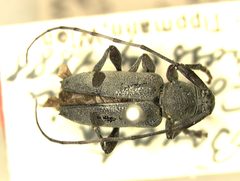
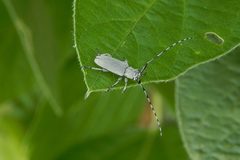
Pronunciation
How to pronounce Dectes: /ˈdɛktɛs/
These audio files are automatically generated. While they are not always 100% accurate, they are a good starting point.
Identification
Dectes are small to medium-sized cerambycid beetles with longer than the body, typical of the Lamiinae. Dectes texanus can be distinguished from the congeneric D. sayi by facial characters: D. texanus has a that is only slightly protruding with a relatively large lower lobe of the , whereas D. sayi has a distinctly more protruding face and a small lower eye lobe that creates the impression of tall cheeks. The is characterized by features of the noted by LeConte in his original description.
Images
Habitat
Agricultural fields, particularly those cultivated with sunflower (Helianthus annuus) and soybean (Glycine max); also associated with wild plants in the Asteraceae including common ragweed (Ambrosia artemisiifolia), giant ragweed, and cocklebur. Larval development occurs within living stems of herbaceous plants.
Distribution
North America, primarily the central and eastern United States. Dectes texanus is distributed across Missouri, western Tennessee, Mississippi, Arkansas, Kansas, Texas, and the upper Mississippi Delta region. The as a whole has a broader North American distribution.
Seasonality
of Dectes texanus emerge in mid-summer (June–July), with an extended period throughout the growing season. Mating occurs shortly after emergence. Larvae feed through late summer and fall, overwinter in the base of stems, and pupate in spring. Adults are long-lived and may persist in fields for an extended period.
Diet
Larvae feed internally on the pith tissue of living plant stems. do not feed significantly on plant tissues; their mouthparts are adapted for minimal feeding if any.
Host Associations
- Helianthus annuus - larval cultivated sunflower; primary agricultural
- Glycine max - larval soybean; colonized approximately 50 years ago, now major agricultural
- Ambrosia artemisiifolia - larval common ragweed; primary for D. sayi, also used by D. texanus
- wild Asteraceae - larval giant ragweed, cocklebur, and other wild
Life Cycle
with larval stage. Females deposit individually in leaf petioles of plants, typically one egg per petiole. Larvae hatch and bore down the petiole into the main stem, feeding on pith tissue. As larvae mature, they tunnel downward to the base of the stalk. Before overwintering, larvae girdle the interior of the stem at or just above ground level, creating a fibrous plug that insulates them for winter. occurs in spring within the stem, followed by . Some larvae may remain in extended .
Behavior
are capable fliers and exhibit -seeking . Females demonstrate oviposition preference for leaf petioles of host plants. Larvae exhibit stem-boring behavior, creating tunnels in pith tissue that reduce structural integrity of host plants. The pre- girdling behavior at the stem base is a distinctive behavioral trait that causes lodging of host plants. Larvae pack fibrous around themselves to form an insulating plug for overwintering.
Ecological Role
Primary consumer (herbivore) in natural , feeding on wild Asteraceae . In agricultural systems, D. texanus functions as a significant pest that reduces yield and quality of sunflower and soybean crops through stem tunneling and pre-harvest lodging. The species has been documented as a for the tachinid Zelia tricolor.
Human Relevance
Dectes texanus is an economically important agricultural pest, particularly in the High Plains and upper Mississippi Delta regions. Yield losses result from both tunneling damage and lodging caused by larval girdling. Management strategies include early harvest to reduce lodging losses, fall tillage to destroy larvae in stubble, crop , and avoidance of no-till or stale seedbed planting that increases overwintering survival. Chemical control is generally not recommended. Research has focused on identifying soybean cultivars with resistance to D. texanus damage.
Similar Taxa
- Dectes sayicongeneric with overlapping use on soybean and sunflower; distinguished by more protruding and small lower lobe
- Mecas spp.other cerambycid stem borers in sunflower ; Mecas also girdle stems but at a different position (about one-third down the stalk) and create two girdles
- Ataxia hubbardilonghorn beetle with similar larval in sunflower stems; does not overwinter in state and does not girdle stalks
More Details
Etymology
The name Dectes derives from the Greek word 'dectes' meaning 'biter,' referring to mandibular characteristics noted by LeConte in his original description. The specific epithet texanus refers to Texas, the type locality.
Host Plant Resistance
Wild sunflower (Helianthus annuus) exhibits substantial resistance to D. texanus oviposition compared to cultivated varieties. This resistance involves a combination of physical and chemical factors: wild sunflower petioles exude more than four times the resinous material when severed, have significantly lower water content (less succulent), and require more force to penetrate the . These antixenotic properties have been inadvertently diminished in breeding of cultivated varieties.
Genomic Research
Transcriptomic studies have identified differentially expressed genes in D. texanus larvae fed on soybean versus primary (sunflower, giant ragweed). Genes up-regulated in soybean-fed larvae include those involved in oxidoreductase and polygalacturonase activities, P450s, carboxylesterases, and glycoside hydrolases, suggesting enhanced detoxification and wall digestion capabilities when feeding on this novel host.
Sources and further reading
- BugGuide
- Wikipedia
- GBIF taxonomy match
- iNaturalist taxon
- NCBI Taxonomy
- Catalogue of Life
- Soybean Insects: Mid-to-Late Season Pests (V8 to Maturity) - AgriLife Extension Entomology
- Managing Insect Pests of Texas Sunflowers - AgriLife Extension Entomology
- longhorned beetles | Beetles In The Bush | Page 10
- Bug Eric: More Insects From Sunflowers
- Bibliography | Beetles In The Bush
- Dectes texanus LeConte
- Biology and Immature Stages of Dectes sayi Dillon and Dillon (Coleoptera: Cerambycidae)
- The biology and behavior of the longhorned beetle, Dectes texanus on sunflower and soybean
- The biology and behavior of the longhorned beetle, Dectes texanus on sunflower and soybean
- Genomic Markers Associated With Soybean Resistance to the Stem Borer, Dectes texanus (Coleoptera: Cerambycidae)
- Variation in Fitness of the Longhorned Beetle,Dectes texanus, as a Function of Host Plant
- The life history of Caurinus dectes Russell, with a description of the immature stages (Mecoptera: Boreidae)
- Zelia tricolor(Diptera: Tachinidae): First Host Record fromDectes texanus(Coleoptera: Cerambycidae)
- Pest Status and Distribution of the Stem Borer,Dectes texanus, in Kansas
- Rearing a Weed Cerambycid, Dectes texanus,1 on an Artificial Medium, with Notes on Biology2,3
- The Nutritional Ecology ofDectes texanus(Coleoptera: Cerambycidae): Does Host Choice Affect the Macronutrient Levels in Overwintering Larvae?
- The nature of resistance to Dectes texanus (Col., Cerambycidae) in wild sunflower, Helianthus annuus
- Biology in Missouri of Dectes texanus,1 a New Pest of Soybean2
- Comparative analyses of transcriptional responses of Dectes texanus LeConte (Coleoptera: Cerambycidae) larvae fed on three different host plants and artificial diet
- Distribution of the Long-Horned Beetle,Dectes texanus,in Soybeans of Missouri, Western Tennessee, Mississippi, and Arkansas