
Dectes sayi
Dillon & Dillon, 1953
Soybean Stem Borer
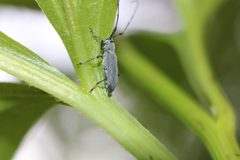
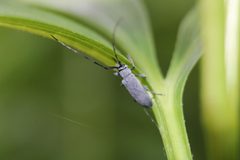
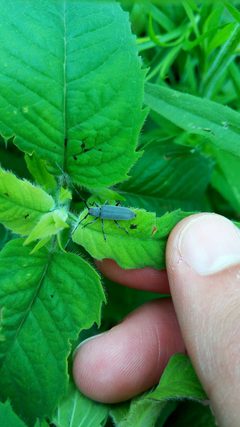
Dectes sayi is a stem-boring longhorn beetle (Cerambycidae: Lamiinae) native to North America. Described by Dillon and Dillon in 1953, this is closely related to the more economically notorious Dectes texanus but is distinguished by morphological features including a more protruding and smaller lower lobe. The larvae are internal feeders within the stems of herbaceous plants, particularly favoring common ragweed (Ambrosia artemisiifolia) over soybean, though it will utilize soybean when available. The species is named in honor of Thomas Say, the 19th-century entomologist regarded as the 'Father of American Entomology.'
Pronunciation
How to pronounce Dectes sayi: //ˈdɛk.teɪs ˈseɪ.aɪ//
These audio files are automatically generated. While they are not always 100% accurate, they are a good starting point.
Identification
Distinguished from the congeneric Dectes texanus by two key facial characters: the is distinctly more protruding, and the lower lobe of the is smaller, creating the impression of 'tall cheeks.' are longhorn beetles with longer than the body. Larvae are legless, -like, with small brown and abdominal segments that resemble an accordion; full-grown larvae reach 1/2 to 5/8 inch in length.
Images
Habitat
Agricultural fields and natural areas supporting herbaceous plants, particularly those in the Asteraceae and Fabaceae . Larvae develop internally within the pith of host plant stems.
Distribution
Broadly distributed across the United States and Canada. GBIF records confirm presence in Manitoba, Ontario, and Québec, Canada, with wider distribution throughout North America.
Seasonality
are active during summer months. Larvae overwinter within girdled plant stems at or near ground level, pupating in spring.
Diet
Larvae feed internally within stems of plants, tunneling through pith tissue. feed on plant tissues including leaf petioles and stems.
Host Associations
- common ragweed - preferred Ambrosia artemisiifolia; this is 'much happier' boring in ragweed than soybean
- soybean - occasional Glycine max; known to bore in stems but less preferred than ragweed
- cocklebur - Xanthium sp.
- sunflower - Helianthus sp.
Life Cycle
Complete . Females lay on or near plants, typically in leaf petioles. Larvae hatch and bore into stems, tunneling downward through the pith to the base of the plant. Mature larvae girdle the inside of the stem at or just above ground level, then move below this girdle to overwinter in an insulated chamber packed with fibrous . occurs in spring, with emerging the following summer.
Behavior
Larval stem-boring involves tunneling through plant pith, causing internal damage without external signs until girdling occurs. Mature larvae exhibit girdling behavior prior to , severing the internal stem structure and predisposing plants to lodging. are weak fliers with localized .
Ecological Role
Native herbivore on wild Asteraceae, primarily common ragweed. Agricultural pest of soybean, though less damaging than Dectes texanus due to stronger preference for alternative .
Human Relevance
Minor agricultural pest of soybean, occasionally causing stem lodging and yield loss. Often confused with the more damaging Dectes texanus. Cultural practices including crop , destruction of , and good weed control (particularly of ragweed) help manage . No chemical control recommendations are currently available; early harvest is the primary management strategy to reduce lodging losses.
Similar Taxa
- Dectes texanusCongeneric with overlapping range and distribution; distinguished by less protruding , larger lower lobe, and greater economic impact on soybean; are pale gray versus the facial structure differences in D. sayi
Misconceptions
Often confused with Dectes texanus and lumped under the 'soybean stem borer,' which properly applies to both . The name 'soybean stem borer' is misleading for D. sayi given its preference for common ragweed over soybean.
Sources and further reading
- BugGuide
- Wikipedia
- GBIF taxonomy match
- iNaturalist taxon
- NCBI Taxonomy
- Catalogue of Life
- Soybean Insects: Mid-to-Late Season Pests (V8 to Maturity) - AgriLife Extension Entomology
- Managing Insect Pests of Texas Sunflowers - AgriLife Extension Entomology
- longhorned beetles | Beetles In The Bush | Page 10
- Bug Eric: Stop Saying the Monarch is a "Gateway Species" for an Appreciation of Other Insects
- Bug Eric: More Insects From Sunflowers
- economic pests | Beetles In The Bush | Page 2
- Biology and Immature Stages of Dectes sayi Dillon and Dillon (Coleoptera: Cerambycidae)