
Oncideres rhodosticta
Bates, 1885
Mesquite Girdler
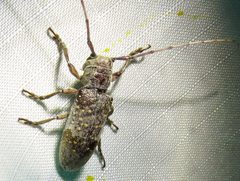
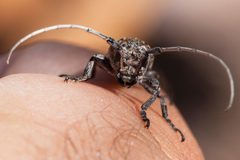
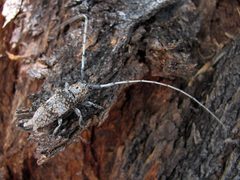
Oncideres rhodosticta is a twig-girdling longhorn beetle (Cerambycidae: Lamiinae) native to the southwestern United States and Mexico. emerge in late summer (August–September) and feed on mesquite foliage. Females engage in distinctive girdling , chewing complete rings through the bark and cambium of living mesquite twigs to create oviposition sites in the dying portions. Larvae develop within the dead twigs, completing a one-year . The is economically significant as a pest of mesquite in rangeland and agricultural settings.
Pronunciation
How to pronounce Oncideres rhodosticta: /ɒnˈsɪdɛriːz ˌroʊdəˈstɪktə/
These audio files are automatically generated. While they are not always 100% accurate, they are a good starting point.
Identification
are medium-sized cerambycids with elongated bodies typical of the Lamiinae. The can be distinguished from other Oncideres by the combination of: pronotum with lateral ; with reddish or orange basal markings and dark apices; and antennal segments that extend beyond the elytral apices in males. The specific epithet "rhodosticta" (meaning "red-spotted") refers to characteristic coloration patterns. Males and females can be separated by antennal length—male are notably longer than those of females. Similar species include other Oncideres twig girdlers, which may be distinguished by associations, geographic range, and subtle differences in elytral maculation and pronotal armature.
Images
Habitat
Mesquite-dominated woodlands and shrublands, particularly in arid and semi-arid regions. Associated with honey mesquite (Prosopis glandulosa) and screwbean mesquite (Prosopis pubescens) stands. Occurs in both natural rangeland and disturbed agricultural settings where mesquite is present.
Distribution
United States (southwestern states including Arizona, New Mexico, Texas) and Mexico. Records indicate presence across the Chihuahuan and Sonoran Desert regions.
Seasonality
active late August through September. Larval development occurs through fall and winter; in spring to early summer.
Diet
feed on foliage of mesquite (Prosopis spp.). Larvae are , developing in dead mesquite twigs created by female girdling .
Host Associations
- Prosopis glandulosa - honey mesquite; primary for feeding and larval development
- Prosopis pubescens - screwbean mesquite; documented for larval development
Life Cycle
One-year cycle. are deposited under bark of girdled twig portions in late summer. Larvae tunnel and feed in dead wood through fall and winter, creating galleries packed with . occurs within the twig in spring to early summer. emerge in late summer (August–September) by chewing exit holes through the bark.
Behavior
Females exhibit specialized twig-girdling : they chew a complete circumferential ring through bark and cambium of living twigs (typically 6–12 mm diameter), severing vascular tissues and causing the portion to die. are laid under bark of the girdled, dying twig. Multiple eggs may be deposited per twig. Girdled twigs eventually break and fall to the ground, where larval development continues. This behavior creates optimal conditions for larval development by providing dead wood with appropriate moisture content and reduced defensive compounds.
Ecological Role
Contributes to mesquite stand dynamics through chronic pruning of twigs, potentially influencing shrub architecture and . Accelerates nutrient cycling through twig death and subsequent decomposition. Creates and food resources for other organisms in mesquite .
Human Relevance
Recognized as a pest of mesquite in rangeland management, where heavy can cause significant twig mortality and reduce mesquite forage value. Girdled twigs falling to the ground may create nuisance in managed landscapes. The has been studied for its potential role in mesquite , though its effectiveness as a standalone management tool is limited by the capacity of mesquite to resprout from girdled branches.
Similar Taxa
- Oncideres cingulataEastern twig girdler with overlapping but distinct geographic range (eastern and central North America); differs in associations (primarily hickory, oak, and other hardwoods rather than mesquite)
- Oncideres cingulata texanaSouth Texas that overlaps with O. rhodosticta in range; may be distinguished by preferences and subtle morphological differences in elytral patterning
- Lochmaeocles cornuticepsAnother mesquite-associated cerambycid with twig-girdling ; differs in pronotal armature and geographic distribution (primarily south Texas)
Sources and further reading
- BugGuide
- Wikipedia
- GBIF taxonomy match
- iNaturalist taxon
- Catalogue of Life
- Halictidae | Beetles In The Bush
- Bug Eric: March 2009
- Beetle Collecting 101: How to rear wood-boring beetles | Beetles In The Bush
- Biology and Ecology of a Mesquite Twig Girdler, Oncideres rhodosticta,1 in West Texas2
- The role of field-collected cues in the host recognition of twig girdlers (Oncideres rhodosticta) on honey mesquite (Prosopis glandulosa)