
Oncideres
Lacordaire, 1830
Twig Girdling Beetles, Twig Girdlers
Species Guides
4- Oncideres cingulata(twig girdler)
- Oncideres pustulata(Coastal Huisache Girdler)
- Oncideres quercus(Arizona Oak Girdler)
- Oncideres rhodosticta(Mesquite Girdler)
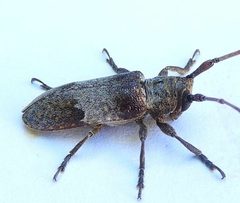
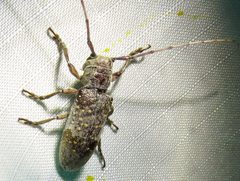
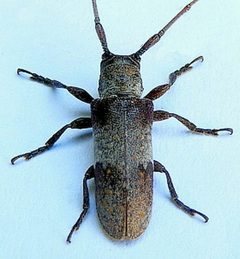
Oncideres is a of longhorn beetles (Cerambycidae: Lamiinae) containing over 120 distributed throughout the Nearctic and Neotropics. These beetles are commonly known as twig girdlers due to the distinctive of females chewing around branches to cause them to break and fall. The larvae develop within the girdled, decomposing wood. Several species are economically significant pests of fruit trees, pecans, and forest trees, while others play roles in engineering by altering plant structure.
Pronunciation
How to pronounce Oncideres: //ˌɒn.sɪˈdɪˌrɛs//
These audio files are automatically generated. While they are not always 100% accurate, they are a good starting point.
Identification
Members of Oncideres can be distinguished from other cerambycid by the combination of: twig girdling (females chew complete or nearly complete rings around branches); association with fallen, girdled branches containing larvae; and membership in the tribe Onciderini. Specific identification typically requires examination of elytral coloration, pronotal , and antennal proportions. Males often have longer than females. The girdled branches themselves are diagnostic field signs—look for cleanly cut or partially cut twigs on the ground beneath trees, often with oviposition scars visible on the bark.
Images
Habitat
Associated with woody plants in forest clearings, orchards, and open woodlands. Girdled branches are found on the ground beneath host trees. Many favor tropical and subtropical regions, though some extend into temperate North America. Specific microhabitat requirements vary by species and host association.
Distribution
occurs throughout the Americas with highest in the Neotropics. Documented from North America (including Florida, Texas, Arizona, and southern states), Mexico, Central America, and South America (Brazil, Colombia, Argentina, etc.). Specific distribution varies by —O. cingulata occurs in eastern and central North America, O. rhodosticta in the southwestern United States and Mexico, O. cervina in southern Brazil.
Seasonality
activity and patterns vary by and latitude. O. cingulata is active in fall (August–October in northern range, later in southern range). O. cervina emerges November through January in southern Brazil. O. bouchardii appears November through February in Colombia following the rainy season. Many species have adult lifespans of less than three months, often concentrated in single .
Diet
Larvae feed on wood of decomposing branches, with some specificity to plant . feed on nectar, pollen, flowers, fruits, leaves, bark, and roots of host plants. Twig nitrogen content has been documented to affect larval survival in some species.
Host Associations
- Persea americana - O. cervina; avocado orchards in Brazil
- Prosopis glandulosa - O. rhodosticta; honey mesquite in southwestern US
- Prosopis juliflora - O. bouchardii; trupillo trees in Colombia
- Acacia farnesiana - O. bouchardii and O. pustulatus; aromo bushes
- Acacia mangium - O. saga; Brazil
- Carya - O. cingulata; hickories
- Diospyros virginiana - O. cingulata; persimmon
- Ulmus - O. cingulata; elm
- Quercus - various Oncideres
- Luehea grandiflora - O. dejeanii; Malvaceae
Life Cycle
Females girdle living branches and deposit into prepared cavities in the bark, often sealing them afterward. Larvae hatch and tunnel into the drying or decomposing wood, feeding for extended periods. In O. cervina, larval-pupal chambers average 28 mm in tunnel length with 4.3 mL wood consumed per larva. occurs within the branch. The of O. bouchardii lasts approximately one year, with the larval stage occupying the longest period. are short-lived, often less than one to two weeks though some survive up to 45 days.
Behavior
The defining is twig girdling: females use their to chew a complete or near-complete ring around the circumference of a branch, cutting through bark and into wood. This causes the branch to die, dry, and eventually break off. Females oviposit into the girdled portion. The function of girdling appears to be creation of favorable larval —dying branches decompose under controlled conditions, providing suitable moisture and nutrition for wood-boring larvae. Males search for females and engage in aggressive confrontations to monopolize access to females, food resources, and oviposition sites. Multiple copulations increase female . location is primarily through olfactory cues detected by antennal ; initial attack may induce host plants to release concentrated volatiles that facilitate localization and attract mates.
Ecological Role
As stem engineers, Oncideres alter plant recruitment and age structure. Girdling kills branches and can kill entire host plants—43% mortality has been documented in some host following girdling. This creates gaps and modifies forest structure. Fallen girdled branches provide for other arthropods, enhancing local biodiversity. The beetles may act as for , fungi, and bacteria. Some species are significant economic pests in orchards and forestry.
Human Relevance
Several are economically important pests. O. cingulata damages pecan orchards and is subject to management recommendations for growers. O. cervina threatens avocado production in Brazil. O. saga affects Acacia mangium plantations. Management typically involves collecting and burning girdled branches to destroy and larvae. Homeowners are generally advised that ornamental tree damage is usually not serious. The is also of scientific interest for studying plant-insect interactions, behavioral of girdling, and sex allocation strategies.
Similar Taxa
- LochmaeoclesAlso in tribe Onciderini and exhibits similar twig girdling ; distinguished by specific morphological characters and associations
- Other Onciderini genera (e.g., Hesycha, Tybalmia)Share twig girdling habit; Oncideres distinguished by specific combinations of body form, elytral , and geographic distribution
- Non-girdling CerambycidaeLack the diagnostic branch-girdling ; larvae typically develop in ungirdled dead wood or living trees
More Details
Sex Ratio Manipulation
Females can manipulate offspring sex ratio by selecting branch diameter—thicker branches tend to produce female offspring, thinner branches male offspring. This parental effect on sex allocation has been documented in O. cingulata and relates to the correlation between body size and reproductive output.
Associated Fauna
Girdled branches of Acacia mangium have been found to harbor additional cerambycid (Engyum quadrinotatum, Eburodacrys sexmaculata, Achryson surinamum, Neoclytus pusillus) and scolytine beetles, suggesting complex interactions in the microhabitat created by Oncideres activity.
Oviposition Mechanics
In O. bouchardii, females use a telescopic, inflatable ovipositor inserted under bark through pressure to force open chambers between bark and wood. Females may mark the bark with the ovipositor to facilitate locating the entrance when completing the chamber with .
Sources and further reading
- BugGuide
- Wikipedia
- GBIF taxonomy match
- iNaturalist taxon
- NCBI Taxonomy
- Catalogue of Life
- 🌿 Botanizing w/ the Webster Groves Nature Study Society (WGNSS) Botany Group at Fults Hill Prairie Nature Preserve — 27 Oct 2025 | Beetles In The Bush
- Halictidae | Beetles In The Bush
- November | 2025 | Beetles In The Bush
- Beetle Collecting 101: How to rear wood-boring beetles | Beetles In The Bush
- Twig Girdler Oncideres spp. (Insecta: Coleoptera: Cerambycidae: Onciderini)
- BIoecology of Oncideres cervina Thomson (Coleoptera: Cerambycidae) on Persea americana Mill. (Lauraceae)
- A Review of the Biology and Ecological Interactions of Oncideres (Cerambycidae): Brazilian Wood Borers Species
- NOTES ON THE BIOLOGY OF Oncideres bouchardii BATES (Coleóptera: Cerambycidae), A TRUPILLO TWIG GIRDTER FROM SANTA MARTA, COLOMBIA
- Entomofauna Associada a Galhos de Acacia mangium Willd. Roletados por Oncideres saga (Dalman) (Coleoptera: Cerambycidae)
- NEW HOST RECORD FOR ONCIDERES DEJEANII THOMSON, 1868 (COLEOPTERA: CERAMBYCIDAE) WITH BIOLOGICAL INFORMATION IN LUEHEA GRANDIFLORA MART. AND ZUCC (MALVACEAE)
- Branch Girdling and Oviposition Biology of Oncideres pustulatus (Coleoptera: Cerambycidae) on Acacia farnesiana
- Twig Morphology and Host Effects on Emergence Patterns and Sex Ratios of the Twig Girdler,Oncideres cingulata(Say) (Coleoptera: Cerambycidae)
- The role of field-collected cues in the host recognition of twig girdlers (Oncideres rhodosticta) on honey mesquite (Prosopis glandulosa)
- Branch Girdling by Oncideres cingulata (Coleoptera; Cerambycidae) and Relative Host Quality of Persimmon, Hickory, and Elm
- Biology and Ecology of a Mesquite Twig Girdler, Oncideres rhodosticta,1 in West Texas2