
Oncideres cingulata
(Say, 1827)
twig girdler, Eastern Twig Girdler
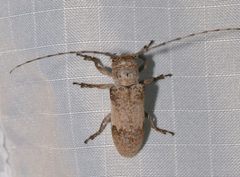
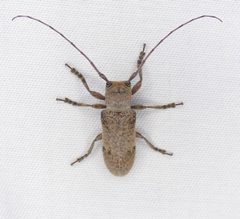
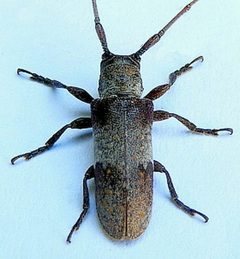
Oncideres cingulata, commonly known as the twig girdler, is a cerambycid beetle notable for its distinctive reproductive where females girdle twigs of trees to create larval . The is brownish-gray, 13–16 mm in length, with 13–25 mm long. Adults are active in late summer and fall, and females cut through bark and wood of small branches (6–12.7 mm diameter) before laying in the severed portion. Larvae develop within the fallen girdled twigs, feeding on woody tissue, and complete a single yearly . The is economically significant as a pest of pecan plantations and other hardwood trees.
Pronunciation
How to pronounce Oncideres cingulata: /ɒnˈsɪdəˌriːz ˌsɪŋɡjʊˈlɑːtə/
These audio files are automatically generated. While they are not always 100% accurate, they are a good starting point.
Identification
Distinguished from similar cerambycids by its twig-girdling and association with fallen girdled twigs. are brownish-gray with long (nearly equal to or exceeding body length). The girdling damage—clean, saw-like cuts encircling twigs 6–12.7 mm in diameter—is diagnostic and unique among North American longhorn beetles. Similar Oncideres occur in different geographic regions and may be distinguished by distribution and subtle morphological differences.
Images
Habitat
Deciduous forests and woodlands, particularly areas with trees including hickory, oak, elm, pecan, and persimmon. Associated with the twigs and branches of these host plants where larvae develop.
Distribution
Eastern and Gulf Coast regions of the United States; recorded from North America including Ontario, Canada.
Seasonality
active in late summer and fall (August–October); larval development occurs through fall and winter within girdled twigs; in spring; of new adults in summer. Single yearly .
Diet
Larvae feed internally on woody tissue of girdled twigs. have been observed feeding on tender woody shoots and bark, though feeding appears limited.
Host Associations
- Carya spp. - larval hickory, including pecan; preferred with high reproductive success
- Quercus spp. - larval oak
- Ulmus spp. - larval elm
- Diospyros virginiana - larval persimmon; moderate quality
- Various hardwood trees - larval including poplar, fruit trees, and lumber
Life Cycle
Females girdle living twigs 6–12.7 mm in diameter by chewing through bark and wood, creating a cut resembling saw damage. are laid singly in separate cuts into the wood above the girdled section. Girdled twigs die and fall to the ground. Larvae hatch and overwinter in twigs, then bore through woody tissue toward the girdled point. Larvae seal themselves in pupal chambers with shredded wood fibers and pupate over 12–14 days. emerge in summer, feed briefly on tender shoots, and mate. Single yearly with patterns and sex ratios influenced by twig diameter and .
Behavior
females exhibit distinctive twig-girdling , cutting complete or partial girdles around twigs that cause structural failure and branch drop. This behavior creates fallen substrate for larval development. Girdling typically occurs late in the growing season, close to nut harvesting in pecan orchards. Adults are attracted to host trees and may be found on or near recently girdled twigs.
Ecological Role
Acts as a natural pruning agent in forest ; girdling causes branch mortality that affects tree growth form and structure. Fallen girdled twigs contribute to forest floor debris. influenced by host plant characteristics and twig , with potential effects on forest stand structure in high- .
Human Relevance
Significant agricultural pest of pecan plantations, causing crop decreases and structural problems from inexpert pruning. Also damages hickory, oak, poplar, elm, and various fruit trees and lumber trees. Management involves collecting and burning fallen girdled twigs during winter to reduce larval survival. Not considered a serious threat to ornamental trees in residential settings.
Similar Taxa
- Oncideres rhodostictaAnother twig-girdling Oncideres ; distinguished by distribution (southwestern U.S., Mexico) and subtle morphological differences in coloration and markings
- Other Oncideres spp.Multiple in share twig-girdling ; geographic separation and associations are primary distinguishing features
- Anelaphus parallelus (twig pruner)Similar twig-cutting cerambycid, but larvae (not ) cut twigs and create smooth cuts rather than saw-like girdles; different (Cerambycidae: Cerambycinae)
Sources and further reading
- BugGuide
- Wikipedia
- GBIF taxonomy match
- iNaturalist taxon
- Catalogue of Life
- Insects that feed on twigs and branches - AgriLife Extension Entomology
- Reduviidae | Beetles In The Bush
- Botany | Beetles In The Bush
- Beetle Collecting 101: How to rear wood-boring beetles | Beetles In The Bush
- 🌿 Botanizing w/ the Webster Groves Nature Study Society (WGNSS) Botany Group at Fults Hill Prairie Nature Preserve — 27 Oct 2025 | Beetles In The Bush
- Bug Eric: March 2009
- Branch Girdling by Oncideres cingulata (Coleoptera; Cerambycidae) and Relative Host Quality of Persimmon, Hickory, and Elm
- Twig Morphology and Host Effects on Reproductive Success of the Twig GirdlerOncideres cingulata(Say) (Coleoptera: Cerambycidae)
- Twig Morphology and Host Effects on Emergence Patterns and Sex Ratios of the Twig Girdler,Oncideres cingulata(Say) (Coleoptera: Cerambycidae)
- Twig Girdler Oncideres spp. (Insecta: Coleoptera: Cerambycidae: Onciderini)