
Oncideres pustulata
LeConte, 1854
Coastal Huisache Girdler
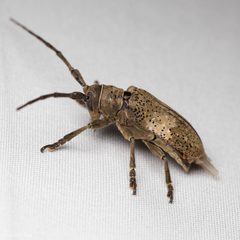
Oncideres pustulata is a of longhorn beetle in the Cerambycidae, described by John Lawrence LeConte in 1854. It is distributed across Mexico and the southern United States. The species is a twig girdler, with larvae that develop within girdled branches of plants in the Leucaena and Prosopis. It is known to feed on Leucaena leucocephala, Leucaena pulverulenta, Prosopis alba, and Prosopis chilensis.
Pronunciation
How to pronounce Oncideres pustulata: /ɒnˈsɪdəˌriːz ˌpʌstjʊˈleɪtə/
These audio files are automatically generated. While they are not always 100% accurate, they are a good starting point.
Identification
Oncideres pustulata can be distinguished from other Oncideres by the presence of distinct pustules (small raised bumps) on the , which give the species its name. The specific epithet 'pustulata' refers to this tuberculate surface texture. As a member of the twig girdler group within Oncideres, it shares the general body plan of robust longhorn beetles with relatively short compared to many cerambycids, but positive identification to species level requires examination of elytral and other subtle morphological features.
Images
Habitat
Associated with mesquite grasslands and arid to semi-arid regions where plants in the Leucaena and Prosopis occur. The is found in supporting of its leguminous host trees and shrubs, including disturbed areas where these plants have been introduced or become established.
Distribution
Mexico and the United States. Records indicate presence in southern Arizona, New Mexico, and Texas, extending south through Mexico.
Seasonality
have been observed in September. Based on related in the , fall activity appears to be the primary adult period, with girdling occurring during this time.
Diet
Larvae feed internally on the wood of girdled twigs of Leucaena leucocephala, Leucaena pulverulenta, Prosopis alba, and Prosopis chilensis. The diet is not documented.
Host Associations
- Leucaena leucocephala - larval
- Leucaena pulverulenta - larval
- Prosopis alba - larval
- Prosopis chilensis - larval
Life Cycle
Females girdle twigs of plants by cutting a notch around the circumference, killing the wood beyond the girdle. are laid in the doomed twig, and larvae bore into the wood to feed and develop. Larval development occurs within the girdled branch, which eventually falls to the ground. likely occurs within the fallen branch, with emerging to continue the cycle.
Behavior
Exhibits twig-girdling typical of the : females cut a complete circumferential notch around plant twigs, effectively severing the vascular connection and causing the portion to die. This creates a favorable substrate for larval development. The behavior is analogous to that of Oncideres cingulata and Oncideres rhodosticta, though host plant preferences differ.
Ecological Role
As a twig girdler, contributes to nutrient cycling by accelerating the death and fall of small branches. Creates microhabitats within girdled twigs that may be used by other organisms. May act as a regulator for plants by reducing growth and seed production through branch mortality.
Human Relevance
May be considered a pest in managed stands of Leucaena or Prosopis grown for timber, fodder, or other purposes due to branch dieback caused by girdling. The 'Coastal Huisache Girdler' reflects its association with huisache (Acacia farnesiana and related ), though documented are primarily in Leucaena and Prosopis.
Similar Taxa
- Oncideres cingulataAlso a twig girdler with similar and , but occurs primarily in eastern North America and uses hickory and other hardwoods as rather than Leucaena and Prosopis.
- Oncideres rhodostictaAnother southwestern twig girdler found on Prosopis glandulosa, but distinguished by different elytral markings and distribution patterns.
More Details
Sources and further reading
- BugGuide
- Wikipedia
- GBIF taxonomy match
- iNaturalist taxon
- Catalogue of Life
- 🌿 Botanizing w/ the Webster Groves Nature Study Society (WGNSS) Botany Group at Fults Hill Prairie Nature Preserve — 27 Oct 2025 | Beetles In The Bush
- Halictidae | Beetles In The Bush
- November | 2025 | Beetles In The Bush
- Beetle Collecting 101: How to rear wood-boring beetles | Beetles In The Bush
- Bug Eric: March 2009