
Rhyzopertha dominica
(Fabricius, 1792)
Lesser Grain Borer, American Wheat Weevil, Australian Wheat Weevil, Stored Grain Borer
Rhyzopertha dominica, the lesser , is a in the Bostrichidae and one of the most destructive pests of stored cereal grains worldwide. It is particularly damaging to wheat, but also infests corn, rice, sorghum, peanuts, and other stored products. The is known for its ability to bore directly into intact kernels, causing both quantitative weight loss and qualitative degradation through . Its global distribution in grain storage facilities makes it a major target of programs, with showing increasing resistance to phosphine and other chemical controls.
Pronunciation
How to pronounce Rhyzopertha dominica: //raɪˈzɒpɜːrθə dəˈmɪnɪkə//
These audio files are automatically generated. While they are not always 100% accurate, they are a good starting point.
Identification
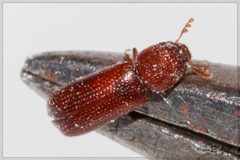
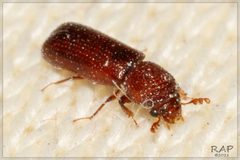
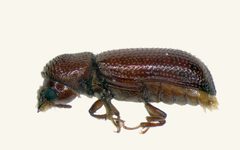
The lesser can be distinguished from other stored-product beetles by its cylindrical, almost rod-like body shape, in contrast to the more rounded or oval forms of Tribolium . Unlike weevils in the Sitophilus, it lacks an elongated rostrum (snout), with mouthparts directed forward rather than at the end of a snout. The is concealed from above by the pronotum, which extends forward to cover it. have a distinct 3-segmented club. When compared to the larger grain borer (Prostephanus truncatus), R. dominica is smaller and less robust. Larvae are C-shaped, white, and legless, typical of Bostrichidae, and develop entirely within grain kernels.
Images
Habitat
Primary is stored grain and cereal products in warehouses, elevators, mills, and domestic storage. Infests bulk grain, bagged grain, and processed cereal products. Thrives in warm, dry conditions typical of grain storage environments. Can persist in residual grain in empty storage structures, machinery, and transport equipment. Not known to occur in natural outdoor habitats; entirely associated with human-stored products.
Distribution
Nearly worldwide distribution in grain storage facilities. Present in North America, South America, Europe, Africa, Asia, and Australia. Particularly problematic in tropical and subtropical grain storage regions, but tolerant of temperate conditions. Records from São Miguel (Azores) and throughout Europe and Northern Asia. Spread through international grain trade.
Seasonality
Continuous breeding in stored grain environments where temperature and humidity permit; no distinct seasonal cycle in controlled storage. Activity and rates increase with temperature within optimal range. In uncontrolled storage, fluctuations may follow seasonal temperature patterns, with reduced activity in colder months.
Diet
Feeds on stored cereal grains and related products. Primary include wheat, corn (maize), rice, sorghum, barley, and oats. Also infests peanuts and other oilseeds. Both and larvae feed; adults can bore into intact kernels, while larvae develop inside kernels. Capable of feeding on damaged grain, grain dust, and milled products, but prefer whole grains. Host preference ranking observed: sorghum > paddy rice > maize (least preferred among tested varieties).
Host Associations
- Oryza sativa - feeds onpaddy variety Sumati tested; intermediate preference
- Zea mays - feeds onhybrid DHM-111 tested; least preferred among three cereals tested
- Sorghum bicolor - feeds onvariety M 35-1 tested; most preferred
- Triticum aestivum - feeds onprimary ; commonly called wheat
- Arachis hypogaea - feeds onpeanut; major pest of peanuts
Life Cycle
Complete (holometabolous). laid singly or in small clusters, typically in cracks of grain or directly on kernels. Egg period: 6.6–7.7 days depending on grain and temperature. Larvae bore into kernels and feed internally, completing development inside grain. Larval and pupal period combined: 35–44 days on different hosts. Total development period from egg to : 42–52 days, varying with host quality and temperature. occurs within kernel. Adults emerge by chewing exit holes. Adults are long-lived; female longevity exceeds male longevity. Multiple overlapping per year in favorable conditions.
Behavior
are active fliers and disperse between storage facilities. Both sexes bore into intact grain kernels; adults feed externally and internally. mediated by . Response to food attractants documented in storage facilities. Movement patterns altered by exposure to -treated surfaces, showing reduced locomotion and erratic movement. -mediated foraging behavioral responses observed: behavior changes with . Capable of penetrating packaging materials. Adults produce characteristic tapping or boring sounds audible in heavy .
Ecological Role
Pest of stored agricultural products; no known beneficial ecological role. In stored grain , acts as primary pest capable of initiating in intact grain. Can microorganisms into grain. Serves as for including Anisopteromalus calandrae, used in programs. can alter grain storage microenvironments through heating and moisture changes.
Human Relevance
Major economic pest of global significance. Causes estimated 10–30% value loss in stored commodities in developed nations; up to 70% in developing nations with fewer pest management resources. renders grain unmarketable or requires downgrading. with live insects, dead bodies, and creates food safety and quality issues. Subject to regulatory action in grain trade ( limits for insect presence). Target of intensive including , , phosphine treatment, netting, , and plant-derived extracts. Development of resistance to phosphine and other insecticides complicates management. Potential for use of long-lasting insecticide netting (LLIN) as physical/chemical barrier in storage facilities.
Similar Taxa
- Tribolium castaneumBoth are major stored-product beetles, but T. castaneum has rounded, flattened body, cannot bore into intact kernels (requires damaged grain), and belongs to Tenebrionidae
- Tribolium confusumSimilar and appearance to T. castaneum; distinguished by more gradual antennal club and subtle morphological differences; also cannot bore into intact kernels
- Sitophilus oryzaeBoth infest stored grain, but S. oryzae has prominent elongated rostrum with mouthparts at tip, and belongs to Curculionidae (true weevils)
- Sitophilus zeamaisSimilar to S. oryzae with distinct rostrum; slightly larger and with different punctation on pronotum; both are weevils with different body plan from cylindrical borer
- Prostephanus truncatusLarger grain borer; similar cylindrical shape and but larger (3–4 mm vs. 2–3 mm), more robust, with different geographic origin and distribution in Africa and Central America
More Details
Insecticide Resistance
have developed resistance to phosphine, the most widely used for stored grain, threatening effective control. Resistance to spinosad and other also documented, associated with mutations in nicotinic receptor subunits.
Thermal Biology
Possesses 6-phosphate synthase gene (rdtps1) contributing to thermal acclimation, enabling survival across variable temperatures in storage environments.
Microbiome
Harbors bacterial (bacteriome) whose structure and metabolism are influenced by chemical properties of cereal grains, affecting development.
Control Innovations
Long-lasting netting (LLIN) with deltamethrin shows promise for reducing and mortality; sublethal effects include reduced locomotion and erratic movement even at low doses.
Sources and further reading
- BugGuide
- GBIF taxonomy match
- iNaturalist taxon
- NCBI Taxonomy
- Catalogue of Life
- Insecticide Netting Could Keep Beetles Out of Your Breakfast Cereal
- New Meta-Analysis Examines How Landscape Fire Smoke Affects Insects
- Decades-old amber collection offers new views of a lost world | Blog
- New Fossil Evidence Shows Beetles Pollinated Orchids Millions of Years Ago
- Did the Malaria Parasite First Evolve in the Insect Vector or the Vertebrate Host?
- Fossilized Tick Provides Evidence that Lyme Disease is Millions of Years Older than Humans
- Lesser Grain Borer, Rhyzopertha dominica (Coleoptera, Bostrichidae)
- Comparative Biology of Rhyzopertha dominica (Fab.) in Major Cereals
- The biology and susceptibility to ionizing radiation of Rhyzopertha dominica (Fabricius)
- Behavioral Responses of Rhyzopertha dominica to Different Food Bait Attractants in Paddy Storage Godown
- Control of Rhyzopertha dominica and Sitophilus zeamais in stored rice with different release rates of the larval parasitoid Anisopteromalus calandrae
- An investigation into application of azadirachtin as a grain protectant : biological and behavioural responses by Rhyzopertha dominica F. (Coleoptera: bostrichidae)
- Reproduction of Rhyzopertha dominica (F.) (Coleoptera: Bostrichidae) on Different Host-grains
- Mutation and transcriptional expression of nicotinic acetylcholine receptor subunit α6 associated with spinosad resistance inRhyzopertha dominica
- Biology and management of stored products’ insect pest Rhyzopertha dominica (Fab.) (Coleoptera: Bostrichidae)
- Toxicity and repellent effects of acetonic plant extracts against the lesser grain borer, Rhyzopertha dominica
- Influence of the Chemical Properties of Cereal Grains on the Structure and Metabolism of the Bacteriome of Rhyzopertha dominica (F.) and Its Development: A Cause-Effect Analysis.
- Density-mediated foraging behavioral responses of Rhyzopertha dominica (Coleoptera: Bostrichidae) and Tribolium castaneum (Coleoptera: Tenebrionidae).
- Trehalose 6-phosphate synthase gene rdtps1 contributes to thermal acclimation in Rhyzopertha dominica.
- Competition of Rhyzopertha dominica and Sitophilus oryzae on six sorghum varieties.