
Sitophilus zeamais
Motschulsky, 1855
Maize Weevil, Greater Rice Weevil
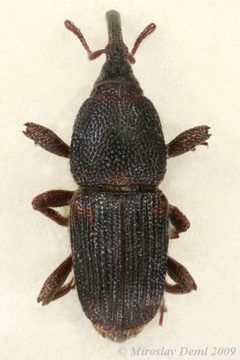
Sitophilus zeamais, commonly known as the maize weevil or greater , is a major pest of stored cereal products and standing crops in tropical and subtropical regions worldwide. The is closely related to Sitophilus oryzae (rice weevil) and can be distinguished by morphological features and preferences. It infests maize, wheat, rice, sorghum, oats, barley, rye, buckwheat, peas, and cottonseed. Research indicates this species has a longer and higher than S. oryzae, with females living approximately 109 days and producing around 203 on average. The species exhibits olfactory responses to cereal volatiles, which mediate host-finding .
Pronunciation
How to pronounce Sitophilus zeamais: /ˌsaɪ.toʊˈfaɪ.ləs ˌziː.əˈmeɪs/
These audio files are automatically generated. While they are not always 100% accurate, they are a good starting point.
Identification
Sitophilus zeamais is morphologically similar to Sitophilus oryzae () and (). It can be distinguished from S. granarius by the presence of wings (S. granarius is flightless). Separation from S. oryzae requires examination of the pronotum and elytral punctation patterns. S. zeamais typically has more widely spaced punctures on the pronotum and is generally associated with maize and warmer climates, whereas S. oryzae is more common on rice. The two can hybridize, complicating identification in areas where both occur.
Images
Habitat
Stored grain products and standing crops in tropical and subtropical regions. Found in warehouses, grain elevators, and farm storage facilities. Attacks both harvested stored grains and pre-harvest standing crops in the field.
Distribution
Tropical areas worldwide; present in the United States. Distribution extends across regions with warm climates suitable for year-round . Records include the Azores (Corvo, Faial, Flores, Graciosa, Pico).
Diet
Feeds on stored cereal grains including maize, wheat, rice, sorghum, oats, barley, rye, buckwheat; also attacks peas and cottonseed. Both and larvae feed internally within grain kernels.
Host Associations
- Zea mays - primary maize/corn
- Oryza sativa - rice
- Triticum spp. - wheat
- Sorghum bicolor - sorghum
- Avena sativa - oats
- Hordeum vulgare - barley
- Secale cereale - rye
- Fagopyrum esculentum - buckwheat
- Pisum sativum - peas
- Gossypium spp. - cottonseed
Life Cycle
Complete . , larva, pupa, and stages all develop within the grain kernel. Average duration approximately 49 days under laboratory conditions (longer than S. oryzae at 35 days). mortality approximately 77%. Sex ratio approximately 0.77 (male-biased).
Behavior
exhibit electroantennographic responses to volatile compounds emitted by cereal grains, using olfactory cues for location. Demonstrates behavioral attraction or repellence to specific cereal volatiles. Adults are capable of , unlike the flightless S. granarius.
Ecological Role
Serious pest of stored products; reduces grain weight and quality through feeding damage. Internal feeding by larvae destroys individual kernels. Can facilitate fungal of stored grains.
Human Relevance
Major economic pest of stored cereals worldwide. Causes significant post-harvest losses in developing countries. Subject of extensive research on and alternative control methods including . Frequently used as a model organism in stored-product entomology research.
Similar Taxa
- Sitophilus oryzaeExtremely similar ; historically confused with S. zeamais. S. oryzae has shorter (35 days vs. 49 days), shorter lifespan, and lower (152 vs. 203 ). S. oryzae more commonly associated with rice; S. zeamais with maize. The two can hybridize.
- Sitophilus granariusSimilar size and appearance, but S. granarius is flightless ( , no wings), has more closely spaced pronotal punctures, and is adapted to cooler temperate climates. S. zeamais has functional wings and is tropical/subtropical.
Sources and further reading
- BugGuide
- GBIF taxonomy match
- iNaturalist taxon
- NCBI Taxonomy
- Catalogue of Life
- William Meikle Seminar: A Case Study With Honey Bees | Bug Squad
- New Meta-Analysis Examines How Landscape Fire Smoke Affects Insects
- BIOLOGI Sitophilus oryzae dan Sitophilus zeamais (COLEOPTERA; CURCULIONIDAE) PADA BERAS DAN JAGUNG PIPILAN
- Fumigant toxicity of five essential oils rich in ketones against Sitophilus zeamais (Motschulsky)
- Electroantennographic and behavioral responses ofSitophilus zeamaisto cereal volatiles
- Chemical composition and insecticidal potential of bioactive fractions from Brucea antidysenteric (abalo) stem bark extract against Sitophilus zeamais.