
Sitophilus granarius
(Linnaeus, 1758)
granary weevil, wheat weevil, grain weevil
is a pest of stored cereals, commonly known as the or wheat weevil. are flightless and infest raw grains including wheat, barley, and oats, causing significant quantitative and qualitative losses in storage facilities. The is distinguished from similar storage weevils by its inability to fly and its preference for cooler, drier conditions. Larvae develop endophytically inside grain kernels, completing their entire within a single seed.
Pronunciation
How to pronounce Sitophilus granarius: //sɪˈtɒfɪləs ɡrəˈneɪriəs//
These audio files are automatically generated. While they are not always 100% accurate, they are a good starting point.
Identification
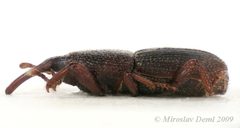
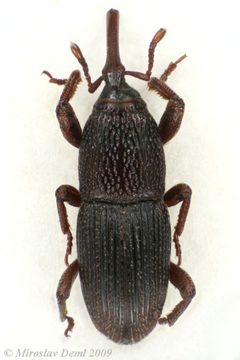
Look for uniformly dark coloration without elytral spots; check for and complete absence of wings beneath—this flightless condition is diagnostic for S. granarius. The rostrum is slender and approximately as long as the pronotum. In storage facilities, can be detected by holes in grain kernels and the presence of fine flour-like . Molecular identification may be required to distinguish from other Sitophilus where morphological characters overlap.
Images
Habitat
Primary is stored grain facilities including granaries, warehouses, silos, and household food storage. Thrives in undisturbed grain masses with low moisture content (12–14%). Tolerates cooler temperatures than , with optimal range approximately 25–30°C. In natural settings, may persist in bird nests, rodent burrows, or spillage from harvested cereals, but rarely found in standing crops.
Distribution
distribution associated with human grain storage and commerce. Present on all continents except Antarctica. Established documented in North America, Europe, Middle East, Africa (including Nile Valley where variety africana occurs), Asia, and Oceania (including Azores: Faial, São Miguel, Terceira). Absent from some tropical lowland regions where S. oryzae predominates.
Seasonality
Continuous breeding in controlled storage environments; time approximately 4–6 weeks at optimal temperatures. In unheated temperate storage, activity and decline during winter months but do not cease entirely due to cold . No observed.
Diet
Obligate primary feeder on stored cereals and cereal products. Consumes whole grains of wheat, barley, oats, rye, and occasionally rice. feed on endosperm through externally visible holes; larvae consume kernel contents from within. Anthocyanin-rich wheat varieties show reduced acceptance and utilization .
Host Associations
- Triticum aestivum - primary Bread wheat; highly susceptible
- Triticum durum - primary Durum wheat; standard rearing substrate
- Hordeum vulgare - primary Barley
- Avena sativa - primary Oats
- Secale cereale - primary Rye
Life Cycle
Holometabolous with complete . : deposited in cavity chewed into grain kernel, sealed with waxy secretion. Larva: three instars, endophytic development entirely within single grain; feeds on endosperm, causing characteristic internal tunneling. Pupa: formed within kernel; chews circular hole (approximately 1 mm diameter) to exit. time temperature-dependent: 4–6 weeks at 25–30°C, extending to several months below 20°C. Adults live 4–8 months; females lay 50–250 eggs over lifetime.
Behavior
Flightless; disperses by or passive transport in grain movement. show negative geotaxis, moving upward in grain masses. Males produce attracting both sexes. Oviposition involves chewing penetration hole into kernel, depositing single , and sealing with gelatinous plug. Adults are thigmotactic, seeking tight spaces between grains. Shows reduced feeding and negative growth rates on anthocyanin-pigmented wheat .
Ecological Role
Major pest of stored cereals causing direct consumption losses and facilitating fungal leading to mycotoxin . In storage , serves as for fungi including bassiana and Isaria fumosorosea. Symbiotic relationship with mycetomal micro-organisms (bacterial and fungal associates housed in specialized organs) that supply B-complex vitamins; however, some strains lack these without apparent reduction. Egyptian strain and variety africana show reduced body size and lighter coloration, possibly correlated with symbiont absence.
Human Relevance
Significant economic pest of global agriculture. cause quantitative grain loss, quality degradation, heating and moisture accumulation in bulk storage, and promotion of secondary fungal and insect pests. Management relies on phosphine , controlled atmosphere, temperature manipulation, and emerging using fungi. wheat varieties with elevated anthocyanin content show promise for . Not known to human .
Similar Taxa
- Sitophilus oryzaeSimilar size and general ; distinguished by four reddish-brown spots on , presence of functional wings enabling , and preference for warmer, more humid conditions. Both may co-occur in storage facilities but S. oryzae dominates in tropical climates.
- Sitophilus zeamaisLarger body size, more robust rostrum, and functional wings; primarily associated with maize but feeds on multiple cereals; tropical and subtropical distribution overlaps minimally with S. granarius in temperate regions.
- Tribolium castaneumRed flour beetle; similar stored-product but belongs to Tenebrionidae. Distinguished by reddish-brown color, flattened body, short non-elbowed , and external feeding habit rather than endophytic larval development.
More Details
Symbiotic micro-organisms
Most strains harbor mycetomal micro-organisms in specialized internal organs that provide B-complex vitamins. An Egyptian strain appears to lack these entirely, and the variety africana from the Nile Valley is smaller and paler, possibly correlated with reduced symbiont load.
Research applications
Subject of pioneering 3D X-ray cine-tomography research at Karlsruher Institut für Technologie, enabling real-time visualization of internal joint mechanics during . This technique revealed precise hip joint kinematics including and translation within the .
Susceptibility to smoke
Landscape fire smoke exposure causes mortality in related Sitophilus (S. oryzae); similar susceptibility likely in S. granarius given shared , though direct studies not documented in available sources.
Sources and further reading
- BugGuide
- GBIF taxonomy match
- iNaturalist taxon
- NCBI Taxonomy
- Catalogue of Life
- S. granarius Archives - Entomology Today
- New Meta-Analysis Examines How Landscape Fire Smoke Affects Insects
- 3D X-ray Video Shows Movement of a Weevil's Hip Joint
- Some Micro-organisms Associated with the Weevils Sitophilus granarius (L.) and Sitophilus oryza (L.), (Coleoptera): II. Population differences of mycetomal micro-organisms in different strains of S. granarius
- Ιnteractions between Beauveria bassiana and Isaria fumosorosea and Their Hosts Sitophilus granarius (L.) and Sitophilus oryzae (L.) (Coleoptera: Curculionidae)
- Acceptance and utilization efficiency of a purple durum wheat genotype by Sitophilus granarius (L.)
- Some Micro-organisms Associated with the Weevils Sitophilus granarius (L) and Sitophilus oryza (L).: I Distribution and Description of the Organisms