
Prostephanus truncatus
(Horn, 1878)
Larger Grain Borer, Greater Grain Borer
, commonly known as the or greater , is a highly destructive in the Bostrichidae. Native to Mexico and Central America where it evolved as a wood-boring insect, it adapted to become a major pest of stored maize. The was accidentally introduced to Tanzania, Africa in the late 1970s and subsequently spread throughout sub-Saharan Africa, where it additionally adapted to cassava as an alternate . can destroy up to 40% of stored maize in three months and cause estimated losses of 52-74% of stored cassava. Climate modeling indicates potential for further range expansion into the southern United States, South America, and tropical Asia.
Pronunciation
How to pronounce Prostephanus truncatus: /proʊˈstɛfənəs trʌŋˈkeɪtəs/
These audio files are automatically generated. While they are not always 100% accurate, they are a good starting point.
Identification
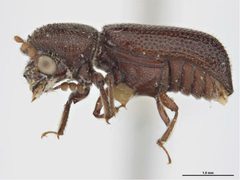
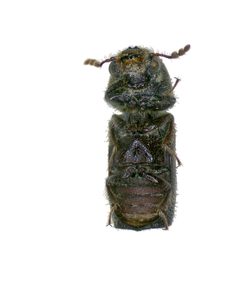
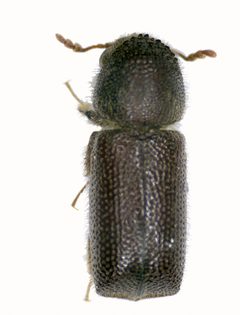
Distinguished from the lesser grain borer (Rhyzopertha dominica) by its substantially larger size—approximately 6 mm versus 3 mm in length. The cylindrical body form is typical of wood-boring Bostrichidae. Accurate identification to level requires examination of morphological characters; misidentification with related stored product pests is possible without careful examination.
Images
Appearance
are approximately 6 mm (0.24 in) in length—roughly twice the size of the related lesser grain borer (Rhyzopertha dominica) at 3 mm. The body is cylindrical and adapted for boring into wood and stored products. in body size has been documented, with females typically larger than males.
Habitat
Primarily associated with stored maize facilities and dried cassava storage. The persists in non-agricultural including woodland areas and forests, which facilitates reinfestation of storage facilities after control measures. Can survive in grain storages and the surrounding landscape, making complete difficult.
Distribution
Native to Mexico and Central America. Introduced and established throughout sub-Saharan Africa following initial detection in Tanzania in the late 1970s; subsequently spread to Togo, Central Africa, Ghana, Benin, Kenya, and major agricultural regions across the continent. Intercepted in the United States (Arizona, California, Texas, Montana, New York, New Jersey, District of Columbia), Canada (Manitoba), and Europe (Germany, France) but no confirmed establishment. Climate models predict potential suitability for the southern United States, South America including Argentina, and tropical regions in Asia.
Diet
Feeds on stored maize and dried cassava chips. In its native range, evolved as a wood-boring insect before adapting to stored products. In Africa, adapted to cassava as an additional crop.
Host Associations
- Zea mays - primary stored maize
- Manihot esculenta - alternate dried cassava chips; in Africa
Life Cycle
At optimum conditions of 80% relative humidity and 32°C (90°F) with available food, completes its lifecycle within 27 days. Development time from to wandering larvae averages 7.54 days; from wandering larvae to averages 11.08 days. Egg to hatching averages 3.2 days. Adult longevity averages 94.33 days.
Behavior
Exhibits strong capability that facilitates ; flight and landing is influenced by wind speed. Can persist in forests and non-agricultural , enabling movement between storage facilities and wild . Rapid spread and observed following introduction to new regions. More destructive in invaded range than native range, possibly due to to local conditions and lack of co-evolved natural enemies.
Ecological Role
Major pest of stored products with significant economic impact. Subject of efforts, particularly using the predatory Teretrius nigrescens in Africa. Persistence in non-agricultural complicates management and facilitates reinfestation.
Human Relevance
Causes severe economic losses in stored maize and cassava. Estimated to destroy up to 40% of stored maize in three months under favorable conditions. In Africa, estimated losses of stored cassava range from 52-74%. Climate change modeling indicates expanding suitable range, with potential establishment in major corn-producing regions including the U.S. Corn Belt, posing significant biosecurity risk. Management strategies include chemical control, using Teretrius nigrescens, and such as camara.
Similar Taxa
- Rhyzopertha dominicaAlso called the lesser grain borer; distinguished by smaller size (3 mm vs. 6 mm) and less destructive impact
- Dinoderus spp.Related bostrichid wood-borers; P. truncatus was originally described as Dinoderus truncatus
More Details
Climate Change Vulnerability
distribution modeling using MaxEnt indicates that suitable will expand away from the equator and inland under warming climate scenarios, with greatest change expected by 2050. High climate change scenarios (RCP 8.5) predict greater expansion than low scenarios (RCP 2.6).
Biological Control
The predatory Teretrius nigrescens has been introduced in Africa as a agent. alternatives including camara have shown efficacy comparable to synthetic at appropriate concentrations.
Sources and further reading
- BugGuide
- GBIF taxonomy match
- iNaturalist taxon
- NCBI Taxonomy
- Catalogue of Life
- Christian Nansen: An Entomologist on the Move | Bug Squad
- The Silence of the Cicadas | Bug Squad
- Encyrtid Holdings | Entomology Research Museum
- Larger Grain Borer: A Pesky Pest That Gets Peskier With Climate Change
- Why Bananas and Sand Will Improve Response to an Invasive Beetle
- Belostomatidae | Beetles In The Bush
- Prostephanus truncatus . [Distribution map].
- Prostephanus truncatus . [Distribution map].
- Modeling the potential range expansion of larger grain borer, Prostephanus truncatus (Coleoptera: Bostrichidae)
- Effectiveness of Tick Berry (Lantana camara) in Controlling Larger Grain Borer (Prostephanus truncatus) in Stored Maize
- Flight and landing behaviour of Prostephanus truncatus (Horn) (Coleoptera: Bostrichidae) in relation to wind speed
- Life history of Prostephanus truncatus (Horn) (Coleoptera: Bostrichidae) at optimum conditions of temperature and humidity
- Combining Natural and Microbial Insecticides with Diatomaceous Earth for Effective Management of Prostephanus truncatus.