
Dineutus
MacLeay, 1825
whirligig beetles
Species Guides
12- Dineutus angustus(whirligig beetle)
- Dineutus assimilis
- Dineutus carolinus(whirligig beetle)
- Dineutus ciliatus(whirligig beetle)
- Dineutus discolor(large whirligig beetle)
- Dineutus emarginatus(whirligig beetle)
- Dineutus hornii(whirligig beetle)
- Dineutus nigrior(whirligig beetle)
- Dineutus productus(whirligig beetle)
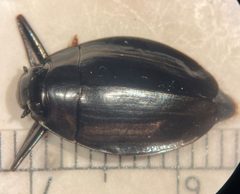
Dineutus is a of whirligig beetles ( Gyrinidae) characterized by relatively large body size compared to other whirligig beetles. are 9–15 mm long with smooth, shallowly lined, or grooved . The genus occurs across North America and other regions, with inhabiting the surface waters of streams and rivers. Members are distinguished from the smaller genus Gyrinus by their larger size and hidden scutellum.


Pronunciation
How to pronounce Dineutus: //daɪˈniː.ʊ.təs//
These audio files are automatically generated. While they are not always 100% accurate, they are a good starting point.
Identification
Dineutus is distinguished from the only other North American whirligig beetle Gyrinus by: larger size (9–15 mm vs. smaller in Gyrinus), hidden scutellum (visible in Gyrinus), and rounded elytral apices. -level identification within Dineutus typically requires examination of coloration (e.g., dark legs in D. ciliatus vs. orange legs in D. emarginatus) and male genitalia structure.
Images
Habitat
Found on the surface of streams, rivers, and other flowing or still freshwater bodies. In North America, occurs in clear, cold waters over gravel bottoms, often in sheltered pools near shore. Some show specificity: D. shorti occurs only in short stretches of creeks within old-growth longleaf pine stands.
Distribution
Widespread across North America; also occurs in New Guinea (D. helleri and D. h. stueberi in the Cyclops Mountains). Specific distribution varies by : D. shorti has a very restricted range in Alabama's Conecuh National Forest; D. nigrior and D. discolor have broader distributions.
Diet
Feeds on organisms or scavenges debris on the water surface.
Behavior
live almost exclusively on the water surface, where they form or 'rafts' containing dozens of individuals. This grouping benefits members through increased detection via multiple scanning the environment. The raft appearance itself may signal noxious chemical defenses from paired pygidial glands to potential predators such as fish. Movement is characteristically fast, erratic, and unpredictable, consisting of constant zigzagging motion that makes individuals difficult to track and photograph.
Ecological Role
Surface-dwelling scavengers and in freshwater . Their may serve as indicators of healthy aquatic surface .
Human Relevance
Occasionally encountered by hikers and naturalists in stream . Some (e.g., D. shorti) highlight the importance of preserving undisturbed aquatic habitats in biodiversity hotspots. are extremely difficult to photograph due to rapid, erratic movement.
Similar Taxa
- GyrinusThe only other North American whirligig beetle ; distinguished by smaller size, visible scutellum, and more pointed elytral apices.
More Details
Species diversity
At least two of whirligig beetles occur in Missouri: Dineutus and Gyrinus. D. shorti, described in 2015, was the first unequivocally new whirligig beetle described from the United States since 1991.
Chemical defense
Like other gyrinids, Dineutus produce noxious volatile substances in their paired pygidial glands, which may be advertised to through the conspicuous appearance of their surface .
Sources and further reading
- BugGuide
- Wikipedia
- GBIF taxonomy match
- iNaturalist taxon
- NCBI Taxonomy
- Catalogue of Life
- Gyrinidae | Beetles In The Bush
- New Whirligig Beetle Showcases U.S. Biodiversity Hotspot
- June | 2010 | Beetles In The Bush | Page 2
- Ozark Trail | Beetles In The Bush
- Notes on Dineutus helleri Ochs, 1925, with new records for the Cyclops Mountains Whirligig Beetle, Dineutus h. stueberi Ochs, 1955 (Coleoptera, Gyrinidae)
- Social Behavior of Adult Whirligig Beetles (Dineutus nigrior and D. discolor (Coleoptera: Gyrinidae)