
Dineutus hornii
Roberts, 1895
whirligig beetle
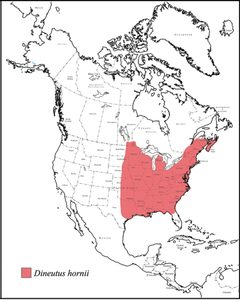
Dineutus hornii is a of whirligig beetle in the Gyrinidae, distributed across North America including Canada (Manitoba, New Brunswick, Nova Scotia) and presumably the United States. Whirligig beetles in the Dineutus are among the largest members of the family, characterized by their distinctive surface-dwelling and on calm water. Like other gyrinids, they possess divided adapted for simultaneous vision above and below the water surface, and pygidial glands that produce defensive secretions.
Pronunciation
How to pronounce Dineutus hornii: /dɪˈnjuːtəs ˈhɔːrni/
These audio files are automatically generated. While they are not always 100% accurate, they are a good starting point.
Identification
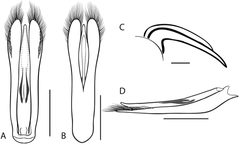
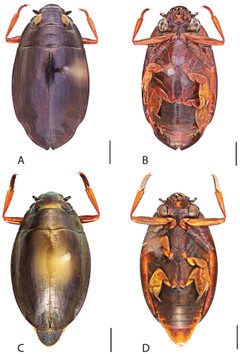
Members of the Dineutus can be distinguished from the smaller genus Gyrinus by their larger size (typically 10-12 mm), rounded elytral apices, and concealed scutellum. -level identification within Dineutus requires examination of characters, particularly leg coloration and male genitalia. Dineutus hornii was described by Roberts in 1895, but specific diagnostic features distinguishing it from such as D. discolor, D. ciliatus, and D. emarginatus are not documented in the available sources.
Images
Habitat
Aquatic with calm, clear water; associated with rivers, streams, and sheltered pools. Based on observations of , likely occupies surface waters of freshwater systems with gravel or rocky substrates.
Distribution
North America; recorded from Canada (Manitoba, New Brunswick, Nova Scotia) and presumably present in the United States given the broad North American distribution cited.
Similar Taxa
- Dineutus discolorSimilar large size and rounded elytral apices; distinguished by coloration and male genitalia
- Dineutus ciliatusSimilar ; D. ciliatus has dark legs while D. emarginatus has orange legs, providing a useful character for distinguishing some
- Dineutus emarginatusSimilar size and ; distinguished by orange legs (versus dark legs in D. ciliatus)
- Gyrinus spp.Smaller gyrinid with exposed scutellum and more pointed elytral apices; Dineutus are larger with concealed scutellum
More Details
Taxonomic note
The specific epithet 'hornii' honors George Henry Horn (1840-1897), a prominent American coleopterist who described numerous in the late 19th century.
Sources and further reading
- BugGuide
- Wikipedia
- GBIF taxonomy match
- iNaturalist taxon
- NCBI Taxonomy
- Gyrinidae | Beetles In The Bush
- New Whirligig Beetle Showcases U.S. Biodiversity Hotspot
- Winter Botany Quiz #6 – answers and a checklist | Beetles In The Bush
- August “jug trap” run | Beetles In The Bush
- April | 2010 | Beetles In The Bush | Page 2
- Let’s make a deal! | Beetles In The Bush