
Dineutus ciliatus
(Forsberg, 1821)
whirligig beetle
Dineutus ciliatus is a of whirligig beetle in the Gyrinidae. It is one of two of whirligig beetles found in Missouri, distinguished from the smaller Gyrinus by its larger size (~12 mm) and hidden scutellum. The species is found in North America and is distinguished from similar primarily by its dark coloration and dark legs, in contrast to the orange-legged D. emarginatus. Whirligig beetles are aquatic insects that live almost exclusively on the water surface, where they form called 'rafts' that provide anti- benefits through increased vigilance and chemical defense.
Pronunciation
How to pronounce Dineutus ciliatus: //daɪˈnjuːtəs sɪˈlaɪətəs//
These audio files are automatically generated. While they are not always 100% accurate, they are a good starting point.
Identification
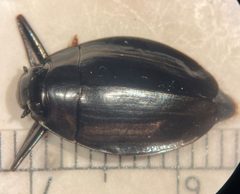
Distinguished from the only other whirligig in Missouri, Gyrinus, by larger size (~12 mm versus smaller) and hidden scutellum (visible in Gyrinus). Within Dineutus, separated from D. emarginatus by dark legs versus orange legs; from D. discolor by coloration (D. ciliatus has darker red venter, D. discolor has pale orange venter). Definitive identification requires examination of ventral coloration. The rounded elytral apices narrow identification to a few possible Dineutus .
Images
Appearance
measure approximately 12 mm in length. The body is oval and streamlined, adapted for life on the water surface. The scutellum is hidden, a diagnostic feature of the Dineutus. Elytral apices are rounded. coloration is dark, with dark legs distinguishing this from the orange-legged D. emarginatus. The body shape is more elongate compared to some . Coloration is non-aposematic despite the beetles' chemical defenses.
Habitat
Found in freshwater aquatic environments, particularly rivers and streams with clear, cold water over gravel bottoms. In the Ozark region, occurs in streams sustained year-round by seeps and springs from karst geology. Occupies sheltered pools near shorelines where surface conditions allow for formation. Lazy, slow-moving waters are preferred over rapids.
Distribution
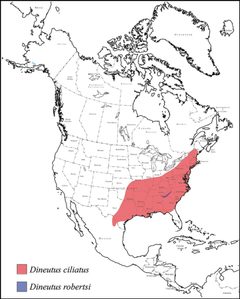
North America. Documented in the Ozark Highlands of Missouri, specifically in the Black River and North Fork River systems. Occurs in the southeastern United States including Alabama. The ' range overlaps with other Dineutus species in the Ozark region.
Seasonality
Active during spring and likely through warmer months. One observation records in early April. have been observed in October, suggesting extended activity period through fall.
Behavior
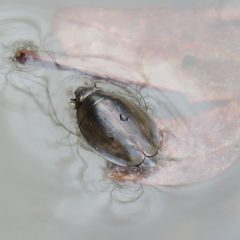
Forms on the water surface called 'rafts,' which can range from small groups to extensive patches. These aggregations provide anti- benefits: increased number of scanning for threats improves detection , and larger rafts function more efficiently for predator detection. The raft appearance itself may serve as an aposematic signal warning fish predators of noxious chemicals produced in paired pygidial glands. Movement is fast, erratic, and unpredictable, consisting of constant zigzagging motion on the water surface. Beetles are highly skittish and difficult to approach for observation or photography.
Ecological Role
Serves as prey for fish, though defended by chemical secretions. Participates in surface scavenging and on small organisms in the water surface microlayer. represent a distinctive behavioral for avoidance in freshwater surface .
Human Relevance
Occasionally encountered by hikers and naturalists in Ozark streams. Subject of interest for macrophotography due to challenging , though few high-quality photographs exist. Not a pest ; no known negative economic impacts. May occasionally be collected by aquatic insect researchers.
Similar Taxa
- Dineutus emarginatusSimilar size and ; distinguished by orange legs versus dark legs in D. ciliatus, and coloration differences
- Dineutus discolorSimilar size and rounded elytral apices; distinguished by pale orange venter versus darker red venter in D. ciliatus
- Gyrinus spp.Only other whirligig in Missouri; distinguished by smaller size and visible scutellum
More Details
Chemical Defense
Produces noxious chemicals in paired pygidial glands; Dineutus reportedly smell sweet (described as similar to sour apple candy), in contrast to Gyrinus species which have pungent, unpleasant pygidial secretions
Photography Challenge
Considered extremely difficult to photograph due to constant motion, erratic and unpredictable swimming patterns, and skittish requiring close approach over water
Sources and further reading
- BugGuide
- Wikipedia
- GBIF taxonomy match
- iNaturalist taxon
- NCBI Taxonomy
- Gyrinidae | Beetles In The Bush
- Calm waters, frenzied beetles | Beetles In The Bush
- June | 2010 | Beetles In The Bush | Page 2
- Ozark Trail | Beetles In The Bush
- New Whirligig Beetle Showcases U.S. Biodiversity Hotspot
- Do “bugs” have brains? And what exactly is a brain anyway? - Buglife Blog - Buglife