
Dineutus assimilis
(Kirby, 1837)
Dineutus assimilis is a of whirligig beetle in the Gyrinidae, native to North America. Like other members of the Dineutus, it inhabits the surface of freshwater bodies where it exhibits characteristic rapid, erratic swimming . The species is distinguished from primarily by coloration and leg pigmentation. It is part of a diverse genus of surface-dwelling aquatic beetles known for their gregarious "rafting" behavior and chemical defenses.
Pronunciation
How to pronounce Dineutus assimilis: /dɪˈneɪ.təs əˈsɪ.mɪ.lɪs/
These audio files are automatically generated. While they are not always 100% accurate, they are a good starting point.
Identification
Distinguished from the only other North American whirligig , Gyrinus, by larger size (~12 mm vs. ~5–7 mm) and hidden scutellum. Within Dineutus, separated from D. emarginatus by dark legs (orange in D. emarginatus) and from D. discolor and D. ciliatus by specific coloration patterns and protarsus . Rounded elytral apices help narrow identification to a subset of Dineutus . Definitive identification requires examination of ventral characters and male genitalia.
Images
Appearance
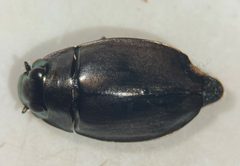
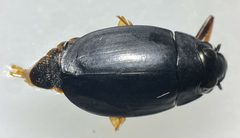
Medium-sized whirligig beetle, approximately 12 mm in length. Body oval and streamlined, adapted for surface swimming. surface typically dark. Scutellum hidden, not visible from above—a key -level trait distinguishing Dineutus from Gyrinus. with rounded apices. coloration and leg pigmentation (dark legs in this ) are primary distinguishing characters from related species. present in protarsus structure, with males possessing modified front legs presumably used for grasping females during mating.
Habitat
Freshwater surface including rivers, streams, and pools with slow-moving or still water. Occurs in clear, cold waters over gravelled or rocky bottoms. Found in sheltered pools near shorelines where beetles form or "rafts." Associated with forested watersheds and karst geology regions with sustained year-round water flow from seeps and springs.
Distribution
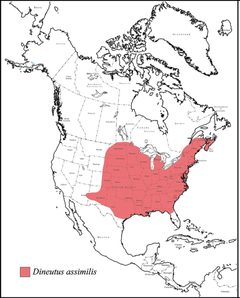
North America. Documented from Canada (Alberta, British Columbia, Manitoba) and the United States. Part of the broader Dineutus distribution across temperate North America.
Behavior
Exhibits rapid, erratic, zigzagging surface swimming motion that is fast and unpredictable. Forms or "rafts" on water surface— that enhances detection through increased vigilance (more scanning for threats) and may serve as aposematic signaling of chemical defenses. Highly skittish and difficult to approach; readily escapes when disturbed. Chemical defense produced in paired pygidial glands produces noxious compounds that deter fish predators.
Ecological Role
Surface-dwelling aquatic insect that feeds on organisms and scavenges debris at the air-water interface. Serves as prey for fish, though its chemical defenses and rafting provide protection. Contributes to nutrient cycling at the water surface.
Human Relevance
Occasionally encountered by hikers and naturalists in suitable freshwater . Subject of interest for macrophotography due to challenging , though its rapid movement makes it among the more difficult insects to photograph well. No significant economic importance.
Similar Taxa
- Dineutus emarginatusOverlapping distribution and similar size; distinguished by orange legs (dark in D. assimilis) and coloration.
- Dineutus discolorCommon sympatric ; distinguished by protarsus , coloration, and subtle differences in body proportions.
- Dineutus ciliatusSimilar size and rounded elytral apices; separated by characters and leg coloration.
- Gyrinus spp.Only other whirligig in North America; distinguished by smaller size (~5–7 mm), visible scutellum, and different swimming patterns.
More Details
Taxonomic note
-level identification in Dineutus relies heavily on coloration, leg pigmentation, and male genitalia structure—characters not easily observed in field photographs or live specimens without capture and examination.
Research context
The Dineutus has received renewed taxonomic attention, with D. shorti described in 2015 as the first unequivocally new U.S. whirligig beetle since 1991, highlighting that diversity in this group remains incompletely documented.
Sources and further reading
- BugGuide
- Wikipedia
- GBIF taxonomy match
- iNaturalist taxon
- NCBI Taxonomy
- Gyrinidae | Beetles In The Bush
- Cricket Virus Leads to Illegal Importation of Foreign Species for Pet Food
- New Whirligig Beetle Showcases U.S. Biodiversity Hotspot
- June | 2010 | Beetles In The Bush | Page 2
- Ozark Trail | Beetles In The Bush