
Dineutus shorti
Gustafson & Sites, 2015
whirligig beetle
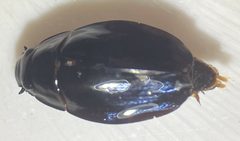
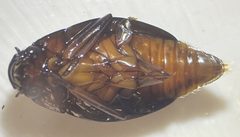
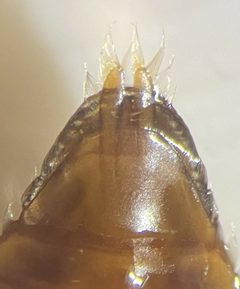
Dineutus shorti is a of whirligig beetle ( Gyrinidae) described in 2015 from the southeastern coastal plain of the United States. It represents the first unequivocally new species of whirligig beetle described from the U.S. since 1991. The species has an extremely restricted range, known only from a narrow section of the coastal plain in the Blackwater and Pensacola river watersheds of Santa Rosa and Okaloosa counties, Florida and Covington County, Alabama. It was named in honor of aquatic coleopterist Andrew E. Z. Short.
Pronunciation
How to pronounce Dineutus shorti: /dɪˈnjuːtəs ˈʃɔːrtaɪ/
These audio files are automatically generated. While they are not always 100% accurate, they are a good starting point.
Identification
Dineutus shorti can be distinguished from the similar and much more common D. discolor by the shape of the male protarsus and the proportions of the . It is also distinguished by its extremely restricted association: it occurs only in short stretches of creeks within old-growth longleaf pine stands, in areas where D. discolor is absent. The rounded elytral apices distinguish it from some other Dineutus . Accurate identification requires examination of male genitalia and protarsal structure.
Images
Habitat
Found in short stretches of creeks within old-growth longleaf pine stands in the southeastern coastal plain. The shows strong specificity, occurring in sheltered pools near shore on the water surface. It is not found in areas where the common D. discolor occurs, suggesting competitive exclusion or distinct microhabitat requirements.
Distribution
Extremely restricted range in the southeastern United States. Known only from the coastal plain in the Blackwater and Pensacola river watersheds of Santa Rosa and Okaloosa counties, Florida and Covington County, Alabama. First collected in the 1970s but not recognized as distinct until 2015.
Diet
Feeds on organisms or scavenges debris on the water surface, based on general characteristics; specific dietary details for D. shorti not documented.
Behavior
Forms or 'rafts' on the water surface, a characteristic of whirligig beetles. These aggregations benefit from increased vigilance against through multiple scanning for threats. The is fast-moving and erratic in its swimming pattern, making it difficult to approach or photograph.
Ecological Role
Contributes to the unique biodiversity of the southeastern coastal plain, a relatively unrecognized biodiversity hotspot. As a surface-dwelling aquatic insect, it likely plays a role in nutrient cycling and as prey for fish and other . The ' restricted distribution makes it a potential indicator of old-growth longleaf pine integrity.
Human Relevance
Named in honor of Andrew E. Z. Short, an aquatic coleopterist at the University of Kansas, recognizing his contributions to insect , aquatic research, and biodiversity conservation. The highlights the importance of natural history collections, as it was first collected in the 1970s and preserved in the Enns Entomology Museum before being recognized as new. Its discovery underscores the need for further exploration of freshwater in the southeastern coastal plain.
Similar Taxa
- Dineutus discolorMuch more common and widespread found throughout much of the range; distinguished by different male protarsus shape, different proportions, and absence from old-growth longleaf pine creek where D. shorti occurs
- Dineutus ciliatusSimilar large size and rounded elytral apices; distinguished primarily by coloration including dark legs (D. shorti leg coloration not explicitly documented)
- Dineutus emarginatusSimilar large size; distinguished by orange legs and different coloration
More Details
Discovery and description
First collected in the 1970s and deposited in the Enns Entomology Museum at the University of Missouri, where specimens were tentatively identified as potentially new. Rediscovered in 2015 by Grey Gustafson in Conecuh National Forest, Alabama, who confirmed its status as a new . The 2015 description by Gustafson & Sites marked the first unequivocally new U.S. whirligig beetle species since 1991.
Conservation significance
The southeastern coastal plain is identified as a relatively unrecognized biodiversity hotspot in need of global designation and further entomological exploration. Dineutus shorti's extreme specificity and small range make it vulnerable to habitat loss and degradation.