
Pterostichus adstrictus
Eschscholtz, 1823
Upland Blackclock
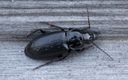
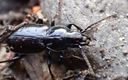
Pterostichus adstrictus is a cold-adapted ground beetle with a Holarctic-circumpolar distribution, occurring across subarctic and alpine regions of North America and Eurasia. In North America it ranges from the Bering Sea coast to Newfoundland and south to Pennsylvania, Indiana, South Dakota, New Mexico, and California's Sierra Nevada. European were historically known only from northern peripheries (Northern Ireland, Wales, Scandinavia) until discovery in the Austrian Alps, representing a glacial relict with arctic-alpine distribution. The exhibits stenotopic specificity and has been observed to form locally dense populations despite restricted geographic occurrence.

Pronunciation
How to pronounce Pterostichus adstrictus: /tɛroʊˈstɪkəs ædˈstrɪktəs/
These audio files are automatically generated. While they are not always 100% accurate, they are a good starting point.
Identification
Member of subgenus Bothriopterus; Austrian show fewer foveolate punctures on and different elytra-to-pronotum ratio compared to Asian populations. Distinguished from related Bothriopterus by morphological characters and data. Austrian and Finnish populations are genetically distinct with limited to no .
Images
Habitat
In the Austrian Alps: pioneer stages of gravel banks along mountain brooks at 1875–2265 m elevation, specifically stable, rarely flooded inner and higher parts with patchy herbaceous vegetation on moderately moist, sandy raw soils under larger stones. Also occurs in silicate scree slopes from historical glacial moraines with sandy fractions, patchy vegetation, constant soil humidity and sufficient stability. Avoids dynamic, regularly flooded riparian zones and transition zones to alpine heath, meadows and pastures. In Russia: forest .
Distribution
Holarctic-circumpolar. North America: coast of Bering Sea to Newfoundland, south to Pennsylvania, Indiana, South Dakota, New Mexico, and Sierra Nevada in California. Europe: Northern Ireland, Wales, southern Scandinavia; southernmost records from Austrian Ötztal Alps (Kaunertal and Taschachtal). Asia: Russia (Khabarovsky Krai, Komsomolsky Nature Reserve).
Seasonality
High surface activity from mid-June to mid-August with maximum in July; seasonal appearance begins soon after snow melt in May. Second activity peak in September represents inactive individuals entering holes under large stones.
Life Cycle
with spring-summer type and imaginal during winter. Larvae observed in July and August; newly hatched appear in September. Overwinters as adult in holes under large stones.
Behavior
Stenotopic (narrow specificity). Forms remarkably large at local sites despite geographically restricted occurrence; sometimes the most common ground beetle at specific sites. Syntopy with other larger Pterostichini rare.
Ecological Role
Accompanies other arctic-alpine and boreo-montane including Nebria gyllenhali, Amara erratica, Amara quenseli quenseli, Trechus rubens, Miscodera arctica and Cymindis vaporariorum. Serves as potential prey for in laboratory studies.
Sources and further reading
- BugGuide
- Wikipedia
- GBIF taxonomy match
- iNaturalist taxon
- NCBI Taxonomy
- Largest Carabid Beetle in California | Bug Squad
- New Guide Offers Latest in Carrot Weevil Management
- Where siblings mingle: Ellipsoptera marginata vs. E. hamata | Beetles In The Bush
- Reuse of science for the benefit of all: the beauty of open access | Blog
- Pensoft blog - Part 136
- Meet Enus | Beetles In The Bush
- Relicts from Glacial Times: The Ground Beetle Pterostichus adstrictus Eschscholtz, 1823 (Coleoptera: Carabidae) in the Austrian Alps
- SPATIAL DISTRIBUTION AND REALIZATION OF THE LIFE CYCLE OF THE GROUND BEETLE PTEROSTICHUS ADSTRICTUS ESCHSCHOLTZ, 1823 (COLEOPTERA, CARABIDAE) IN THE KOMSOMOLSKY NATURE RESERVE, KHABAROVSKY KRAI