
Galerita lecontei
Dejean, 1831
false bombardier beetle
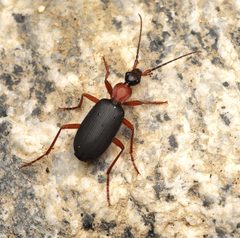
Galerita lecontei, commonly known as the false bombardier beetle, is a ground beetle in the Carabidae distributed across North America, Central America, and the Caribbean. The is notable for its defensive chemical spray containing primarily formic acid, ejected from paired abdominal glands when threatened. range from 14.9 to 20.0 mm in length and display predominantly black coloration with red or orange markings on the and legs. The species exhibits hunting and possesses elongated legs adapted for rapid movement.
Pronunciation
How to pronounce Galerita lecontei: //ɡæləˈriːtə lɛˈkɒntaɪ//
These audio files are automatically generated. While they are not always 100% accurate, they are a good starting point.
Identification
Distinguished from similar ground beetles by combination of: black with red/orange thoracic and leg markings; long and tibiae (contrasting with short-legged burrowing like Scarites subterraneus); shallow, narrow prothorax; and presence of paired abdominal defensive glands. Differs from true bombardier beetles (Brachinini) in gland chemistry and anatomy—Galerita lecontei produces formic acid-based spray rather than the explosive benzoquinone discharge of Brachinini. Distinguished from other Galerita species by geographic range and subtle morphological features.
Images
Habitat
Occupies temperate zone woodlands and grasslands with moist microhabitats. Frequently found under logs and in leaf litter piles where humidity is sufficient for -laying. Requires environments combining cover from with proximity to food sources.
Distribution
Native to North America, Central America, and the Caribbean. Documented from continental United States (concentrated in California, Florida, and North Carolina), Mexico, Mesoamerica, and the West Indies. Records include Cayman Islands, Cuba, Hispaniola, Honduras, and Lesser Antilles. G. l. veracrucis reported from Pakistan (first Asian record, 2020–2021).
Diet
Semi-fluid feeder consuming fragments and fluids. Prey includes smaller insects captured during hunting. Within Carabidae, larvae preferred when available, likely due to soft body texture facilitating consumption.
Life Cycle
deposited in moist, protected locations near food sources such as underground tunnels or wood cracks containing prey organisms. Development: egg → larva (with periodic molting and feeding) → pupa (resembling form) → adult. Adults live several weeks and reproduce during this period.
Behavior
that aggregates in dark, damp locations during daytime. Rapid runner with weak pushing ability, contrasting with burrowing-adapted . When threatened, accurately aims defensive spray toward stimulated appendage; discharge is unilateral (same side as threat) and jet-like with oscillating trajectory. Spray contains approximately 0.8 mg fluid per ejection, with gland capacity for roughly 6.5 discharges before depletion. Does not exhibit cooperative defense against predators.
Ecological Role
of small arthropods in forest floor and grassland . Chemical defense interactions with ants documented; spray composition includes formic acid at quantities comparable to several ants but hydrocarbon content approximately 10× single gland capacity. Defensive spray serves as alarm signal to ants rather than lethal weapon under typical discharge conditions.
Human Relevance
No special conservation status (IUCN). No documented economic importance or pest status. Chemical defense mechanism subject of scientific research regarding gland anatomy and defensive biochemistry.
Similar Taxa
- Scarites subterraneusAnother ground beetle with contrasting —short and tibiae adapted for burrowing and strong pushing, versus G. lecontei's elongated legs for rapid running. Body cylindrical with narrow, flat rear in Scarites versus shallow, narrow prothorax in Galerita.
- Brachinini (true bombardier beetles)Share reference to chemical defense but differ fundamentally in gland chemistry and discharge mechanism. True bombardier beetles produce explosive benzoquinone spray through catalyzed reaction; G. lecontei ejects pre-formed formic acid solution without explosive discharge.
- Cicindela sexguttataSimilar bright coloration and ground-dwelling habit, but distinguished by more domed profile, tapered elytral apex, and white in both sexes (G. lecontei has dark labrum in females).
Misconceptions
"false bombardier beetle" reflects historical confusion with true bombardier beetles (Brachinini), but the lacks the explosive catalytic discharge mechanism characteristic of that group. The defensive spray, while chemically potent, is not explosive.
More Details
Subspecies
Four recognized: G. l. bicoloripes (Reichardt, 1967); G. l. lecontei Dejean, 1831; G. l. tenebricosa Klug, 1834; G. l. veracrucis Ball & Nimmo, 1983. The latter represents first documented Asian occurrence when collected in Sialkot, Pakistan (2020–2021).
Defensive gland chemistry
Abdominal gland fluid composition: ~80% formic acid (4.56 mg per total), acetic acid, and lipophilic components (long-chain hydrocarbons and esters). Gland anatomy includes secretory clusters, coiled efferent duct to compression, kidney-shaped storage sac with compressor muscles, and opening at abdominal tip.
Locomotor morphology
Long bone lengths (pro-femoral, meso-femoral, meta-femoral, tibial) correlate with body length and facilitate rapid running. Weak pushing ability reflects to rather than lifestyle.