
Galerita bicolor
(Drury, 1773)
False bombardier beetle
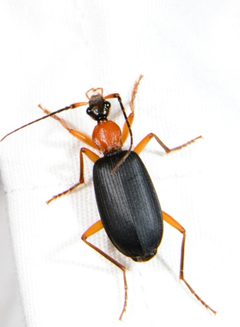
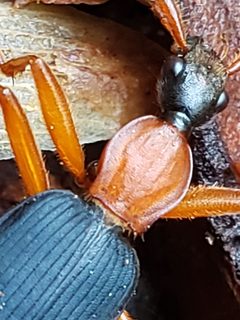
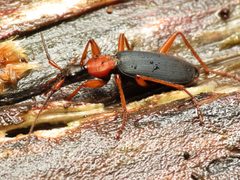
Galerita bicolor, commonly known as the false bombardier beetle, is a ground beetle occurring in the eastern United States. It exhibits of true bombardier beetles (Brachinini), sharing their characteristic red-and-black coloration without possessing the explosive defensive chemical spray. are large, elongated beetles measuring 17.0–22.5 mm, found primarily in moist woodland and meadow . The species is active year-round under bark and leaf litter, with peak activity from February through November.
Pronunciation
How to pronounce Galerita bicolor: /ɡəˈlɛrɪtə ˈbaɪkələr/
These audio files are automatically generated. While they are not always 100% accurate, they are a good starting point.
Identification
Distinguished from true bombardier beetles (Brachinini) by lack of defensive gland openings at abdominal tip and inability to produce explosive chemical spray. Separated from other Galerita by specific red-and-black pattern: red pronotum contrasting with black and . Large size (17–22.5 mm) and elongated body form help distinguish from smaller carabids. Antennal bases slightly widened, pale in color. Larvae resemble bombardier beetle larvae, requiring careful examination for positive identification.
Images
Habitat
Moist environments including woodlands, meadows, and suburban backyards. Frequently found under bark, leaf litter, rocks, and logs. Occupies both natural and anthropogenic settings with sufficient ground cover and humidity.
Distribution
Eastern United States, ranging from New York south to Florida and west to South Dakota and Texas.
Seasonality
Active year-round with peak activity from February through November. frequently encountered under bark throughout all seasons.
Diet
Predatory on insects; both larvae and feed on other insects.
Life Cycle
Females construct purse-shaped mud attached to undersides of leaves where are deposited. Larvae develop in these cells. Larval stage resembles larvae of true bombardier beetles. can live 1–2 years in the wild.
Behavior
Emits foul-smelling defensive secretion when disturbed, though less potent than true bombardier beetles. Frequently encountered dead or hiding under cover objects. or activity pattern suggested by sheltering .
Ecological Role
of other insects; subject to system where it gains protection from visually-hunting predators by resembling chemically-defended bombardier beetles. Prey for birds and other .
Human Relevance
Occasional backyard inhabitant; harmless to humans. May be mistaken for bombardier beetles. No economic significance.
Similar Taxa
- Brachinus spp. (true bombardier beetles)Share red-and-black coloration and elongated body form; distinguished by presence of abdominal defensive glands capable of explosive chemical discharge, and different antennal structure.
- Other Galerita speciesG. bicolor specifically identified by red pronotum with black and ; other may have different color patterns or all-dark coloration.
Misconceptions
Frequently mistaken for true bombardier beetles due to color mimicry; however, G. bicolor cannot produce the explosive, high-temperature chemical defense that characterizes Brachinini.
More Details
Defensive chemistry
Produces formic acid (80%) as defensive secretion, as demonstrated in G. lecontei; secretion is irritating but not explosively discharged.
Mimicry system
Classic example of where harmless gains avoidance by resembling unpalatable or dangerous model species.