
Galerita
Fabricius, 1801
False Bombardier Beetles
Species Guides
8- Galerita aequinoctialis
- Galerita atripes
- Galerita bicolor(False bombardier beetle)
- Galerita forreri
- Galerita janus
- Galerita lecontei(false bombardier beetle)
- Galerita mexicana(Mexican false bombardier beetle)
- Galerita reichardti
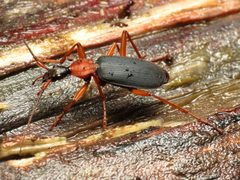
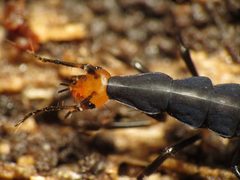
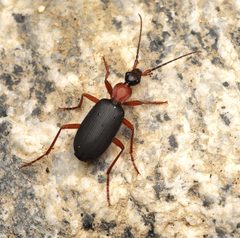
Galerita is a of ground beetles in the Carabidae, containing over 90 described . Members are commonly known as False Bombardier Beetles due to their resemblance to bombardier beetles (Brachinus), though they lack the explosive chemical defense mechanism. The genus was established by Fabricius in 1801 and belongs to the tribe Galeritini within the Dryptinae. These beetles are primarily distributed across the Americas, with species found in North, Central, and South America.
Pronunciation
How to pronounce Galerita: /ɡaˈleːr.i.ta/
These audio files are automatically generated. While they are not always 100% accurate, they are a good starting point.
Identification
Distinguished from true bombardier beetles (Brachinus) by the absence of the explosive pygidial gland defense system. Galerita possess a more elongated body form compared to many other carabid . are thread-like () and moderately long. typically smooth or with fine punctation, often with metallic or dull black coloration. Legs are long and adapted for running. The pronotum is usually narrower than the elytra at the base, with distinct lateral margins.
Images
Habitat
Terrestrial including forests, woodlands, and grasslands. Often found in leaf litter, under stones, logs, or other ground debris. Some occur in more open habitats including agricultural fields and disturbed areas.
Distribution
Primarily distributed across the Americas. occur in North America (United States, Mexico), Central America, and South America. The shows a New World distribution pattern with greatest diversity in tropical and subtropical regions.
Ecological Role
Ground-dwelling that contribute to regulation of in soil and leaf litter . As predators, they likely play a role in controlling populations of small insects, spiders, and other arthropods. Their presence in diverse indicates adaptability to varying environmental conditions.
Similar Taxa
- BrachinusTrue bombardier beetles that share similar body form and reference; distinguished by presence of explosive chemical defense and different antennal structure.
- ChlaeniusAnother in the Dryptinae with similar ground beetle ; distinguished by different coloration patterns and pronotal shape.
Sources and further reading
- BugGuide
- Wikipedia
- iNaturalist taxon
- NCBI Taxonomy
- Catalogue of Life
- Distribution and Behavioural Ecology of the Sulphur-Crested Cockatoo (Cacatua Galerita L.) in New Zealand
- Social and ecological factors associated with innovation in urban sulphur-crested cockatoos ( Cacatua galerita )
- Do sulphur-crested cockatoos (Cacatua galerita) call the weather?
- Carboplatin pharmacokinetics following a single‐dose infusion in sulphur‐crested cockatoos (Cacatua galerita)
- Notes on the Biology of the Carabid Genera Brachynus, Galerita and Chlaenius*
- Social network analysis reveals context-dependent kin relationships in wild sulphur-crested cockatoos, Cacatua galerita
- New feather mite species (Acari, Astigmata) from the Sulphur-crested Cockatoo Cacatua galerita and Yellow-crested Cockatoo C. sulphurea (Psittaciformes, Cacatuidae)
- MELIOIDOSIS IN A SULPHUR‐CRESTED COCKATOO (CACATUA GALERiTA)