
Brachininae
Bonelli, 1810
bombardier beetles
Genus Guides
1- Brachinus(bombardier beetles)
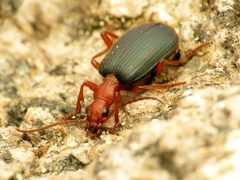
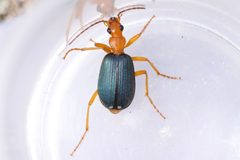
Brachininae is a of ground beetles (Carabidae) comprising approximately 7,500 across 14 . Members are commonly known as bombardier beetles due to their distinctive explosive defensive chemistry. The subfamily contains two tribes: Brachinini (9 genera including Brachinus, Pheropsophus, and Mastax) and Crepidogastrini (5 genera). The group has a global distribution with significant diversity in the Oriental and Palearctic regions.
Pronunciation
How to pronounce Brachininae: //brəˈkɪnɪni//
These audio files are automatically generated. While they are not always 100% accurate, they are a good starting point.
Identification
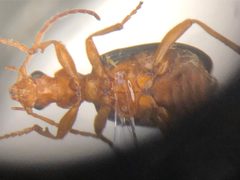
Brachininae can be distinguished from other Carabidae by the presence of defensive glands that produce and eject a hot, noxious chemical spray—a trait unique to this group within the . The subfamily includes with varied body forms: Brachinus are typically small to medium-sized with elongated bodies, while Pheropsophus species often have more robust, rounded . Accurate identification to genus and species level requires examination of male genitalia, particularly the lobe of the .
Images
Distribution
Global distribution with documented records from Europe (including Romania, France, Germany, Italy, Spain, Portugal, Austria, Greece, Ukraine, Republic of Moldova), Asia (India, Western Ghats, Indo-Burma region, Eastern Himalayas, Kazakhstan, Indonesia/Java, Russia), Northern Africa (Algeria, Egypt), and the Nearctic region. The exhibits significant regional , with multiple Pheropsophus to the Indian subcontinent, Western Ghats, and specific mountain ranges.
Behavior
The defining behavioral characteristic of Brachininae is the explosive defensive mechanism, in which beetles eject a hot, noxious spray from paired abdominal glands when threatened. This chemical defense has been extensively studied in Brachinus . Some species have been observed in laboratory settings, though detailed behavioral descriptions are limited to specific such as Pheropsophus aequinoctialis and Stenaptinus jessoensis.
Ecological Role
Members of Brachininae function as in terrestrial . Specific such as Pheropsophus aequinoctialis and Stenaptinus jessoensis have been identified as economically beneficial predators, suggesting potential roles in .
Human Relevance
Bombardier beetles are of significant scientific interest due to their unique explosive defensive chemistry, which has been extensively studied as a model system for chemical defense evolution and biochemistry. Certain are recognized as economically beneficial with potential applications in pest management. The group has also served as a focal in phylogenetic studies addressing species group delineation and molecular .
Similar Taxa
- Other Carabidae subfamiliesBrachininae is distinguished from all other ground beetle by the presence of explosive defensive glands; no other Carabidae subfamily possesses this chemical defense mechanism.
More Details
Tribal Classification
The is divided into two tribes: Brachinini Bonelli, 1810 (9 : Aptinoderus, Aptinus, Brachinulus, Brachinus, Mastax, Pheropsophus, Styphlodromus, Styphlomerus) and Crepidogastrini Jeannel, 1949 (5 genera: Brachynillus, Crepidogaster, Crepidogastrillus, Crepidogastrinus, Crepidolomus, Crepidonellus).
Phylogenetic Revisions
Molecular phylogenetic studies using COI, CAD, and 28S loci have substantially revised group boundaries within Brachinus (subgenus Neobrachinus), finding that morphologically-defined groups were often polyphyletic. Eight new species groups were erected based on molecular evidence: cinctipennis, cyanipennis, galactoderus, gebhardis, mexicanus, phaeocerus, quadripennis, and tenuicollis.
Sources and further reading
- BugGuide
- Wikipedia
- iNaturalist taxon
- NCBI Taxonomy
- Catalogue of Life
- On The Species Of Brachinini (Coleoptera: Carabidae: Brachininae: Brachinini) In Romanian Museum Collections
- Bombardier beetles of the genus Pheropsophus Solier 1833 (Carabidae: Brachininae: Brachinini) from Indian subcontinent
- On the distribution of the ‘Javan bombardier’ — Stenaptinus agnatus (Chaudoir, 1876) (Coleoptera, Carabidae: Brachininae) in Russia
- Molecular phylogeny and revision of species groups of Nearctic bombardier beetles (Carabidae, Brachininae, Brachinus ( Neobrachinus))
- New Record of the Genus <i>Pheropsophus</i> Solier (Coleoptera: Carabidae: Brachininae) from the Northern Western Ghats of India
- Economically Beneficial Ground Beetles. The specialized predators Pheropsophus aequinoctialis (L.) and Stenaptinus jessoensis (Morawitz): Their laboratory behavior and descriptions of immature stages (Coleoptera: Carabidae: Brachininae)