
Amblycheila katzi
Duran & Roman, 2019
Trans-Pecos Giant Tiger Beetle
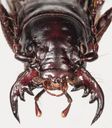
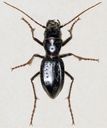
Amblycheila katzi is a small-sized tiger (23–28 mm) to the Trans-Pecos region of western Texas. It is distinguished from all other Amblycheila by its strongly petrophilous , occupying vertical rock walls rather than ground . are active on limestone surfaces 1–5 m above ground. The has been successfully bred in captivity, with 59 adults reared from .
Pronunciation
How to pronounce Amblycheila katzi: /ˌæmblɪˈkaɪlə ˈkætsi/
These audio files are automatically generated. While they are not always 100% accurate, they are a good starting point.
Identification
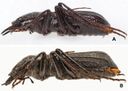
Small Amblycheila (23–28 mm) with trapezoidal pronotum and almond-shaped bearing sharply defined carinae. Elytra smooth and polished with sparse, irregular setigerous punctures. Male hind lacks spine-like projection present in . Distinguished ecologically by exclusive association with vertical rock walls; not captured in pitfall traps.
Images
Habitat
Steep-sided canyons with exposed Cretaceous limestone bedrock. occupy vertical rock surfaces 1–5 m above ground, using crevices, grooves, and ledges. Larvae inhabit fine calcareous clays within grooves and crevices of vertical limestone walls. Not found on ground or soil substrates.
Distribution
to the Trans-Pecos region of western Texas (Val Verde and Terrell Counties), within the Chihuahuan Desert. Likely extends into adjacent northern Mexico given proximity to international border.
Seasonality
Earliest recorded observation is 23 May. Activity period likely extends through warmer months in desert canyon environments.
Diet
of .
Life Cycle
Larvae observed as 2nd and 3rd instars in vertical rock wall crevices. Captive breeding successful; laid in captivity produced 59 beetles.
Behavior
Strongly petrophilous (rock-dwelling); uniquely associated with vertical rock walls among North American tiger beetles. Nocturnally active. frequently found in areas where Latrodectus spiders are abundant.
Ecological Role
in desert canyon .
Similar Taxa
- Amblycheila baroniOccurs in ground and soil rather than vertical rock walls; larger body size.
- Amblycheila cylindriformisGround-dwelling ; lacks exclusive rock wall association.
- Other Amblycheila speciesAll occupy ground or soil ; A. katzi is the only petrophilous member of the .
Sources and further reading
- BugGuide
- Wikipedia
- GBIF taxonomy match
- iNaturalist taxon
- Catalogue of Life
- Miridae | Beetles In The Bush
- A new petrophilous tiger beetle from the Trans-Pecos region of Texas and revised key to the genus Amblycheila (Coleoptera, Carabidae, Cicindelinae)
- A new petrophilous tiger beetle from the Trans-Pecos region of Texas and revised key to the genus Amblycheila (Coleoptera, Carabidae, Cicindelinae)