
Talitridae
Rafinesque, 1815
Sandhoppers, Landhoppers
Genus Guides
8- Americorchestia(beach hoppers)
- Arcitalitrus(Lawn Shrimps)
- Megalorchestia(sand-hoppers)
- Orchestia
- Platorchestia(sand flea)
- Talitroides(landhopper)
- Traskorchestia(beach hoppers)
- Uhlorchestia(beach hoppers)
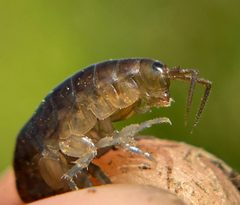
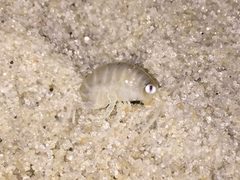
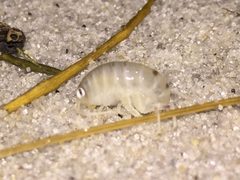
Talitridae is a of amphipod crustaceans encompassing diverse ecological forms including beach-dwelling sandhoppers, terrestrial landhoppers, and specialized driftwood hoppers. Members occupy ranging from marine intertidal zones to fully terrestrial environments in rainforest leaf litter and caves. The family exhibits remarkable physiological adaptations for desiccation resistance and aerial respiration, with some Southern Hemisphere being entirely terrestrial. Ecological diversity within Talitridae includes wrack , psammophilic burrowers, palustral salt marsh dwellers, driftwood , and freshwater forms.
Pronunciation
How to pronounce Talitridae: /tæˈlaɪtrɪdiː/
These audio files are automatically generated. While they are not always 100% accurate, they are a good starting point.
Images
Habitat
Talitrids occupy four primary estuarine/marine ecotopes in the North Atlantic littoral: sandy beaches (supralittoral zone), salt marshes, driftwood in driftlines, and coastal dune systems. Marine occur in the strandline but desiccate rapidly; talitrids uniquely survive prolonged aerial exposure. Terrestrial forms inhabit rainforest leaf litter and caves (troglobionts). Freshwater species occur in riverine and lacustrine systems. driftwood talitrids are obligately associated with decomposing marine driftwood for both food and shelter, exhibiting cryptozoic habits within wood.
Distribution
Global distribution spanning Atlantic coasts of Europe (Portugal, France, Azores, Canary Islands), Mediterranean (Tunisia, Morocco), North Atlantic islands, southern Sweden, South Africa, Micronesia (Pohnpei, Palau), Myanmar, and Thailand. Northern hemisphere records dominate for driftwood . Southern Hemisphere contains entirely terrestrial .
Diet
Wrack feed preferentially on stranded macroalgae. driftwood talitrids consume decomposing wood tissue. Diet of terrestrial and freshwater forms not well documented.
Life Cycle
driftwood talitrids exhibit : retain features, achieve sexual maturity at early developmental stages, undergo fewer moults per , and maintain constant size increments at each moult. This dwarfism (adults <15mm, some <8mm) facilitates prolonged residence within floating driftwood for long-distance .
Behavior
Exhibits non-visual orientation using magnetic fields and celestial cues. Shows zonal recovery and locomotor activity rhythms on beaches. driftwood talitrids are passive dispersers, hitchhiking on floating logs for long-distance transport across oceanic islands; this mode is more durable than wrack-associated transport due to wood longevity. Wrack display phenotypic plasticity and can occupy multiple secondary ecotopes.
Ecological Role
Wrack function as key processors of stranded macroalgae in sandy beach , contributing to secondary production and nutrient cycling. Serve as bioindicators for beach environmental quality through fluctuating asymmetry studies. Form component of terrestrial macroinvertebrate in coastal and inland systems. Driftwood represent a rare guild with specialized nutrient cycling roles in wood decomposition at sea.
Human Relevance
Commonly encountered as sandhoppers on beaches; frequently misidentified as 'sand fleas,' though talitrids do not bite humans and are not siphonapteran fleas. Subject of extensive behavioral research on orientation and . Some used as bioindicators for coastal environmental monitoring.
Similar Taxa
- Siphonaptera (true fleas)Misleading 'sand flea' causes confusion; talitrids are crustaceans, not insects, and lack parasitic biting
- Other amphipod familiesTalitrids uniquely possess desiccation resistance and prolonged aerial survival; marine amphipods washed ashore die rapidly on drying
Misconceptions
The 'sand flea' is taxonomically misleading. Talitrids are crustaceans (Amphipoda), not insects (Siphonaptera), and do not bite humans. They are not limited to sandy beaches, with substantial radiation into terrestrial, freshwater, and specialized driftwood .
Sources and further reading
- BugGuide
- Wikipedia
- GBIF taxonomy match
- iNaturalist taxon
- NCBI Taxonomy
- Catalogue of Life
- Tiny travellers of the animal world: Hitchhikers on marine driftwood | Blog
- Mating behaviour in the talitridae (amphipoda)
- Distribution and Dispersal of Talitridae (Amphipoda) in Southern Sweden
- Talitrus saltator (Montagu, 1808), a species complex (Amphipoda, Senticaudata, Talitroidea, Talitridae)
- New species of Floresorchestia from Micronesia living in unusual habitats (Crustacea, Amphipoda, Talitridae)
- New talitrids from South Africa (Amphipoda, Senticaudata, Talitroidea, Talitridae) with notes on their ecology
- Reproduction of the Sandhopper, Talorchestia Capensis (Dana) (Amphipoda, Talitridae)
- Evolutionary ecology of the North Atlantic Talitridae (Crustacea, Amphipoda): A review
- A new terrestrial talitrid genus, Kachinorchestia, with a new species from Myanmar (Crustacea, Amphipoda, Arcitalitridae).
- Two new species of riparian hoppers (Amphipoda, Talitridae) from Trat and Samut Prakan provinces, Thailand.