
Senticaudata
Lowry & Myers, 2013
Family Guides
12- Anisogammaridae
- Bathyporeiidae
- Calliopiidae
- Caprellidae(Skeleton Shrimp)
- Corophiidae
- Crangonyctidae
- Gammaridae(gammarids)
- Hadziidae
- Hyalellidae
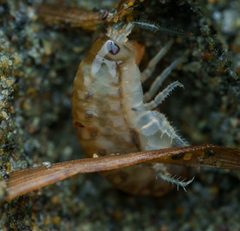
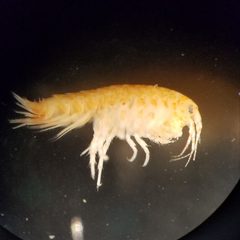
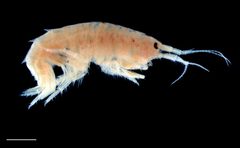
Senticaudata is a suborder of amphipod crustaceans established in 2013, containing over 6,000 —more than half of all known amphipod diversity. It was separated from the traditional suborder Gammaridea based on the diagnostic presence of strong setae on the first and second uropods. The suborder encompasses six infraorders: Bogidiellida, Carangoliopsida, Corophiida, Gammarida, Hadziida, and Talitrida. It includes the majority of the world's freshwater amphipods, though most species are marine.
Pronunciation
How to pronounce Senticaudata: //ˌsɛn.tɪˈkɔː.də.tə//
These audio files are automatically generated. While they are not always 100% accurate, they are a good starting point.
Identification
Distinguished from other amphipod suborders by the presence of strong setae on uropods 1 and 2. This morphological feature was the primary basis for its separation from Gammaridea in the 2013 taxonomic revision by Lowry and Myers. The suborder also incorporates the former suborders Caprellidea (skeleton shrimp and whale ) and Corophiidea.
Images
Habitat
Marine environments dominate, with occurring on diverse substrates including sediment, , sponges, cnidarians, ascidians, mangrove roots, fouling , coral rubble, and rhodolith banks. Includes the majority of global freshwater amphipod diversity. Terrestrial representatives occur in the infraorder Talitrida, which contains all known landhoppers (truly terrestrial amphipods) found in moist habitats of fields and forests.
Distribution
. Marine occur from intertidal zones to deep sea (depths exceeding 4,700 m recorded). Freshwater species documented across multiple continents. Terrestrial talitrids have discrete global distributions explained by vicariance due to limited capacity; show distinct biogeographic patterns such as Arcitalitridae to Australasia and South Africa, and Makawidae endemic to Zealandia and Tasmania.
Human Relevance
Includes used as indicators of beach ecological quality and developmental stability. Some terrestrial species have been introduced to new regions, including Talitroides alluaudi and T. topitotum in Brazil. The suborder contains frequently studied for orientation and locomotor activity rhythms.
Similar Taxa
- GammarideaSenticaudata was historically included within Gammaridea; separated based on uropodal setation characters. Gammaridea in the revised sense lacks the strong setae on uropods 1 and 2 that define Senticaudata.
- CaprellideaFormerly recognized as a separate suborder for skeleton shrimp and whale ; now subsumed within Senticaudata as the infraorder Corophiida.
- CorophiideaFormerly a distinct suborder; now incorporated into Senticaudata as the infraorder Corophiida.
More Details
Taxonomic history
Established by Lowry and Myers in 2013 as part of a comprehensive reorganization of amphipod higher . The revision split the traditional Gammaridea and reorganized previously recognized suborders Caprellidea and Corophiidea within Senticaudata.
Dispersal limitations
Terrestrial talitrids have extremely limited capacity due to the absence of a dispersive stage—all amphipods release fully formed young. Their terrestrial adaptations prevent oceanic dispersal, making their distributions primarily explained by vicariance rather than rafting.
Sources and further reading
- BugGuide
- Wikipedia
- iNaturalist taxon
- NCBI Taxonomy
- Catalogue of Life
- Talitrus saltator (Montagu, 1808), a species complex (Amphipoda, Senticaudata, Talitroidea, Talitridae)
- New talitrids from South Africa (Amphipoda, Senticaudata, Talitroidea, Talitridae) with notes on their ecology
- Review of New Zealand Coastal Talitroids with description of three new genera (Crustacea, Amphipoda, Senticaudata)
- Life history of Dulichiella appendiculata (Amphipoda, Senticaudata, Melitidae) in Maryland Coastal Bays, USA
- A new species of Stilipedidae (Amphipoda: Senticaudata) from the South Mid-Atlantic Ridge
- Talitrid amphipods from India, East Africa and the Red Sea (Amphipoda, Senticaudata, Talitroidea, Talitridae)
- Catalogue of the Order Amphipoda from Brazil (Crustacea, Peracarida): Suborders Amphilochidea, Senticaudata and Order Ingolfiellida
- The correct authorship of the amphipod genus-group name Quasimodia (Senticaudata: Hyaloidea: Phliantidae)
- A review of Quadrimaera Krapp-Schickel & Ruffo, 2000 (Amphipoda: Senticaudata) from Brazil
- The conquest of land by the Amphipoda (Senticaudata, Talitroidea) explained by global tectonics and vicariance
- A new superfamily and family of the infraorder Hadziida (Amphipoda, Senticaudata) based on a new genus and species from the Clarion-Clipperton Zone, Pacific Ocean.