
Platorchestia
Bousfield, 1982
sand flea
Species Guides
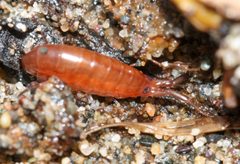
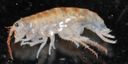
1- Platorchestia platensis(sand flea)
Platorchestia is a of semi-terrestrial amphipods in the Talitridae, commonly known as sand fleas. The genus was established by Bousfield in 1982 and is classified in the Platorchestiinae. Members inhabit coastal environments including sandy beaches, estuarine marshes, and shores of lakes and rivers. The genus exhibits a Southern Hemisphere distribution pattern, with some introduced to Northern Hemisphere regions.

Pronunciation
How to pronounce Platorchestia: /ˌplætoʊrˈkɛstiə/
These audio files are automatically generated. While they are not always 100% accurate, they are a good starting point.
Identification
Belongs to Platorchestiinae; diagnostic features for -level identification include distribution pattern of setae on the lateral margin of the and sharpness of the ramus tip of uropod 3. is present, with males showing particular modifications in appendage structure. Detailed taxonomic analysis often required for definitive species assignment.
Images
Habitat
Coastal environments including sandy beaches, marine rocky coasts, estuarine marshes, and shores of lakes and rivers. are frequently abundant under drifted aquatic plants (wrack), which provide food and shelter.
Distribution
Native to Southern Hemisphere; first recorded in southeastern Pacific coast at Antofagasta, northern Chile. Introduced established in southern Baltic Sea and South Africa. GBIF records indicate presence in Denmark, Norway, and Sweden.
Seasonality
In temperate regions, resting metabolic rate and growth cease during colder months (), with metabolic activity resuming toward the end of March. Metabolic rate peaks near the summer solstice in wrack-acclimated , approximately one month later in driftwood-acclimated populations.
Diet
; feed on decaying plant material including wrack (drifted aquatic plants) and driftwood. Driftwood-fed exhibit lower specific dynamic action energy costs than wrack-fed populations, possibly due to microbial subsidy effects.
Life Cycle
Sexual maturity occurs at approximately 5.0–5.25 mm body length. Ovigerous females carry year-round; mean brood size ranges from 5–18 with increasing exponentially with female size. Mean size increases during embryonic development. Male lifespan 11–14 months; female lifespan approximately 15 months. structure polymodal throughout the year.
Behavior
Exhibits seasonal metabolic depression () during winter months. show acclimation responses to different food substrates, with distinct metabolic profiles for wrack- versus driftwood-acclimated individuals.
Ecological Role
that process decaying plant material in coastal . Serve as prey for birds and other animals, occupying a significant position in coastal .
Human Relevance
Some introduced outside native range; Platorchestia platensis recorded as in southern Baltic Sea and South Africa. In invaded regions, may compete with native talitrid species and achieve higher abundance than counterparts.
Similar Taxa
- TalitrusBoth are talitrid amphipods inhabiting sandy beaches; Platorchestia distinguished by placement (Platorchestiinae vs. Talitrinae) and morphological features of the and uropod 3.
- OrchestiaCo-occurring talitrid ; Platorchestia differs in classification and specific appendage , particularly in sexually dimorphic male structures.
Sources and further reading
- BugGuide
- Wikipedia
- GBIF taxonomy match
- iNaturalist taxon
- NCBI Taxonomy
- Catalogue of Life
- Seasonal resting metabolic rate in Platorchestia platensis (Amphipoda, Talitridae)
- Zoogeography and evolutionary ecology of the genusPlatorchestia(Crustacea, Amphipoda, Talitridae)
- Two new genera of coastal Talitridae (Amphipoda: Senticaudata) from Chile, with the first record of Platorchestia Bousfield, 1982 in the southeastern Pacific coast
- Cryptic diversity of the semi-terrestrial amphipod Platorchestia japonica (Tattersall, 1922) (Amphipoda: Talitrida: Talitridae) in Japan and Taiwan, with description of a new species
- Oxygen uptake by wrack- and driftwood-acclimated populations of Platorchestia platensis (Amphipoda, Talitridae) during feeding and fasting
- On the reproductive biology of the talitrid amphipod Platorchestia monodi (Mateus et al.,1986) from the Shatt Al-Arab region, Basrah, Iraq
- Disentangling the identities and distribution patterns of the introduced beachfleas Orchestia gammarellus and Platorchestia platensis (Crustacea: Amphipoda: Talitridae) in South Africa
- Distribution and abundance of Talitridae in the southern Baltic Sea – twelve years after the first record of Platorchestia platensis (Krøyer, 1845) in 2005